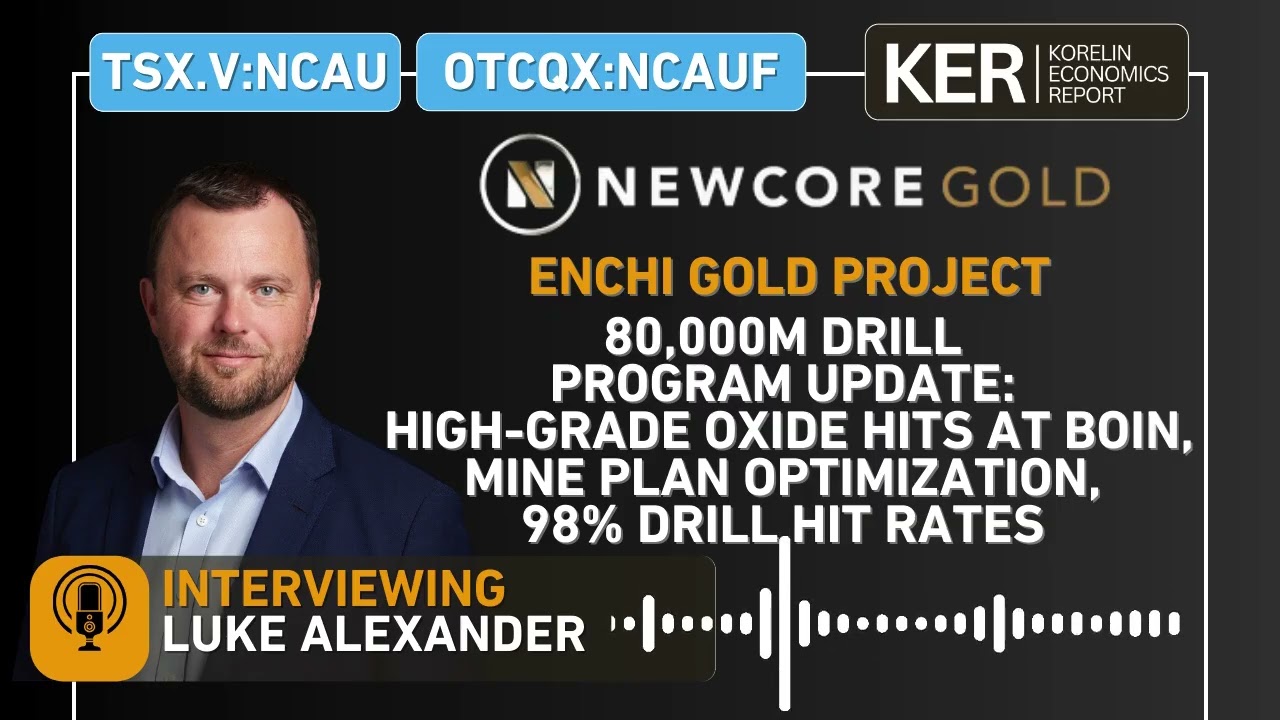
Newcore Gold (NCAU): 98% drill hit rate, shallow oxide at Boin, and a market cap the CEO calls disconnected from a US$650M after-tax NPV
Newcore Gold's CEO says 98% of drill holes at Enchi have hit mineralization, with roughly 30,000m of assays still pending and shallow oxide intercepts at Boin (2.59 g/t over 69m; 1.16 g/t over 41m) aimed at lifting early mine-plan economics. He also argues a ~US$80M market cap sits against a ~US$650M after-tax PFS NPV.
Investor angle
The thesis here is a timing argument, not a discovery argument. Two of the most recent intercepts came from outside the current pit shells, and Alexander's own framing is that none of the 2026 results are yet in the resource or the PFS mine plan — so the near-term question is when that optionality converts into an updated study, not whether the rock is there. What to track: the roughly 30,000 metres of pending assays; whether follow-up drilling expands the higher-grade footprint at Boin's most northerly pit; and the pace of the geotechnical, metallurgical and environmental work a construction decision depends on. Two cautions. The "disconnect" between a US$80M market cap and a US$650M after-tax NPV is management's framing of its own study, not an independent valuation, and it rests on a gold price of roughly US$4,200. Second, a 98% hit rate measures whether a hole found mineralization, not whether that mineralization is economic — the grade and location of each intercept matter more than the aggregate percentage.
# Newcore Gold: drilling is working, and management says the market is not paying for it
**The setup.** In a company update published by The KE Report on October 9, 2026, Newcore Gold president and CEO Luke Alexander laid out the state of drilling at the company's Enchi gold project in southwest Ghana. Two threads ran through the conversation: the drill program is delivering, and he believes the equity market is not paying for what the project is worth.
## How much is left to drill
The campaign targets roughly 80,000 metres. The first 28,000 metres fed the mineral resource estimate (MRE — the company's inventory of measured, indicated and inferred ounces) completed earlier in 2026, which in turn fed the preliminary feasibility study (PFS). The remaining 52,000 metres are earmarked for future resource updates and studies. About half of that second tranche is now drilled, leaving roughly 30,000 metres of assays still to be reported — "we will be very active from a drill and news flow perspective over the next number of months." Four rounds of results have come out since his previous interview at the end of June. Alexander said none of the 2026 results are currently included in the resource or in the PFS mine plan.
## A 98% hit rate, and why the drilling is cheap
"98% of our holes have hit mineralization," Alexander said, which he reads as evidence that gold is distributed across the property rather than confined to isolated pockets. The drilling strategy has three parts: grow the overall resource by systematically stepping out from existing pits; keep testing for the higher-grade shoots he sees at other operations along the Sefwi-Bibiani belt; and optimise the mine plan.
The stepping-out is described as low-cost because it is surface drilling that can use an RC (reverse circulation) rig — "about 40% of the cost of using a diamond rig."
The mine plan work is the part with direct economic leverage. Alexander said the company is targeting material it calls 0.7, 0.8 and 0.9 gram — sub-1 g/t, but above what the current schedule mines — around existing pits and inside pits that are not yet in the indicated category. He expects that to improve NPV (net present value), IRR (internal rate of return) and payback period, and to lower AISC (all-in sustaining cost — what it really costs to produce an ounce).
## The resource today, and how little depth has been tested
The most recent MRE, from March, contains more than 2.1 million ounces indicated plus inferred, with about 1.5 million ounces in the indicated category, spread across four deposits. Boin and Sewum together account for more than 80% of it.
Alexander flagged the constraint on today's resource: the average vertical depth of the pits that bound it is only about 100 metres. "That is relatively shallow," he said, which he treats as room to drill deeper at Boin and Sewum. Nyam, the third area producing recent results, is where he says the company is also tracking high-grade shoots.
## Boin: shallow, oxide-hosted, higher grade
Boin is the second-largest of the four deposits and, on his account, the highest-grade. Two releases carry the argument:
- **September 17:** 2.59 g/t gold over 69 metres, including a 6.4 g/t core over 24 metres — "one of the best grade-metre intercepts" at the deposit, and roughly four times the average grade of the global resource. It started just under 60 metres below surface, with much of the intercept in oxide material. The stock rose almost 30% that day. - **October 6:** 1.16 g/t over 41 metres, starting about 2 metres below surface, so the intercept sits entirely in oxide. Roughly double the project's average grade. These were step-outs north and south of the most northerly pit at Boin.
Oxide is the operative detail. Alexander's argument is that oxide material is easier to process and easier to put through a mill than fresh rock, and that near-surface higher grade is the fastest available lever on project economics because it can be pulled into the first years of the mine schedule.
## District scale
Pulled back to a long section, Boin shows roughly six kilometres of strike along a north-south shear. Alexander compared that scale to Bibiani and to a second deposit he called Toronto, describing both as roughly 5.5 to 6.5 million ounce endowments, and noted this size is common among greenstone-hosted deposits. The open question is how much higher-grade tonnage sits inside that strike. The October 6 step-outs are his answer in progress; he points readers to a 3D model of the deposit hosted on the company's website.
## Ghana's assay advantage
Alexander contrasted the company's turnarounds with peers in a cash-flush sector complaining about rig availability and slow laboratories. "We've drilled over 140,000 metres on this project" over the past five years, he said, with strong relationships with in-country service providers including the assay lab, returning assays "typically within a 2 or 3" weeks. The practical effect is that the program can be re-aimed at a good result and followed up quickly, which he describes as "a bit of a no-brainer."
## The valuation claim
The company trades at roughly C$100 million, or about US$80 million. The PFS published at the end of June, run at a gold price of around US$4,200, produced an after-tax NPV of roughly US$650 million. Alexander calls that gap a disconnect.
He attributes part of the discount to a specific shareholder reaction. The company had previously outlined a heap leach project, then switched to CIL (carbon-in-leach) after test work, which he argues was the right route for the ore — but the economics disappointed enough holders to sell. Since the study came out, he said, more than 60 million shares have traded. His reading: sellers who wanted out have largely had their chance, and the roughly 30% move on September 17 absorbed remaining supply, leaving what he calls a "new floor" to build from.
## Funding and de-risking
Alexander said the company is funded for the entire 80,000-metre program and into 2027. Alongside drilling, work continues on hydrology, geotechnics, metallurgy, environmental baseline work and trade-off studies — not market-moving in his words, but needed to move Enchi toward a construction decision.
## Disclosure
The video carries a standard investment disclaimer and notes that guests and hosts may own shares in companies mentioned. No sponsorship or paid promotion is declared in the supplied metadata.
Generated by Pixys from the source video below. Not investment advice.