Sitka Gold: Rosgobel Stretches 400 Metres, 60,000-Metre 2026 Drill Plan Backed by $45M
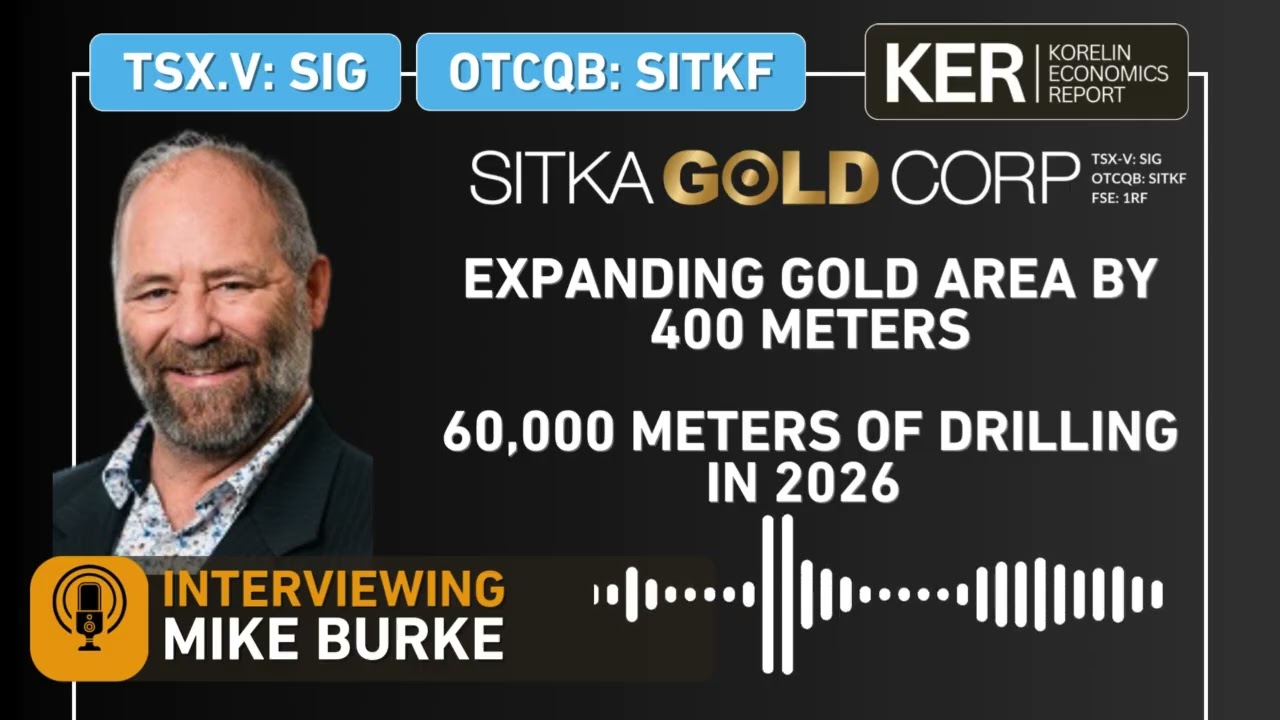
Sitka Gold's January 6 drill release stretched the Rosgobel mineralized zone to 975 metres — 400 metres longer than before — and the company is heading into 2026 with a 60,000-metre drill plan and roughly $45 million in the bank to fund it.
Investor angle
What changes for an investor here is the rate at which Rosgobel is being de-risked. The target has moved from a 575-metre strike to a 975-metre strike on a single batch of assays, the 2026 drill meterage is more than four times the 2025 program, and the $45M treasury covers that program with cushion. The two things to watch in 2026 are: (1) whether drilling pushes Rosgobel deeper than the current 400-metre envelope, given the Blackjack analogue at 1.1 km vertical, and (2) whether the tungsten byproduct thesis advances from visual scheelite logging into a recoverable resource figure. A preliminary economic assessment on the three-deposit Clear Creek complex is the articulated year-end objective.
Sitka Gold is starting 2026 with a fresh set of drill holes from its flagship RC Gold Project in the Yukon, and the headline from the January 6 release is straightforward: the mineralized footprint at the Rosgobel target is now 975 metres long. That is 400 metres longer than the 575-metre strike Sitka had previously drilled off, and the company says the zone remains open in every direction.
On a January 7 update with The KE Report, director and VP of corporate development Mike Berkey walked through what those 11 new holes actually mean. Across the Rosgobel intrusion, Sitka has now drilled about 1.1 kilometres east-west and still has not reached the margins of the body. Hole 18, the furthest west step-out, returned 17 metres of 1.05 grams per tonne gold. Drilling has hit mineralization down to 400 metres depth, but the company has no geological reason to think the system stops there — it points to the Blackjack deposit, six kilometres north, which is mineralized over a vertical distance of 1.1 kilometres, as the local analogue for how deep these intrusion-related gold systems can run.
Drill spacing at Rosgobel sits between roughly 60 and just over 100 metres, tight enough, in Sitka's view, to support a preliminary mineral resource estimate. Berkey was clear that any such estimate would be early-stage — this is the first year of substantive drilling on the target, with about 13,000 metres sunk in 2025 — and that the more important output of 2026 will be a better read on overall size.
That is where the 2026 program comes in. Sitka has budgeted up to 60,000 metres of diamond drilling for the year, with Rosgobel set to absorb the bulk of it. The work will test the near-surface expression of the zone, push step-outs to the east where assays are still pending, and probe depth extensions. The same program will also touch a handful of secondary targets within the broader Clear Creek intrusive complex — the Pukoman intrusion, the contact zone, Bearpaw breccia and the Josephine intrusion, all of which Berkey flagged as having produced encouraging intercepts in earlier drilling.
One of the quieter but potentially most interesting items in the update is tungsten. Berkey described Rosgobel as sitting in the Tombstone–Tungsten suite of intrusions, the same belt that hosts Fireweed Metals' Mactung deposit and the historic Cantung mine. Sitka has been logging coarse scheelite crystals (scheelite is the main tungsten-bearing mineral) in drill core alongside the gold mineralization, and early assays from holes 2 and 4 have returned "splashy" tungsten grades using more accurate analytical methods. The company is still working out which assaying technique gives the cleanest numbers before systematically re-assaying existing drill samples. If tungsten holds up at scale and is recoverable by gravity — both open questions — it could become a meaningful byproduct credit on top of the gold story.
The May Q target, in the southeast of the property, saw two helicopter-supported holes. The best intercept was 2 metres of 0.7 g/t gold — modest next to Rosgobel, but Berkey framed it as a successful first test on a large, lightly explored target that will see follow-up work in 2026.
On the financial side, Sitka ended the discussion with roughly $45 million in the bank. All-in drilling costs ran about $350 per metre (Canadian) in 2025, a function of the project's accessibility — it sits about 35 kilometres off the Klondike Highway and roughly a two-hour drive from Dawson City. At that cost rate, the $45 million more than covers the planned 60,000-metre program, with money left over for baseline environmental studies, metallurgical work and to carry the company into the following year.
Berkey also set out the year's explicit goal: define the size potential of the three deposits Sitka now sees within the Clear Creek intrusive complex — Blackjack, Eiger and the new Rosgobel — well enough that the company can begin to look at preliminary economics. The existing Blackjack and Eiger resource totals about 2.8 million ounces (1.3 million indicated, 1.5 million inferred). Berkey noted that for a preliminary economic assessment, or PEA, there is no immediate requirement to upgrade those ounces into higher-confidence categories — that work would come later, in the resource-and-reserve conversion stage.
For investors, the takeaways from this update are tightly clustered: Rosgobel continues to grow on every axis, the 2026 drill meterage is large enough to materially advance the story, and the treasury is comfortable. The two open questions Sitka itself flagged — the depth potential at Rosgobel and whether the tungsten mineralization becomes a real byproduct — are the ones most likely to drive the next round of news flow.
Sitka trades on the TSX Venture Exchange under SIG, on the OTCQB under SITKF and on the Frankfurt Exchange under 1RF.
Generated by Pixys from the source video below. Not investment advice.