KGHM Polska Miedz S.A
KGHKGHM Polska Miedź is one of the global leaders in copper and silver production, operating primarily from its flagship underground mines in the Legnica-Głogów Copper Belt in southwestern Poland. As a major diversified miner, KGHM boasts a massive resource base, producing roughly 400,000 tonnes of copper and 40 million ounces of silver annually. The company's integrated operations—spanning mining, smelting, and refining—provide substantial operational synergies and establish it as a critical component of the European industrial metals supply chain.
The company's asset portfolio is anchored by its Tier 1 Polish operations, which benefit from exceptional infrastructure, local expertise, and a long operational history. KGHM also holds international assets, including the Sierra Gorda copper-molybdenum mine in Chile and the Carlota mine in the United States, providing geographic diversification. The Polish operations are characterized by high silver grades, making KGHM one of the world's largest primary silver producers, a byproduct credit that significantly lowers its effective copper cash costs.
Financially, KGHM exhibits the robust profile expected of a major producer. The company generates substantial operating cash flow, supported by its high-margin Polish operations. While capital expenditures remain significant for ongoing mine development and environmental compliance, the balance sheet is conservatively managed with moderate leverage. KGHM maintains a strong commitment to shareholder returns through a consistent dividend policy, funded by its robust free cash flow generation in favorable commodity environments.
Looking forward, KGHM's strategic focus remains on extending the life of its Polish operations through deep exploration and technological advancements in extraction, alongside optimizing its international portfolio. The company faces structural challenges, including gradually declining ore grades and high energy costs in Europe, but its scale, integrated infrastructure, and dominant position in silver byproduct credits provide a durable competitive advantage. Its role in supplying critical minerals to the European market underscores its strategic importance and stable operational foundation.
Data Quality
Market Cap
$15.26B
Total valuation
Stock Price
$76.09
▲ 1.80% today
Free Cash Flow
N/A
Annual
Financial Position
-$381.97M
Net debt position
PEG Ratio
ⓘN/M
Not meaningful
Analysis
Score Interpretation
Hover any criterion below to reveal its full rationale, key metrics, strengths, concerns, and source documentation.
Criterion Detailed Analysis
Recommendation
KGHM Polska Miedź represents a solid, low-risk investment in the global copper and silver sectors. The company's world-class, fully integrated Polish operations provide a durable competitive advantage, characterized by massive scale, extensive reserve life, and exceptional infrastructure. The significant silver byproduct production not only positions KGHM as a leading global silver producer but also provides a substantial hedge against copper price volatility and operational cost inflation.
While the company scores well on asset quality and financial stability, its appeal is somewhat tempered by structural factors. The influence of the Polish State Treasury introduces political risk and potential sub-optimal capital allocation from a minority shareholder perspective. Furthermore, the development pipeline is focused on life extension rather than transformational growth, meaning production profiles are likely to remain stable rather than expand significantly.
Overall, KGHM offers investors reliable exposure to the copper and silver markets underpinned by a robust balance sheet and consistent dividend payouts. It is best suited for investors seeking stable, long-term exposure to industrial metals with a significant precious metals byproduct, rather than those seeking high-growth exploration upside.
Red Flags
| Criterion | Severity | Score | Description |
|---|---|---|---|
| jurisdiction | Medium | 7.00 | Significant state ownership (31%) introduces political risk and potential for windfall taxation, as seen in recent years. |
| development_pipeline | Low | 6.50 | Limited organic growth profile; capital is primarily allocated to maintaining existing production levels rather than expanding output. |
Scenario Analysis
Bull Case
Bull case assumes copper prices exceed $12,000/t due to severe global supply deficits and green energy demand, while silver prices rally above $40/oz, driving record free cash flow and special dividends.
Base Case
Base case assumes copper prices remain stable around $9,500-$10,000/t, allowing KGHM to maintain current production levels, cover capex, and sustain its regular dividend yield.
Bear Case
Bear case assumes a global economic slowdown reduces copper demand, pushing prices below $8,000/t, while European energy costs spike, severely compressing margins and forcing dividend cuts.
Audit Trail
| # | Source |
|---|---|
| 1 | Annual Financial Report (2023): Financial statements, reserve estimates |
| 2 | WSE Regulatory Filings: Share structure, insider ownership |
| 3 | Company Strategy Presentations: Development pipeline, capital allocation |
| 4 | Market Data: Current metal prices, exchange rates |
Financials
Core Metrics
Annual Production
N/A
Troy oz per year
Revenue
$3.06B
Latest reported
Net Income
$636.62M
Annual
Enterprise Value
$15.65B
Net debt: $381.97M
Adj. EBITDA
$1.15B
EV/EBITDA 13.65x
Income & Cash Flow
Waterfall · Revenue to Free Cash Flow
Key P&L Ratios
N/A
Free Cash Flow Generated
Balance Sheet & Leverage
Capital Structure
- Equity $4.58B
- Long-Term Debt $0.00
- Short-Term Debt $0.00
- Cash & Equivalents $763.94M
Leverage & Coverage
$381.97M
Net Debt (Strong)
Cash Uses & Returns
- Capital Expenditures $381.97M
- Dividends Paid $203.72M
- Share Buybacks $0.00
- Interest Expense $0.00
- Debt Repayment / Other $432.90M
Profitability & Returns
Returns
Margins
Liquidity & Coverage
Yield
Valuation
Valuation Multiples
Share Structure & Ownership
Share Structure
- Outstanding 2.00B 2.00B
- Options 10.00M 10.00M
- RSUs 10.00M 10.00M
- Warrants 0.00 0.00
Per-Share & Buyback Metrics
$0.00
Remaining Buyback Capacity
Health Indicators
Strength across all solvency and liquidity metrics
25.0% of 1.0x threshold
11.1% of 3.0x threshold
89.0% of 3.0x target
50.0% of 48 months target
6.7% of 15% threshold
Asset Pipeline
Jurisdiction Exposure
Geographic distribution of mining properties · Equal-weighted (no NPV data)
- Poland50.0% · Unknown · 1 property
- Chile50.0% · Tier 2 · 1 property
Operating Mines
Distribution across development stages · Equal-weighted (no NPV data)
- Production (Steady-State)100.0% · 2 Assets
Cost Structure
All-in Sustaining Cost (AISC) breakdown • Peer-leading efficiency
$2,165/oz • 100%
Legnica-Głogów Copper Belt
Sierra Gorda
Information
Key Information
Legal Entity
KGHM Polska Miedz S.A
Sector
Precious Metal
Founded
January 3, 2000
Employees
33,882
Reporting Currency
PLN
Contact Phone
48 76 747 8200
Website
kghm.comHeadquarters Address
48 M.Sklodowskiej-Curie Street , Lubin 59-301 , PL
Identifiers
ISIN
PLKGHM000017Commodity Portfolio
Liquidity
- Avg dollar volume (50d)
- —
- Last trade date
- Jul 30, 2026
- Days since last trade
- 74
- Last evaluated
- Oct 12, 2026 10:30 PM
Stock Exchanges
Organization
Management Team
Tomasz Zawicki
Chief Executive Officer
Insider Ownership
1.00%
Industry Partnerships
Sumitomo Metal Mining
Joint Venture
Project: Sierra Gorda
Ownership: 55.0%
Source: Joint Venture Agreements, Annual Report
Partner Market Cap
$10.00B
Chart
Interactive chart powered by TradingView. Use the chart tools to analyze price trends.
Videos

This Copper Giant Holds 1.2 Billion Silver Ounces | Jordan Pandoff
Key Highlights
detailed- KGHM's smelter sits 25 km from Lumina's Nova Sül project, and Lumina has signed a non-binding letter of intent to supply KGHM with copper concentrate.
- KGHM is described by Jordan as the Polish state miner and currently one of the world's top silver producers — Lumina at full build would rank just behind KGHM and Fresnillo at #2.
- Jordan frames the LOI against a backdrop where Europe imports over 50% of its copper concentrate and KGHM needs feed, making the offtake strategically meaningful for both sides.
Nova Sül would rank Lumina as the world's third-largest silver producer at full output — backed by 15Mt copper and 1.2Boz silver in inventory. Lumina could fund the $6.4B Nova Sül build with EU debt and a silver stream — IPO was 4x oversubscribed at $300M. Poland's capped 2012 mineral extraction tax gives Nova Sül asymmetric leverage — at spot copper and silver, the post-tax NPV triples versus the PEA. Twin identical $3B shaft complexes let Lumina scale by reusing one design across the continuous Kupferschiefer copper-silver seam. Sulmierzyce (Silmir Zisha) is a potential spinout with 6Mt copper and 300Moz silver — ongoing drilling is expected to grow that resource materially.
Magna Mining – Q2 Financials, Development Updates at Levack & Crean Hill, and Exploration Strategy
Key Highlights
brief- The guest describes the KGHM asset takeover in 2025 as the most challenging transition Magna has done to date: the company went from about 25 people to inheriting an operation with roughly 150 employees, an ERP system, and subsidiaries Lonmin and Ursa, with then-CFO Scott Gilbert leading the accounting systems work.
- KGHM is referenced only as the source of the acquired Sudbury assets — no separate investment thesis, current outlook, or numbers are offered in this interview.
Magna hit record Q2 production at McCreedy West — 4.5M CuEq payable lbs at an AISC (All-In Sustaining Cost) of US$4.54/lb, and turned cash-flow positive. Alpayana's $140M investment funds parallel development at Levack and Crean Hill; both studies (PEA, PFS) are due this quarter, with first ore targeted for 2027. Levack could ship development ore to Vale by Q1 2027 via the R2 drift; Crean Hill targets commercial production about 25 months from construction start. CFO Scott Gilbert retires by year-end; Greg Huffman, current SVP Capital Markets, takes over, supporting a planned internal succession. Exploration is pivoting from delineating the R2 discovery back to greenfield drilling, with new drill programs at both Levack and Crean Hill footwall targets.

Magna Mining – Q2 Operations Review, Key Strategic Investment By Alpayana Brings in C$140Million
Key Highlights
brief- The host recalls that Crean Hill came with Magna's KGHM acquisition announced about two years before this recording, when investors worried the project would be shelved, and notes the dual-track development now underway has proven otherwise.
A C$140 million strategic investment by Alpayana for a 19.9% stake lets Magna fast-track Levack and Crean Hill toward commercial production by 2028. Magna's Sudbury model ships ore to Vale and Glencore mills with spare capacity, so restarts skip building mills, tailings facilities and waiting on permits. McCreedy West set a record under Magna ownership near 92,000 tons in Q2, averaging 3.55% copper equivalent (CuEq — combined metal value expressed as copper). The Levack PEA (early-stage economics) lands this quarter, while high-grade R2 zone drilling stays excluded until a resource exists; a drift will enable underground drilling. First Levack ore could ship before year-end; with Podolsky and Shakespeare permitted, management sees a path to five producing mines without another equity raise.

Why This New Copper Spinout Has Huge Upside
Key Highlights
brief- The guest says the previous management team at the Premier restart came primarily out of KGHM, a company specializing in large open pits, and argues that open-pit habits — less infill drilling and easier multi-mine supply — contributed to the failed underground operation.
Cambria Gold Mines will spin its Mount Margaret deposit — a historical 570-million-ton resource at 0.72% copper equivalent — into a new US company, Freedom Copper. Abandoned after the Mount St. Helens eruption, the porphyry (a large copper system) remains open in every direction, and every 2010 hole ended in mineralization. Cambria shareholders keep 49.9% exposure plus a 15% dividend in the spinout, while Cambria focuses on restarting the Premier gold mine in British Columbia. The restart plan feeds one 2,500-tonne-per-day mill from four deposits, led by high-grade Red Mountain — 544,000 measured ounces near 9 grams per tonne. A planned $100 million raise funds about 100,000 meters of drilling toward a modern resource estimate, a PEA (early economic study), and US permitting.

Magna Mining – Q1 Operations/ Financials, More High-Grade Results Returned From R2 Zone At Levack
Key Highlights
brief- The CEO says Magna bought the KGHM assets, including the McCreedy West mine, at the end of February 2025, and that the same KGHM property acquisition added the permitted, past-producing Poldosky mine.
- KGHM is cited as the latest operator in the Levack mine's history, after Inco and FNX, a lineage the guest says mined about 65 million tons in total.
McCreedy West delivered a $6.0 million Q1 cash margin at a US$4.21 AISC (all-in sustaining cost — the full cost to produce a pound). New Levack drilling went 14-for-14 at the R2 Zone, headlined by 29.7% copper equivalent (CuEq — all metals converted to a copper grade) over 3.4 metres. The Q3 PEA (Preliminary Economic Assessment — an early economic study) excludes the lightly drilled R2, so its high-grade upside is not yet valued. Levack's restart is progressing organically — shaft work and development muck could see ore hoisted to surface and shipped by year-end. Crean Hill's PFS (Pre-Feasibility Study — the detailed pre-construction study) is due by end of Q3, with construction possible as early as 2027.
Lumina Metals: Europe's Largest Copper-Silver District | Jordan Pandoff and Jimmy Connor
Key Highlights
detailed- The guest cites KGHM as proof that Polish copper deposits are multi-generational: since 1974 the state-controlled miner has produced over 20 million tons of copper yet still holds 20 million tons in reserve, suggesting Nova Sul's 20-year initial PEA mine life is only the starting point.
- KGHM owns the Głogów smelter just 25 kilometers from Nova Sul, and Lumina has signed a letter of intent for cooperation including supplying copper concentrate — valuable because Polish concentrate carries over 1,000 g/t of silver.
- The KGHM smelter network can produce nearly 600,000 tons of metal annually, but now sources up to 30% of its feed globally as Polish copper production has declined under the 2012 copper tax.
- The guest argues that reducing Poland's ~70% effective copper tax rate would also benefit KGHM's bottom line, framing tax reform as a shared industry priority for both companies.
An interview with Lumina Metals CEO Jordan Pandoff on the post-IPO status of the Nova Sul flagship copper-silver project in Poland's Kupferschiefer basin, the Polish fiscal regime challenges, and the path to a mining concession by the end of the decade.

Ross Beaty on Investing and Lessons Learned | Jimmy Connor
Key Highlights
detailed- The guest describes KGHM as Europe's largest copper complex, mining the Kupferschiefer copper shale in Poland for 70 years and now ranking among the world's largest copper producers.
- The guest notes KGHM has been the world's second-largest silver producer for the past 50 years because the Kupferschiefer geology delivers silver as a byproduct of copper.
- The guest argues KGHM, being state-controlled, never explored below its current mining levels, leaving deposits beyond KGHM's licenses open for Lumina to discover.
- The guest frames Lumina's Novasol discovery as an extension of the same geology that has made Poland Europe's largest copper and silver producer.
AI and data center electricity demand is set to roughly double by 2030, the guest argues, locking in structural copper demand growth. Easy surface copper is largely depleted; deeper, lower-grade ore means new projects need materially higher prices to be economic. Mine development timelines have stretched from 5-10 years historically to 15-25 years today, complicating new copper supply. Barrick's $5.5B first-phase capex and Teck's $2B Highland Valley extension underscore why copper development costs stay stubbornly high.

Live Q&A with Rick Rule, hosted by Steve Barton 📱
Key Highlights
brief- Rick identifies KGHM as the dominant miner of Poland's copper-silver district and, as a consequence, the largest silver producer on the planet.
- He recounts that in a dispute between KGHM and Lumina, the Polish government found for Lumina against the incumbent.
Rick Rule argues resource equities remain reasonably priced after two years of gains, but a 2008-style liquidity crisis could force overexposed investors to sell. Consolidation keeps rewarding shareholders: mergers cut duplicated overhead, and larger miners gain index inclusion, passive buying, and a lower cost of capital. Oil's move from $65 to $105 is anticipatory pricing for rationing, so an unresolved conflict points to higher energy prices ahead. Copper holding firm despite oil-driven slowdown and speculator selling defies Rule's expectations, an anomaly he flags without claiming an answer. In the Q&A, Rule calls Cameco's flood a buying opportunity, favors debt-free Uranium Energy, and explains net present value's blind spots on tier-one deposits.

Live Q&A with Rick Rule, hosted by Steve Barton
Key Highlights
brief- Rule describes KGHM as the dominant company on Poland's Kupferschiefer copper-silver belt and, as a result, the largest silver producer on the planet.
- He notes KGHM has mined the belt's contact mineralization for 80 years, and that the Polish government ruled for Lumina over KGHM in their earlier dispute.
Rule argues resource equities are not excessive despite two years of gains, but liquidity-crisis risk means checking your own exposure. Mining consolidation looks set to continue; Rule favors owning likely takeover beneficiaries because mergers cut overhead and lower capital costs. Rule calls Cameco's flood-driven sell-off a buying opportunity, since a three-month outage barely dents reserves measured in decades. Build NPV (net present value — discounted future cash flow) from measured and indicated resources only, then add back optionality for growth and tail. Development-stage mining assets deserve a basket approach across several names, Rule says, never a single speculative position.
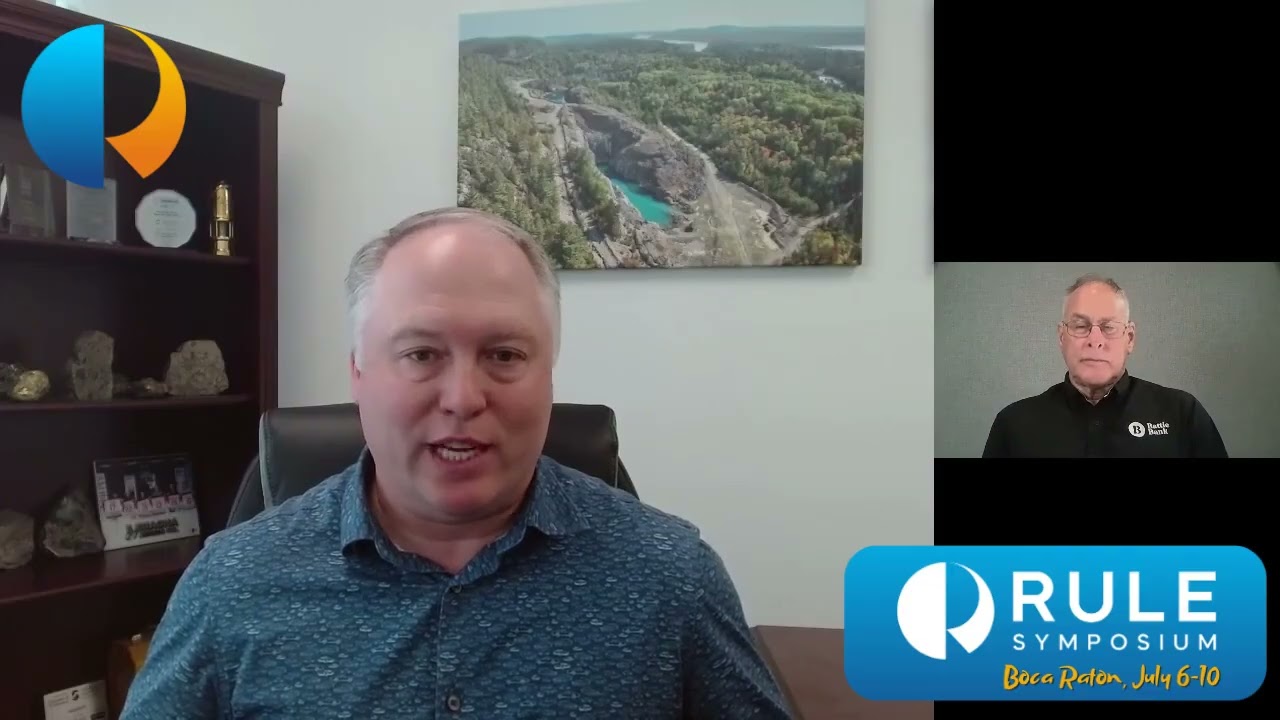
Jason Jessup, CEO of Magna Mining | Rule Symposium 2026: Rick Rule interviews
Key Highlights
brief- Jessup says FNX merged with Quadra and the combined Quadra FNX was then acquired by KGHM, the Polish copper miner, but within a few years he judged the Sudbury camp a poor fit for KGHM — the impetus to found Magna in 2016.
- Magna bought its property package, including the former Aurora Platinum ground, from KGHM, putting those Sudbury assets back under a junior operator.
Brownfield restarts in Sudbury avoid mill construction: Magna sells ore to Vale and Glencore mills at a fixed price per ton. The company already produces: the MacCready West mine generated cash flow in Q4, leaving $55 million cash plus $21 million in receivables. Four past-producing mines are fully permitted, which the CEO argues removes the multi-year permitting wait that burdens most new projects. A Levac PEA (early-stage mine study) and a Creen Hill PFS (bankable feasibility study) are due in Q3, setting up restart decisions. The guest credits his prior company FNX with a 4,200% return from 2000 to 2010 restarting Sudbury mines, his template for Magna.
“We'll Have the Largest Silver Resources of Any Company on the Planet”: Ross Beaty on Lumina Metals
Lumina Metals controls a copper-silver deposit in Poland with over 1.5 billion ounces of silver resources, which Ross Beaty argues is the world's largest undeveloped silver deposit. The company benefits from a cooperation agreement with KGHM and proximity to an underfed local smelter, providing a clear path toward a mining license within five years. Beaty explains that recent post-IPO share volatility stems from warrant exercises and selling pressure, with plans to pursue a U.S. listing after twelve months to attract silver-focused retail investors.

#99 Digging for Dollars #27 How to Win Over Europeans, Kai Hoffmann's “Must” for Junior Miners
Key Highlights
brief- Panelists identify KGHM as the established Polish producer in the Kupferschiefer sediment-hosted copper district, saying it is publicly listed rather than state-run and also works a lot in Sudbury.
- They note the district has been mined since roughly 1100 AD and that a Polish coal company was expropriated in the recent past, so country risk cannot be fully ruled out.
Winning German retail investors takes years of consistent delivery: they are loyal, detail-oriented gold and silver buyers who reward juniors that keep their promises. A 'smear' is one narrow high-grade hit stretched across a wide interval; when the whole drill hole carries gold, the criticism does not apply. European investors anchor on a published resource estimate because few fund managers there have geology backgrounds, making measured numbers the shared language. Mogotes Metals' first holes into its porphyry (large copper-gold system) return broad, low-grade intercepts, leaving investors weighing patience against pivot. Dig This Deal pitches span a $1.2 billion Polish copper developer, a $22 million Saskatchewan gold explorer, and a funded Spanish copper drill program.

Magna Mining – Q4 Operations Update at McCreedy West, Exploration and Development Pathway At Levack
Key Highlights
brief- Magna Mining acquired McCreedy West and other assets from KGHM International on March 1, 2025, anchoring the current producing operation
- KGHM is referenced only as the prior owner of the Sudbury Basin assets; no current operational detail is discussed in this video
McCreedy West produced 84,953 tons at 1.31% copper in Q4 — PGM and gold grades more than doubled versus Q3, with silver up 40%+. Underground diamond drilling at McCreedy West jumped 91% quarter-over-quarter to 29,334 feet with three rigs now turning. Magna swapped contractors for in-house crews at McCreedy West, locking in sustainable operations and avoiding contractor premiums. Levack mine PEA is underway with a Q3 target — a restart decision is possible in H2. Seven payable metals (Cu, Ni, Co, Pt, Pd, Au, Ag) give Magna pricing flexibility as nickel and precious metals push higher.
Articles
No articles available
Published articles for this company will appear here
Want the full picture on more companies?
Be one of the first.
A room for resource investors taking shape now — independent, spam-free, no hype.