

Revival Gold Inc logo

Revival Gold Inc

RVG

Revival Gold Inc. operates as a gold mineral exploration and development company in Canada. It holds 100% interest in the Beartrack-Arnett Gold Project located in Lemhi County, Idaho; and 51% interest in the Diamond Mountain Phosphate Project located in Uintah County, Utah. The company was formerly known as Strata Minerals Inc. and changed its name to Revival Gold Inc. in July 2017. The company was incorporated in 2008 and is based in Toronto, Canada.

Score

—
Updated
—
—

Data Quality

N/A

Market Cap

N/A

Total valuation

Stock Price

N/A

Latest close

Free Cash Flow

N/A

Annual

Financial Position

N/A

Cash position

PEG Ratio

ⓘ

N/A

P/E ÷ growth

Analysis

Subscribe to see the AI Analysis

Score breakdown, criteria, red flags, bull/base/bear scenarios.

Subscribe

Financials

Subscribe to see Financials

Cash flow, balance sheet, valuation metrics, share structure.

Subscribe

Asset Pipeline

Subscribe to see the Asset Pipeline

Jurisdiction exposure, project portfolio, cost structure.

Subscribe

Information

Key Information

Legal Entity

Revival Gold Inc

Sector

Precious Metal

Founded

July 10, 2018

Employees

9

Reporting Currency

CAD

Contact Phone

416-366-4100

Headquarters Address

145 King Street West , Toronto , ON M5H 1J8 , CA

Identifiers

Commodity Portfolio

AU Gold Primary
AG Silver Byproduct

Stock Exchanges

RVG TSXV • CAD
RVG:CVE
RVLGF OTC • USD
RVLGF:OTCMKTS

Organization

Subscribe to see Organization

Management team and industry partnerships.

Subscribe

Chart

Loading chart...

Interactive chart powered by TradingView. Use the chart tools to analyze price trends.

Videos

Lab Report | Oct 8 Deep Dives on Decade, Onyx, Revival, and Algo Grande

Lab Report | Oct 8 Deep Dives on Decade, Onyx, Revival, and Algo Grande

CEO.CA
5 days ago 1:12:02

Key Highlights

detailed
  • TOP: The host says Bear Track/Arnett drilling intersected 8.4 g/t gold over 6.2 m and 8.5 g/t over 3.4 m, and that what matters most is the support this gives for continuity of the mineralised structures at the Joss underground deposit - grade plus continuity, not grade alone.
  • He points to the depth of the results - high grade at about 799 m, another 8.45 g/t intercept at 555 m and 2.2 g/t over 49.5 m - as fitting orogenic systems with deep roots that suit underground mines, drilled here with wedge holes off vertical mother holes.
  • He declines to place Revival on his Lassonde curve, saying he does not know the project well enough and will wait for more assay results, while noting it is the more advanced company in the episode and moving out of the development-discount window.
  • The Merkur project comes up mainly through investor sentiment he reads out: optimism about a rerating as a targeted 2027 preliminary feasibility study approaches, with debate over metallurgical recoveries, project economics and possible M&A interest.
  • On trading he notes a roughly $218 million valuation, average volume near 298,000 shares a day, and that the buy side looks stronger than the sell side, which he reads as a possible new bottom.

Price reaction is noise: the host reads value from discoveries and says only assays confirm grade, not visual core. Decade's Bonaparte project in British Columbia hit porphyry in every hole reaching bedrock, with assays still pending. Onyx Gold found sediment-hosted gold three kilometres south of Argus, extending the search along a northeast-trending Abitibi fault corridor. Revival Gold's high grades holding near 800 metres depth support continuity at Joss, ahead of a targeted 2027 PFS. Algo Grande's skarn — rock the intrusion has altered — points to a deeper porphyry, with gravity surveys set to target drilling along a seven-kilometre corridor.

Revival Gold: Clear Path to Gold Production by 2029

Revival Gold: Clear Path to Gold Production by 2029

CEO.CA
12 days ago 6:50

Key Highlights

detailed
  • The guest says phase one of the Bear Track-Arnett open-pit heap-leach project needs under $150 million of capital to build roughly half a billion dollars of net asset value at $3,000 per ounce of gold.
  • He puts first-phase capital cost at about $200 per ounce of gold at Bear Track-Arnett, and about the same at the Merkur project, which he frames as among the lowest capital costs per ounce in gold production.
  • Merkur in Utah is the first project in the sequence because it sits on a faster permitting timeline and on private ground; he estimates roughly $200 million of capital for about $750 million of NPV there.
  • He backs a two-step, Australian-style development plan: start with the open-pit heap-leach oxide phase, then use its cash flow to fund the deeper sulphide phases, rather than drilling out one very large project up front.
  • The preliminary feasibility study for the Merkur Gold Project is his stated number-one objective, targeted for the end of the first quarter of 2027, with a substantial drilling program still to report.

Agro argues a phased, lower-case start can build a junior gold producer without drilling off one billion-dollar resource. Bear Trek's phase-one open-pit heap leach targets under $150 million of capital for roughly $500 million of net asset value at $3,000 gold. Merkur in Utah comes first on private ground, with about $200 million of capital and roughly $750 million of NPV on a faster permitting path. AISC (All-In Sustaining Cost — what it really costs to produce an ounce) sits in the lowest cost quartile on both projects. The Merkur preliminary feasibility study is the top objective for Q1 2027, with more BearTrack Garnet drilling to follow.

Revival Gold ($RVG.V | $RVLGF): Building a Path Toward U.S. Gold Production

Revival Gold ($RVG.V | $RVLGF): Building a Path Toward U.S. Gold Production

Investor TV
about 2 months ago

Key Highlights

detailed
  • Per CEO Hugh Agro, Revival Gold is a US-focused gold developer with two brownfield projects — Merkur in Utah and BearTrack Garnet in Idaho — totaling about 6 million ounces of 100% gold resource in lower-48, mining-friendly states with existing power, roads, water, and a town of 30,000 within roughly 30 minutes of the Merkur site.
  • The Merkur PEA outlines roughly 90,000 to 100,000 ounces per year over a 10-year open-pit heap-leach mine life with about $208 million of capex and up to roughly $300 million per year of free cash flow at current gold prices, with a construction decision targeted for 2028.
  • Management frames the company at about $1.2 billion of NAV on the engineered 2.5 million ounces of resource versus a sub-$200 million US-dollar market cap, equating to roughly $25 per ounce in the ground at the time of the interview.
  • Capital structure at the time of the interview: about 319 million shares outstanding (fully diluted around 350 million), roughly $28 million Canadian in cash, average daily volume of about one million shares, listings on TSX (RVG) and OTCQX (RVLGF), and roughly 60% institutional and corporate ownership with about 8% management and board.
  • Aggressive exploration upside is highlighted on both assets — a Carlin-type system with 9 to 10 miles of strike and deep undercover targets at Merkur, and a recently released roughly 500 gram-meter hole at the Joss zone at BearTrack — with four rigs drilling by month-end at Merkur and a PFS targeted for Q1 next year.

Hugh Agro pitches Revival Gold as a US-focused developer with two multi-million-ounce brownfield gold assets — Mercur (Utah) and Beartrack-Arnett (Idaho). Mercur's PEA targets 90-100k ounces a year over a decade at about $208M capex, supported by existing roads, water, and a 30-minute drive to labor. Beartrack-Arnett's underground Joss zone recently returned a roughly 500 gram-meter intercept, with miles of untested strike still ahead. Junior developers are re-rating as gold holds $4,000+; Mercur's Q1 PFS and 2028 construction decision are the next triggers. Trading near US$200M with ~$28M-Canadian cash, Revival is about $25 per ounce in the ground — well below the ~$100/oz junior average.

Jeff Phillips – Juniors w/ Compelling Catalysts– Revival, Headwater, Kingsmen, Gladiator, Greenlight

Jeff Phillips – Juniors w/ Compelling Catalysts– Revival, Headwater, Kingsmen, Gladiator, Greenlight

The KE Report
about 2 months ago

Key Highlights

detailed
  • The guest frames Revival Gold as a top take-out candidate, citing Rick Rule's on-record BNN comment that if the share price does not move, someone will buy the company.
  • He describes Revival as a roughly $300M-plus Canadian market cap gold company with two US projects — Merkur in Utah and an Idaho project — totaling close to 6 million ounces in a safe jurisdiction.
  • He points to Merkur being advanced toward a financing decision to put it back into production, and notes recent strong drill results from the Idaho project.
  • He calls Revival an 'excellent' name for investors looking at the bigger end of his typical $40M-to-$250-500M market cap range.

Activist investor Jeff Phillips highlights five junior resource stocks spanning gold, silver, and copper, each anchored by a near-term catalyst. Headwater Gold's prospect-generator model unlocks roughly $200M of partner-funded exploration without forcing shareholder dilution or equity raises. Juniors with multi-year cash runway sidestep dilution; Kingsmen Resources trades near a $13M enterprise value against $15M in cash. Junior mining stocks historically peak after PDAC in March and bottom in early August before rallying into September and October. Copper supply is tightening as existing mines grow deeper and more costly to operate while new development lags.

Revival Gold Proves Deep High-Grade Gold Continuity

Revival Gold Proves Deep High-Grade Gold Continuity

CEO.CA
2 months ago 6:30

Key Highlights

detailed
  • The guest calls the Merkur preliminary feasibility study, targeted for the first quarter of 2027, the key near-term value catalyst because it gates the permitting and engineering work that follows.
  • Recent Bear Trek jaw-zone drilling returned more than 131 metres at 3.43 grams per tonne gold with cores above 11 grams per tonne, roughly 500 gram-metres, which the guest calls one of the company's biggest intercepts to date in that zone.
  • The host contrasts Bear Trek as the scale asset with Merkur as the fastest route to cash flow, and the guest argues Merkur is comparatively easy to permit and staff because it sits on private land with little water and near a town of about 30,000 people.
  • An 18,000-metre infill programme at Merkur, planned to expand to four rigs, is aimed at converting inferred ounces to measured and indicated; the first metallurgical phase finished in 2025 and follow-up results are running behind schedule but expected before the end of summer 2026.
  • He frames the valuation gap as a de-risking opportunity, about $25 per ounce of gold in the ground against a metal price near $4,000 per ounce as of 2026-08-07, with a construction decision targeted for 2028 and, if all goes well, gold production in 2029.

The guest frames Beartrack-Arnett's 131-metre, 3.43 grams per tonne intercept as proof of underground continuity in a system open in all directions. Two pending wedge holes are short step-outs testing whether the high-grade zone can be mined efficiently, not whether more ore exists. Mercur in Utah is the fastest route to cash flow: private land and no water competition, the CEO says, make permitting quicker. An 18,000-metre infill program upgrades inferred ounces to measured and indicated resources, feeding a pre-feasibility study the CEO calls a big value catalyst. Follow-up metallurgy is running behind schedule on harder rock, but the CEO still targets a 2028 construction decision and 2029 first gold.

Nick Hodge – Shifting Macro Forces May Ignite A Blaze In Gold, Copper, Rare Earths, & Uranium Stocks

Nick Hodge – Shifting Macro Forces May Ignite A Blaze In Gold, Copper, Rare Earths, & Uranium Stocks

The KE Report
2 months ago

Key Highlights

detailed
  • Nick reports Revival Gold announced roughly 450 gram-meter underground intercepts at its JAS deep target in Idaho, sending the stock up 10-20% on the day of the news.
  • He flags Revival Gold as a speculative holding in his portfolio that has been executing on its exploration plan.
  • He cites it as evidence that small explorers are getting rewarded now that the precious-metals bid is back and investor sentiment is improving.

A softer dollar below 100 with bond yields rolling over is giving gold, silver, and resource stocks a bid into fall. Copper is Nick's favorite 2026 metal, with prices hitting new all-time highs above $6.70/lb on US-bound flows and tariff-driven positioning. Pre-resource explorers without a defined resource routinely sell off 50-60% on mediocre drill results as the market anticipates upcoming dilution from capital raises. Critical minerals need capital deployment and permitting fast-tracking rather than policy announcements — uranium's fourfold price rise barely moved US output. Defense-grade heavy rare earths (specialty metals for magnets) drive Nick's investment thesis, with Energy Fuels (UUUU) and CoTec (CTH) as his top holdings.

“I Sold My Oil Stocks to Buy These Three Gold Stocks” - Pro Investor David Erfle

“I Sold My Oil Stocks to Buy These Three Gold Stocks” - Pro Investor David Erfle

MiningStockEducation.com
2 months ago

The guest rotated from oil into three gold-stock buys — Alamos Gold, New Pacific Metals, and Perpetua Resources — after a 30–55% correction. Erfle reads junior miners leading the move: GDX and GDXJ hit their 18-week moving average resistance near $85 and $110 this week. Newmont returned $1.9B of its $2.2B Q2 free cash flow to shareholders — Erfle calls it a 'gun shy' M&A stance after last cycle's deals. Erfle says retail has not arrived: the TSX Venture has stalled near $1,000–$1,100 for 13 years, so the 200% rally has not drawn new buyers.

Erik Wetterling–Value Proposition: Revival Gold, Westward Gold, Miata Metals, & Red Canyon Resources

Erik Wetterling–Value Proposition: Revival Gold, Westward Gold, Miata Metals, & Red Canyon Resources

The KE Report
2 months ago

Key Highlights

detailed
  • Wetterling argues Revival Gold is unusually cheap because the market mainly values the Mercur flagship while assigning little value to its other assets.
  • He highlights BearTrack-Arnett drilling of 6.6 grams per tonne over 42.5 metres, noting the estimated true width is about half the reported interval.
  • He says the underground BearTrack-Arnett component may represent a third potential mine and does not appear to be included in the company's NAV or an economic study.
  • He expects Mercur could be in production within two to three years if metal prices remain supportive and studies perform roughly as expected.
  • He sees a potential multi-year growth path from Mercur production, BearTrack-Arnett open-pit development, and further exploration at depth.

Wetterling argues that Revival Gold offers developer exposure alongside exploration upside at Beartrack-Arnett, where a recent wide, high-grade intercept renewed interest in underground potential. Westward Gold's Nevada trenching supports a Carlin-style exploration thesis, but Wetterling stresses that technical indicators still require drilling to establish a meaningful discovery. Miata Metals' expanded La Mancha investment provides third-party validation, while its Suriname exploration story remains dependent on continued drill results and geological interpretation. Red Canyon's Osiris targets show early porphyry potential, but Wetterling cautions that the company still needs assays, funding and follow-up drilling to test it.

2 Big Things Just Happened For Gold! China Buying & The Supply Problem | Revival Gold

2 Big Things Just Happened For Gold! China Buying & The Supply Problem | Revival Gold

Liberty and Finance
3 months ago

Key Highlights

detailed
  • The guest argues Revival Gold is deeply discounted to its peers: developers trade at roughly $25-$50 per ounce of gold in the ground versus about $500 for senior gold producers, with gold near $4,000 an ounce as of early July 2026.
  • Two US development projects anchor the story - the Merkur gold project in Utah at about 1.4 million ounces, roughly 40 minutes from Salt Lake City airport, and an Idaho project of about 4.6 million ounces where underground drilling has returned what he calls really exciting results.
  • He says the company has built six million ounces of gold since founding six to seven years ago, with engineering studies on about 2.5 million ounces, which he values at $1.2 billion of net asset value at a $3,000 gold price against a market cap near $150 million.
  • The company held roughly $33 million in cash at the end of June 2026, which he says funds it through a construction decision on Merkur expected in early 2028, and ownership is about 60% institutional.
  • Management is buying stock: he says he has exercised options and warrants and bought about 200,000 shares over the past month and a half, and the company recently sold a non-core phosphate asset.

Gold holds near $4,000 an ounce after the recent pullback, while senior producers trade at roughly $500 per ounce of gold in the ground. Hugh Agro argues developers like Revival Gold trade at $25 to $50 per ounce in the ground, a steep discount to producing peers. Agro says China's central banks are swapping Treasuries for gold as their top reserve holding, and expects that shift to continue. Agro traces a dozen-year slide in exploration and development spending to too few new gold projects for the next decade's demand. Revival Gold says $33 million of cash funds it through a Merkur construction decision targeted for early 2028.

This Company Is Sitting on $24 Billion in Gold | Hugh Argo - Revival Gold

This Company Is Sitting on $24 Billion in Gold | Hugh Argo - Revival Gold

The Deep Dive
3 months ago

Key Highlights

detailed
  • CEO Hugh Agro says Revival Gold is one of the largest US gold developers with two projects totalling 6 million ounces of resource, and is targeting a construction decision at Mercur in early 2028.
  • Agro argues the company's in-ground ounces are valued at about $25 each versus about $500 for producers and metal worth over $4,000 an ounce as of the interview, on a market cap of roughly C$230 million.
  • He says the Mercur project in Utah, previously owned and operated by Barrick, is being built first as an open-pit heap leach producing about 100,000 ounces a year, which would make it the largest gold producer in Utah.
  • He puts initial capex at about $208 million, roughly $100 million lower than it otherwise would be because Barrick-era infrastructure (power line, paved road, water wells) is already in place.
  • At the Idaho project (Bear Track Arnett), Agro says 4.6 million ounces have been discovered with high-grade continuation, the trend is outlined over about 5.5 km with another 5 km to explore to the south, and a potential future underground mine is the goal.

Hugh Agro argues gold developers like Revival Gold trade near $25 an ounce in the ground versus $500 for producers and over $4,000 for bullion. Revival Gold’s Mercur project in Utah, a former Barrick mine, targets 100,000 ounces a year on $208 million capex, helped by $100 million infrastructure savings. The CEO calls Mercur a Carlin-type system — the big gold settings that host major resources — and sees multi-million-ounce discovery potential. An Idaho exploration project adds 4.6 million ounces, with mineralization traced along 5.5 kilometers and about 5 kilometers still to test to the south. Watch for a pre-feasibility study by Q1 2027, completed permitting by end-2027, and a construction decision in early 2028.

Gold/Silver Miner Buy The Dip List (June 2026)

Gold/Silver Miner Buy The Dip List (June 2026)

Don Durrett
4 months ago

Key Highlights

detailed
  • Durrett groups Revival Gold with Integra as two similar stories that both need to build mines.
  • He says Revival has three projects to build against Integra's two.
  • His argument is that both should be bid up as sentiment improves, given where their mines are located.
  • Revival's assets are in the US, in Utah and Idaho, and he expects the stock to fly once Merkur enters construction.

Gold and silver broke below their 200-day moving averages, and the host calls the 25% to 47% drop a buyable correction in a bull market. His trigger is the gold-to-S&P 500 ratio — gold's price divided by the index — near 0.6 today; 0.8–0.9 signals gold outperforming stocks. The watchlist spans producers, developers and explorers, with price assumptions of $7,000 gold and roughly $175 to $190 silver. Producers adding ounces rank above one-off development stories, since incremental production flows straight to free cash flow and lifts valuations quickly. He expects another, deeper dip before year-end tied to an S&P selloff, so he is assembling names to buy at lower prices.

Massive Gold Shortage Ahead? Revival Gold Targets Production by 2029 | Hugh Agro

Massive Gold Shortage Ahead? Revival Gold Targets Production by 2029 | Hugh Agro

Liberty and Finance
5 months ago

Global gold supply faces a major long-term shortage due to permitting challenges, financing difficulties, and a lack of new discoveries. Revival Gold is targeting production by 2029 by reviving past-producing U.S. gold mines in Utah and Idaho with existing infrastructure. Gold developers are trading at a fraction of their net asset value, creating a rare asymmetric investment opportunity in the current bull market.

Hugh Agro, President & CEO of Revival Gold Inc. | Rule Symposium 2026: Rick Rule interviews

Hugh Agro, President & CEO of Revival Gold Inc. | Rule Symposium 2026: Rick Rule interviews

Rule Investment Media
5 months ago

Key Highlights

detailed
  • Agro says Revival Gold aims to take its Merkur project in Utah into production by 2029, with a construction decision targeted for early 2028, and says the company is funded for that whole program.
  • The Merkur preliminary economic assessment completed in 2025 contemplates about 100,000 ounces of gold a year for roughly $210 million of initial capital, which Agro says generates about $750 million of net asset value at $3,000 gold and $1.2 billion at $4,000 gold.
  • Agro values existing infrastructure — an energized power line, paved roads, water and office buildings at Merkur, plus an ADR gold processing plant at the Idaho project — at $200-250 million, roughly equal to the company's about C$250 million market cap.
  • BearTrack in Idaho holds a 4.6 million ounce resource over about 3 miles of strike; its first 1.1 million ounces are in a PFS as an open-pit heap leach with about $110 million of capital, and Agro says two drill rigs are expanding a system that is open at depth and along strike.
  • As of the May 2026 interview, Agro cites about C$34 million in cash and roughly 600,000 shares traded a day across the Canadian Venture Exchange (RVLG) and OTCQX (RVLGF), with the stock near 40 cents at the 2025 Rule conference before substantial financings.

Revival Gold hunts large past-producing US gold projects idled at low prices, betting they turn economic near $4,000-5,000 gold. CEO Hugh Agro says left-behind infrastructure — an energized power line, roads, an existing processing plant — is alone worth the C$250 million market cap. Merkur in Utah: a preliminary economic assessment (PEA — an early, rough economics study) outlines 100,000 annual ounces on roughly $210 million of capital. BearTrack in Idaho holds 4.6 million ounces; its first 1.1 million ounces fit a planned open-pit heap leach (a low-cost gold recovery method). Management maps a prefeasibility study (PFS — a deeper economic blueprint) for early 2027, permitting and feasibility by end-2027, and a construction decision in early 2028.

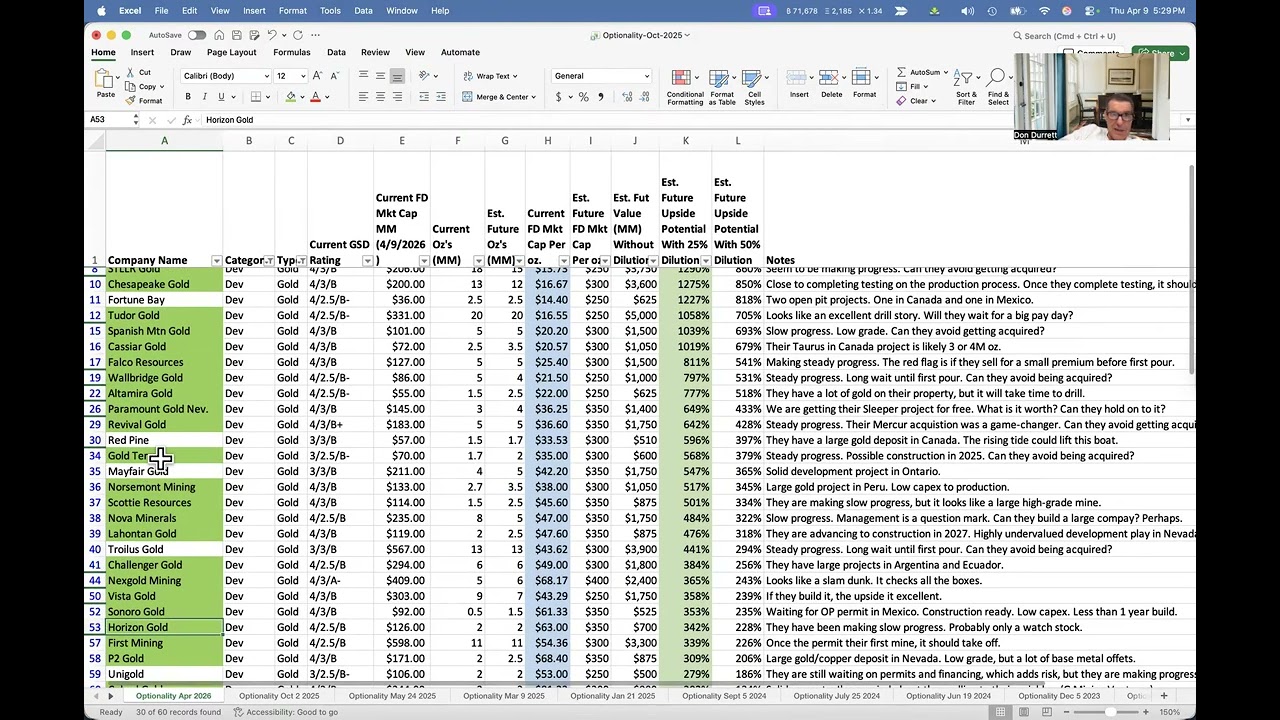
Optionality Update - April 2026

Optionality Update - April 2026

Don Durrett
6 months ago

Key Highlights

brief
  • Durrett likes Revival Gold, which has three projects and trades at about $36 per ounce in the ground, and he expects the resource to grow.

G Mining Ventures' $2 billion acquisition of G2 Goldfields implies roughly $500 per ounce, resetting valuation benchmarks for Canadian gold developers. A 72% premium for an exploration-stage project lifts per-ounce benchmarks, creating optionality across junior gold and silver names. Durrett screens about 60 juniors by future ounces against market cap, applying $250-$450 gold and $5 silver in-ground price assumptions. Names like Freegold, Triumph, Falco and Cabral show multi-bagger optionality if further deals clear at $300-$450 an ounce. He expects development-stage stocks to re-rate together if upcoming acquisitions keep pricing gold in the ground near $400 per ounce.

Newsletter Favorites Upside (using New GSD Defaults)

Newsletter Favorites Upside (using New GSD Defaults)

Don Durrett
7 months ago

Key Highlights

brief
  • The host calls Revival Gold another long-term play that has to build three mines.

Raising default price assumptions to $7,000 gold and $200 silver reflects conviction that current metal prices undershoot the macro setup. Screening 90 favorite miners at those prices prints 20-plus-bagger upside for many, but most need three-to-four-year mine builds first. Near-term producers like Guanajuato Silver need no new growth, so they offer immediate leverage if silver reaches $200. A gold-silver ratio squeeze toward 2.5-3% underpins the $175-200 silver target alongside $7,000 gold within 24-36 months. Timeline to getting paid is the key filter: the longer a mine build, the longer investors must wait for the printed upside.

Newsletter Favorites Overview (Feb 2026)

Newsletter Favorites Overview (Feb 2026)

Don Durrett
8 months ago

Key Highlights

brief
  • Don calls Revival Gold one of the better development plays, very cheap at $190 million.
  • He expects it to benefit in a big way if the market gets into a mania.

Durrett argues there is limited time left to buy gold and silver producers while they are still cheap, expecting one more significant dip. His Newsletter Favorites list leans on quality Canadian and Australian mid-tier producers, which he expects to re-rate as the bull market warms up. Companies whose second and third projects get no market value offer free upside — you pay for the first asset and get the rest for nothing. Cheap forward free-cash-flow multiples persist in West Africa and among silver producers, where weak sentiment discounts heavy leverage to metal prices. Australian producers like Ramelius reaching major-sized valuations is, in his view, the first sign the junior gold bull market is broadening.

Articles

Revival Gold: Bear Trek Intercept Argues for Mineability, Not New Tonnage — Merkur's Q1 PFS Is the Repricing Event

An August 2026 CEO.CA interview puts Revival Gold's value inflection in two places: a 131-metre, 3.43 g/t Bear Trek intercept that management frames as underground continuity rather than new discovery, and a Merkur PFS the guest calls a big value catalyst for the first quarter of next year. Management targets a 2028 construction decision and 2029 first gold.

2 months ago

Revival Gold Proves Deep High-Grade Gold Continuity
Read article

Revival Gold’s Beartrack-Arnett Drill Result Adds to a Multi-Asset Development Case

The video frames Revival Gold as a multi-asset developer whose Mercur project is closest to production while Beartrack-Arnett could add unrecognized exploration and development optionality. The discussion focused on a recent high-grade Beartrack-Arnett intercept and the possibility that its underground component could become a third mine.

2 months ago
Erik Wetterling–Value Proposition: Revival Gold, Westward Gold, Miata Metals, & Red Canyon Resources
Read article

Want the full picture on more companies?

Be one of the first.

A room for resource investors taking shape now — independent, spam-free, no hype.

Join the founding community on Discord