
Sibanye Stillwater Limited
SSWSibanye-Stillwater Limited (SSW) is a leading international mining group headquartered in South Africa, with a highly diversified portfolio of precious metal commodities. Originally established as a gold producer through the unbundling of Gold Fields' older South African assets in 2013, the company aggressively expanded via acquisitions into platinum group metals (PGMs) and, more recently, into green metals and battery minerals (lithium, nickel, copper). The company maintains significant operations across Southern Africa (South Africa, Zimbabwe, Mozambique) and the United States (Montana), alongside a growing international footprint through development and exploration assets in Europe and Australia.
The company's strategic pivot towards 'green metals' aims to position Sibanye-Stillwater for the global energy transition, mitigating the mature and geologically challenging nature of its legacy deep-level South African gold mines. However, this ambitious diversification strategy has been tested by severe cyclical downturns in the PGM market, which historically constituted the vast majority of the company's revenue and cash flow. The recent sharp decline in palladium and rhodium prices has significantly impacted profitability, forcing management to restructure operations, defer capital, and prioritize balance sheet preservation over aggressive growth.
From a Rick Rule perspective, Sibanye-Stillwater presents a complex investment profile. The management team, led by CEO Neal Froneman, is highly experienced and has a proven track record of executing complex M&A transactions and restructuring operations. However, the company's jurisdictional risk profile is heavily weighted toward South Africa, which introduces significant political, regulatory, and operational risks, including unreliable power supply (Eskom) and labor unrest. The company's cost structure is currently under severe pressure due to inflation and depressed PGM basket prices, compressing margins and challenging the viability of higher-cost operations.
Don Durrett's quantitative framework highlights the current valuation disconnect. Sibanye-Stillwater trades at a deep discount to its resource base and historical averages, reflecting the market's pessimistic outlook on PGMs and South African jurisdictional risks. While the balance sheet carries moderate leverage, the company's substantial resource base and diversified metal portfolio offer significant optionality. The investment thesis hinges on a recovery in PGM prices and the successful execution of the green metals strategy, balanced against the structural challenges of operating in complex jurisdictions.
Data Quality
Market Cap
$99.78B
Total valuation
Stock Price
$8.55
▲ 2.03% today
Free Cash Flow
N/A
Annual
Financial Position
-$1.50B
Net debt position
PEG Ratio
ⓘN/M
Not meaningful
Analysis
Score Interpretation
Hover any criterion below to reveal its full rationale, key metrics, strengths, concerns, and source documentation.
Criterion Detailed Analysis
Recommendation
Sibanye-Stillwater is a highly diversified, major mining company currently facing severe headwinds from depressed PGM prices and South African operational challenges. While the stock trades at a deep discount to its substantial resource base (EV/oz of ~$45) and NAV, reflecting significant value potential, the path to realizing this value is highly dependent on a cyclical recovery in palladium and rhodium prices. The company's strategic pivot to green metals is promising but capital-intensive and carries significant execution risk. The South African jurisdictional risks, including power supply issues and regulatory uncertainty, further weigh on the investment thesis. Investors should view Sibanye-Stillwater as a high-beta play on PGM prices and the energy transition, suitable only for those with a high tolerance for volatility and a contrarian outlook on commodity cycles.
Red Flags
| Criterion | Severity | Score | Description |
|---|---|---|---|
| cost_structure | High | 4.00 | South African PGM and Gold operations are high-cost and currently experiencing severe margin compression due to depressed metal prices and inflation. |
| jurisdiction | High | 4.50 | Heavy concentration in South Africa exposes the company to significant political, regulatory, and infrastructural risks (Eskom power crisis). |
| balance_sheet | Medium | 5.50 | Moderate leverage with rising net debt; cash flow is under pressure, limiting financial flexibility and increasing the risk of dilutive capital raises. |
| market_timing | Low | 4.00 | Stock is in a strong downtrend with bearish technicals and negative market sentiment, indicating continued institutional selling pressure. |
Scenario Analysis
Bull Case
Bull case assumes a strong recovery in PGM prices driven by sustained supply deficits and robust automotive demand. Successful execution of the green metals strategy (Keliber, Rhyolite Ridge) creates significant additional value. South African operational risks are mitigated by improved power supply and political stability.
Base Case
Base case assumes a modest recovery in PGM prices from current depressed levels, allowing the company to generate sustainable free cash flow. Green metals projects advance but face typical development delays. The stock re-rates modestly as balance sheet concerns ease.
Bear Case
Bear case assumes a prolonged downturn in PGM prices due to global economic recession and accelerated substitution away from palladium in automotive catalytic converters. South African operations face further disruptions, forcing asset closures and potential dilutive equity raises to fund debt obligations and green metals capex.
Audit Trail
| # | Source |
|---|---|
| 1 | Integrated Annual Report (2023): Financial statements, operational metrics, reserve/resource estimates |
| 2 | Mineral Resources and Mineral Resports Report (2023): Detailed resource breakdown by operation |
| 3 | SEC Form 20-F (2023): US regulatory filing with comprehensive operational and financial data |
| 4 | JSE SENS Announcements (2024): Operational updates, corporate actions, market notifications |
Financials
Core Metrics
Annual Production
N/A
Troy oz per year
Revenue
$5.50B
Fiscal year 2026
Net Income
-$200.00M
Annual
Enterprise Value
$101.28B
Net debt: $1.50B
Adj. EBITDA
$800.00M
EV/EBITDA 126.60x
Income & Cash Flow
Waterfall · Revenue to Free Cash Flow
Key P&L Ratios
N/A
Free Cash Flow Generated
Balance Sheet & Leverage
Capital Structure
- Equity $5.00B
- Long-Term Debt $0.00
- Short-Term Debt $0.00
- Cash & Equivalents $800.00M
Leverage & Coverage
$1.50B
Net Debt
Cash Uses & Returns
- Capital Expenditures $500.00M
- Dividends Paid $0.00
- Share Buybacks $0.00
- Interest Expense $150.00M
- Debt Repayment / Other $0.00
Profitability & Returns
Returns
Margins
Liquidity & Coverage
Yield
Valuation
Valuation Multiples
Share Structure & Ownership
Share Structure
- Outstanding 2.75B 2.75B
- Options 50.00M 50.00M
- RSUs 30.00M 30.00M
- Warrants 0.00 0.00
Per-Share & Buyback Metrics
$0.00
Remaining Buyback Capacity
Health Indicators
Strength across all solvency and liquidity metrics
46.0% of 1.0x threshold
8.0% of 3.0x target
30.2% of 48 months target
19.3% of 15% threshold
Asset Pipeline
Jurisdiction Exposure
Geographic distribution of mining properties · Equal-weighted (no NPV data)
- South Africa50.0% · Tier 5 · 2 properties
- Finland25.0% · Tier 2 · 1 property
- United States25.0% · Tier 1 · 1 property
Operating Mines
Distribution across development stages · Equal-weighted (no NPV data)
- Depletion/Closure25.0% · 1 Asset
- Production (Steady-State)50.0% · 2 Assets
- Development & Construction25.0% · 1 Asset
Cost Structure
All-in Sustaining Cost (AISC) breakdown • Cost improvement opportunity
$1,400/oz • 85%
$270/oz • 16%
Keliber Lithium Project
South Africa Gold Operations (Driefontein, Kloof, Beatrix)
South Africa PGM Operations (Kroondal, Rustenburg, Marikana)
US PGM Operations (Stillwater, East Boulder)
Information
Key Information
Legal Entity
Sibanye Stillwater Limited
Sector
Precious Metal
Founded
February 11, 2013
Employees
57,857
Reporting Currency
USD
Contact Phone
27 11 278 9600
Website
www.sibanyestillwater.comHeadquarters Address
Bridgeview House, Building 11 , Weltevredenpark 1709 , ZA
Identifiers
Commodity Portfolio
Organization
Management Team
Neal Froneman
Chief Executive Officer
Specialization: Former CEO & Executive Director | Sibanye-Stillwater | Architect of a Diversified Mining Goliath
Neal Froneman is one of the most consequential mining executives of the 21st century, having built Sibanye-Stillwater from a collection of South African gold assets into a globally diversified metals producer. Appointed CEO in January 2013 after Gold Fields spun off its labour-intensive, conventional gold mining operations, Froneman pursued an aggressive acquisition strategy that transformed the company's commodity exposure and geographic footprint. His deal-making prowess earned him a reputation as one of the mining industry's most bold and strategic operators. Under Froneman's leadership, Sibanye-Stillwater expanded well beyond its gold origins. The company acquired platinum group metal (PGM) assets, including the purchase of Aquarius Platinum and the Rustenburg operations from Anglo American Platinum, establishing Sibanye as one of the world's largest PGM producers. The transformative acquisition of Stillwater Mining in 2017 gave the company a strategic foothold in the United States, adding palladium and platinum operations in Montana. Froneman further diversified into battery metals through investments in lithium and nickel projects, positioning Sibanye-Stillwater to capitalize on the energy transition. Froneman's career in mining spans decades, with previous executive roles at several mining companies including Uranium One, where he served as CEO, and Aflease Gold, which he built through consolidation before it evolved into what would become Sibanye. His experience across uranium, gold, and PGMs gave him a rare breadth of commodity expertise. He has also served as Chair of the World Gold Council, underscoring his standing in the global gold mining community. Known for his candid assessments of the mining industry's challenges, Froneman has been a vocal advocate for operational efficiency, responsible mining practices, and the strategic importance of critical minerals. In a McKinsey interview, he articulated his vision for building a modern mining company, emphasizing lessons learned from decades in the industry. His leadership style has been described as hands-on and decisive, willing to make difficult portfolio decisions—including restructuring and asset rationalization during commodity downturns. Froneman announced his retirement in early 2025, set to depart at the end of September that year. His legacy is a company that spun South African gold into a global mining conglomerate spanning precious metals, PGMs, and battery minerals. For commodity investors, Froneman's career offers a masterclass in value creation through strategic M&A, commodity diversification, and the willingness to make contrarian bets on unloved assets.
Insider Ownership
10.00%
Charl Keyter
Chief Financial Officer
Insider Ownership
2.00%
Industry Partnerships
Various Offtakers
Offtake Agreement
Project: Keliber Lithium
Ownership: 79.0%
Source: Company Announcements, Integrated Annual Report
Chart
Interactive chart powered by TradingView. Use the chart tools to analyze price trends.
Videos

Stillwater Critical Minerals: Neighbor on Strike. The PEA Will Stand Alone
Key Highlights
detailed- Rowley confirms a strike is underway at Sibanye-Stillwater's Stillwater mine and, he believes, at the Columbus smelter/hydromet facility as of the interview.
- Rowley says Sibanye-Stillwater is publicly struggling with costs, trying to get from over $1,300 down to a $1,000 target, and has been upfront that it has to look at its options.
- Rowley stresses there is no corporate connection and no discussions between Sibanye-Stillwater and Stillwater Critical Minerals, though the neighboring infrastructure and good neighbor agreement are relevant.
- Sibanye-Stillwater runs two sulphide flotation mills and a smelter-refinery complex that Rowley says sit underutilized, making them a relevant, compatible processing option for Stillwater's similar nickel-copper sulphide ore.
Sibanye-Stillwater faces a labor strike at its Montana mines and Columbus plant while running costs above $1,300 an ounce against a stated $1,000 target. Stillwater Critical Minerals confirms no talks with its neighbor, though analysts model its future feed through Sibanye's two underused sulfide mills and smelter-refinery. A 29.4-million-tonne indicated and 805-million-tonne inferred resource underpins a standalone PEA (preliminary economic assessment — a first-pass economics study) in about a year. Shareholder Glencore wants a bigger US footprint and joined Project Vault, the new US critical-minerals stockpile program. Near-term news flow includes drill results, an OTCQX listing, metallurgy work, and plans for the company's largest drill program in 2027.

Sam Leung of Centauri Minerals Inc. talks to Brian Leni | Metals Investor Forum Sept. 2026
Key Highlights
brief- Sold the Altar project in 2017-2018 while exiting Argentina, which allowed the Aldebaran/Black-Heather team to acquire it
Centauri Minerals recently debuted on the TSX-V via an Aldebaran spin-out, giving investors a fresh entry to 40,000 hectares across six Northern Argentina gold-copper-silver projects. A desktop resource update at the flagship Rio Grande project roughly doubled contained gold, copper and silver, anchoring a near-C$30M treasury raise. Two rigs mobilize in Q4 2026: one tests shallow oxide gold and copper, the other chases the deep sulfide source beneath historic high-grade intercepts. At the second project, Agua Scolianta, an AMT and IP geophysical program just started using the same crew from Rio Grande's recent 3D MT work. Management plans to keep optionality intact, evaluating unsolicited Argentine prospect deals rather than granting third-party options on pieces of the existing portfolio.

Stillwater Critical Minerals ($PGE | $PGEZF): Updated Polymetallic Resource Sets the Stage for a PEA
Key Highlights
detailed- Mike describes Sibanye as America's palladium-platinum producer and a neighbor in the Stillwater Igneous Complex in southern Montana, with a smelter and refinery complex in nearby Columbus.
- John notes Sibanye mines a thin, 1.8m-thick J-M Reef that hosts the highest-grade palladium-platinum deposit in the world and dips at about 60 degrees.
- Mike points out Sibanye's current AISC is more than double the $599/4E oz reference from the South African Platreef benchmark he is targeting.
- John flags that Sibanye is currently in union negotiations, which he presents as a local labor consideration for the project.
Stillwater Critical Minerals released its third, largest MRE: 4.82 billion pounds of nickel-copper-cobalt and 7.43 million ounces of PGMs (platinum-group metals) and gold. Stillwater's Montana project applies South Africa's Platte Reef bulk-mining model, targeting AISC (all-in sustaining cost) near $600 per 4E ounce. CEO Rowley plans a PEA in about a year but skips a full PFS, aiming to upgrade resources and attract a major's bid. Hosts frame Stillwater as a 'buy-and-forget' optionality play: buy ounces cheap, let the PEA re-rate them, then wait for Glencore or another major to bid. The U.S. has only one small nickel mine and no nickel processing capacity; Rowley is engaging D.C. on funding but says grants take time.

Stillwater Critical Minerals – Updated MRE More Than Doubles The Mineral Resource at Stillwater West
Key Highlights
brief- Rowley frames Sibanye-Stillwater as the producing neighbor within the Stillwater Igneous Complex, noting they run two concentrators doing conventional sulfide flotation and ship a nickel-copper sulfide concentrate to Columbus, Montana for smelting and hydromet.
- He cites Sibanye-Stillwater's current cost pressures as part of the case for U.S. government interest in Stillwater West as a domestic critical minerals project (as of 2026-09-04).
Updated MRE more than doubled Stillwater West to 805M tonnes Inferred plus 29M tonnes Indicated at 0.34% NiTEq — polymetallic scale. Roughly 40-50% of Stillwater West's value is nickel; copper, cobalt, PGMs, gold and chromium each layer on 5-15% — an unusually balanced polymetallic suite. Stillwater West now holds the largest known rhodium deposit in North America and the largest nickel-cobalt resource in any active US mining district. Glencore's 13% strategic stake signals major-producer interest, drawn by 267M tonnes of mid-grade 0.35% NiTEq rock offering 30-40-year production optionality. Three rigs are pivoting from expansion to infill drilling ahead of a Preliminary Economic Assessment expected next year, supported by $6M in DOE grants.

Resource Triples to 805Mt & PEA Next Year | Stillwater Critical Minerals
Key Highlights
detailed- Sibanye-Stillwater's East Boulder mine sits roughly half a kilometer underground from Stillwater Critical's Chrome Mountain deposits and shares the same Stillwater Complex reef geology
- Sibanye-Stillwater's US PGE AISC is around $1,300 per 2 oz and the company is losing money at current prices, targeting $1,000 per 2 oz via more mechanized mining and union talks
- Sibanye-Stillwater's East Boulder Mill is two miles north in the valley and the company already produces nickel-copper at Columbus, giving the Stillwater Critical project nearby infrastructure to leverage
- Rowley describes Sibanye-Stillwater as a conservative, late-stage investor; conversations are getting longer as Stillwater Critical matures, and Sibanye-Stillwater's own recent call flagged that 'anything is possible' if the US cost reset fails
Stillwater Critical Minerals tripled inferred resources at Stillwater West to 805Mt at 0.34% NiTEq, adding a first 29.4Mt of indicated tonnes at 0.38% NiTEq. Management is targeting a 2027 PEA after further flotation testwork, noting a PEA does not require indicated resources but a PFS does. The polymetallic system lists 10 critical minerals, with 6.6 billion pounds of inferred chromium left without recovery or economic assumptions pending metallurgy. Three rigs are turning in Montana with C$15M in treasury, while the company engages Glencore's technical team and US government officials on the deposit. Management benchmarks Stillwater West against Sibanye-Stillwater's loss-making US PGM operations and Platreef's roughly $599 per 4oz AISC as a cost target.
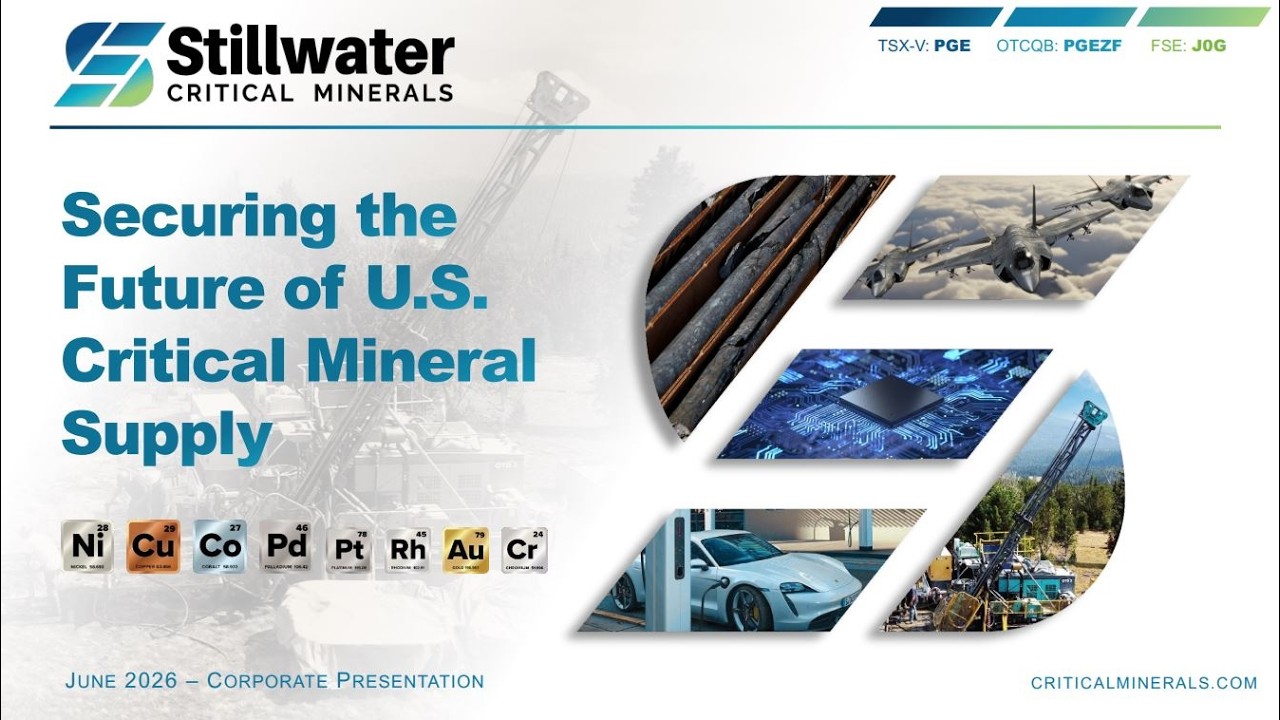
Stillwater Critical Minerals-Visual Update Of The 2026 Exploration Strategy & Upcoming Key Catalysts
Key Highlights
detailed- Rowley argues Stillwater Critical's claims sit directly adjacent to Sibanye-Stillwater's Montana operations and that what Sibanye is mining is just another level of the same layered system the company holds.
- Rowley says Sibanye runs three mines on the JM Reef — over 100 million ounces of the world's highest-grade palladium-platinum ore at more than half an ounce per ton — and makes nickel sulfate and copper products at Columbus.
- Rowley claims Sibanye has been losing money for a few years on the US operations, with South Africa currently the benefit, and says Stillwater Critical's project could change that economics.
- Grobler says Platreef's all-in cost of roughly $600 per ounce is about half of Sibanye's current cost, as Sibanye itself made clear at the Butte show.
- The presented cross-section shows Sibanye's East Boulder mine and concentrator along strike, north of the company's ground to the south.
Stillwater Critical Minerals expects a geologic-model-based mineral resource update in Q3, adding 14 holes from its 2023 and 2025 drilling. A fully funded three-rig 2026 campaign targets the gaps between Chrome Mountain and Iron Mountain, which are shaping up as two deposits. Management applies South African Bushveld and Platreef-style geology in Montana, arguing magmatic layering controls thick, near-surface, polymetallic mineralization. Glencore keeps backing the company through repeated financings, while $6 million in federal grants and chromium's strategic status support the critical minerals case. Pending assays and machine-learning geophysics aim to sharpen drill targeting before metallurgical studies and preliminary economic assessment (PEA) work begin.

Clem Chambers: The End of Democracy, Oil 'Screaming Buy' Right Now & Gold To Continue To Crash
Key Highlights
brief- The guest says he owned Sibanye-Stillwater and got out near the top 'by good fortune'.
- Answering a question on platinum and palladium miners, he says precious-metals miners fall even against gold and behave in ways he cannot explain, so he avoids them.
Chambers expects gold to fall toward $3,500 as the China-Taiwan war premium fades and inflation replaces geopolitics as the main driver. He argues China's sacked generals show the army resisted invading Taiwan, postponing the geopolitical bid that had driven gold's rally. He frames the US-China AI race as an energy build-out where electricity is destiny, favoring nuclear, fossil fuels, and grid investment. He favors platinum and palladium: tiny 200-ton annual supply, Russian and South African production risk, and catalytic converters destroy roughly as much as is mined. He advises holding 2.5 to 5 percent of assets in physical gold or ETFs through dollar-cost averaging, and avoiding miners he cannot predict.

Aldebaran Resources Inc. ($ALDE | $ADBRF): Altar Project Opportunity & Next Steps
Key Highlights
brief- Per the speaker, Sibanye-Stillwater sold the Altar project to Aldebaran in 2018 and retains a 20% interest under their joint venture, with Aldebaran holding the other 80%.
Aldebaran's Altar project in Argentina ranks as the fourth-largest undeveloped copper project held by a junior company. A busy 12-to-24-month catalyst runway includes ongoing drill results, a Sentari Minerals spin-out, an updated resource estimate, and a pre-feasibility study by mid-2027. Submitting for Argentina's REHI benefits would lock in long-term tax stability at a reduced rate — a major de-risking step. The team's repeatable model: buy overlooked projects in downturns, de-risk them by drilling, then sell to a major miner. The guest argues Altar trades at a discount to copper-development peers on price-to-NAV and enterprise-value-per-pound, implying re-rating potential.
Articles
No articles available
Published articles for this company will appear here
Want the full picture on more companies?
Be one of the first.
A room for resource investors taking shape now — independent, spam-free, no hype.