




West Red Lake Gold Mines Ltd logo

West Red Lake Gold Mines Ltd

WRLG

Operating within Canada, West Red Lake Gold Mines Ltd. specializes in the acquisition, exploration, and development of gold deposits. Its principal asset is the West Red Lake project, a substantial 3,100-hectare land package located in the Red Lake Archean Greenstone Belt, part of the Red Lake Gold District in Northwestern Ontario. This project incorporates significant properties such as the NT Zone, the Mount Jamie Mine, the Rowan Mine, and the Red Summit Mine. The company, which was previously named DLV Resources Ltd., officially became West Red Lake Gold Mines Ltd. in December 2022 and maintains its corporate headquarters in British Columbia, Canada.

Score

—
Updated
—
—

Data Quality

N/A

Market Cap

N/A

Total valuation

Stock Price

N/A

Latest close

Free Cash Flow

N/A

Annual

Financial Position

N/A

Cash position

PEG Ratio

ⓘ

N/A

P/E ÷ growth

Analysis

Subscribe to see the AI Analysis

Score breakdown, criteria, red flags, bull/base/bear scenarios.

Subscribe

Financials

Subscribe to see Financials

Cash flow, balance sheet, valuation metrics, share structure.

Subscribe

Asset Pipeline

Subscribe to see the Asset Pipeline

Jurisdiction exposure, project portfolio, cost structure.

Subscribe

Information

Key Information

Legal Entity

West Red Lake Gold Mines Ltd

Sector

Precious Metal

Founded

August 8, 1996

Employees

182

Reporting Currency

CAD

Contact Phone

604-609-6110

Headquarters Address

595 Burrard Street , Vancouver , BC V7X 1J1 , CA

Identifiers

CUSIP

95556L101

Commodity Portfolio

AU Gold Primary

Stock Exchanges

WRLG TSXV • CAD
WRLG:CVE
WRLGF OTC • USD
WRLGF:OTCMKTS

Organization

Subscribe to see Organization

Management team and industry partnerships.

Subscribe

Chart

Loading chart...

Interactive chart powered by TradingView. Use the chart tools to analyze price trends.

Videos

West Red Lake Gold Mines – Q2 Financials, H2 Development & Production Ramp Up, Exploration Update

West Red Lake Gold Mines – Q2 Financials, H2 Development & Production Ramp Up, Exploration Update

The KE Report
19 days ago 22:12

Key Highlights

detailed
  • The CEO says the Q2 2026 results, released August 25, 2026, delivered the promised step up: gold production rose 51% and AISC fell 30% versus Q1, even with the gold price down over the same period, and he expects full run-rate production by the end of 2026.
  • A pre-feasibility study folding Rowan into the plan is expected around end-September or early October 2026; the CEO says the combined hub-and-spoke operation points to 100,000-120,000 ounces a year, with a path toward 200,000 ounces through regional consolidation and a mill expansion to 1,500 tonnes per day.
  • The strategy is four to five independent mining hubs - underground zones plus surface satellites - feeding the 800 tonne-per-day Madsen mill, adding roughly one satellite a year: Fork enters the mine plan in the back half of 2027 and the next surface target in 2028.
  • Shaft refurbishment is a major cost lever: the 1,200-metre shaft would cost about $200 million to build today, skipping is roughly a quarter the cost of trucking, and hoisting capacity steps from 200 to 700 and up to 2,000 tonnes per day, with the real benefit in the back half of 2027.
  • With 50-60% of Madsen costs fixed, the CEO argues AISC falls as ounces rise, and Rowan's higher-grade ore - which he says recovers better and suits gravity processing - is planned at a couple hundred tonnes per day to add ounces without major mill capex.

Madsen's Q2 showed the ramp-up is delivering: production up 51% and AISC (all-in sustaining cost — full cost per ounce) down 30%. The CEO argues high fixed costs mean AISC falls mechanically as ounces rise, so quarterly snapshots mislead until the year-end run rate. Shaft hoisting costs about a quarter of truck hauling, and phase two could lift hoisting capacity to 700 tons per day in late 2027. Williams outlines a hub-and-spoke plan: multiple satellite deposits feeding the Madsen mill, aiming for 100,000-120,000 ounces with a study due soon. He points to a larger Canadian peer's multibillion-dollar market cap, arguing regional consolidation could lift output toward 200,000 ounces.

Lab Report | Sep 21 Deep Dives on West Red Lake Gold, Copper Giant, Power Metallic, and Kingsmen

Lab Report | Sep 21 Deep Dives on West Red Lake Gold, Copper Giant, Power Metallic, and Kingsmen

CEO.CA
21 days ago 50:12

Key Highlights

detailed
  • Laboucan's top point is that the Madsen turning point arrives when mining reaches ground never mined before, in the 904 and 955 complexes, and he expects that to be a 2027 event rather than something investors see this year.
  • He reports assays of 176 g/t gold over 5.3 m, 128 g/t over 4.5 m and 35 g/t over 13 m from the 904 and 955 complexes, coming out of the ongoing underground definition drill program at Madsen.
  • He treats the coarse visible gold in the core photos as evidence that these Red Lake orogenic systems have deep roots, but he balances that with the previous operator Pure Gold going bankrupt on near-surface material at Madsen — grade without continuity, in his view.
  • He says sentiment improved after Q2 production rose, but all-in sustaining cost was still US$3,284/oz against roughly US$2,000 or less for most operations, with only about US$9.7 million of positive free cash flow; he expects more ounces and lower costs in H2 while investors watch Q3 and Q4 grades.
  • He calls the roughly $348 million valuation modest if production reaches the 50,000–100,000 ounces management talks about and costs come down, but flags financing and dilution risk from thin free cash flow and a delayed shaft.

Grade without continuity bankrupts mines, so Madsen's turning point is reaching never-mined ground below the old workings, likely in 2027. West Red Lake Gold's all-in sustaining cost of US$3,284 per ounce sits far above the US$2,000 most operations target, keeping financing pressure on. Copper Giant's 12.7 billion pounds of copper equivalent in its Mocoa resource is rare at this scale, and copper near US$7 per pound supports it. Power Metallic's resource estimate pulled it into a valuation discount window, where investors may ignore good drill results until a PEA clears it. Kingsmen Resources' 218 grams per tonne silver equivalent over 6.5 metres matches the widths that make Mexican epithermal veins economic.

Summit Royalties – Comprehensive Update On 4 Producing and 3 Key Development Assets

Summit Royalties – Comprehensive Update On 4 Producing and 3 Key Development Assets

The KE Report
21 days ago 18:21

Key Highlights

detailed
  • Madsen cleared commercial production in January 2026, and Q2 output rose 51% over Q1 to a little over 8,500 oz as the operator targets a 10,000 oz per quarter run rate, the midpoint of 2026 guidance.
  • Clark says head grade is reconciling well with the mine plan, AISC is down 30%, and the mine is generating cash, with Summit's Madsen revenue expected to rise from roughly $300,000 last quarter toward $500,000 per quarter at $4,000 gold if guidance is met.
  • A PFS due in the second half of 2026 will integrate the Rowan deposit, which Summit does not hold a royalty on, and is expected to outline a longer mine life than currently envisioned.
  • The hosts note VP of Exploration Will Robinson has been highlighting high-grade 'jewel box' zones at depth, the 447 and 904 zones, and Clark expects the higher-grade 904 panel to be accessed around 2027 with meaningful impact.
  • The shaft has been restarted and mining is moving laterally into areas with less remnant mining to add working faces and tonnage.

Drew Clark argues Summit Royalties trades at 0.75x net asset value (NAV) against 1.2-1.6x for royalty peers, leaving room to re-rate. Four producing royalties are compounding as operators expand — Madsen, Bomboré, Zancudo and Keysbrook grow Summit's cash flow at no extra cost. Copperstone and Pitangu should reach production in 2027, with the guest's math valuing the 4% Copperstone gold stream at about US$6 million yearly. Banyan Gold's year-end AurMac PEA (preliminary economic assessment — an early-stage mine study) could re-rate Summit's unvalued royalty on the project. A US$50 million National Bank credit facility funds accretive royalty acquisitions without heavy dilution, and management owns 12% of the company.

This Gold Mine Finally Started WorkingThumbnail: | West Red Lake Q2 2026 Earnings

This Gold Mine Finally Started WorkingThumbnail: | West Red Lake Q2 2026 Earnings

The Deep Dive
about 1 month ago 15:16

Key Highlights

detailed
  • Q2 was the first positive free cash flow quarter the Madsen mine has produced, with production up 51% and all-in sustaining costs down 30% — the host calls it the best quarter the operation has had.
  • The mill ran at 842 tons/day against an 800 tons/day rated capacity and the company is targeting 1,000 tons/day in H2; a 10,768-ton stockpile at quarter-end shows the mine is now outrunning the mill.
  • Production is only 36% of the way to the midpoint of full-year guidance after H1, requiring a 21-50% step-up from Q2 to hit the 35,000-45,000 oz range.
  • Cash fell $11M in H1 2026 despite the positive FCF, because the FCF definition excludes $6M of growth capex and all debt service; WRLG carries $75M of net debt and is the only net-debt name in the host's peer set, with management stating it is actively looking to lower the cost of capital.
  • An updated pre-feasibility study combining Madsen and Rowan is expected in mid-to-late September 2026, with Rowan's indicated resource coming in at 335,000 oz at 13 g/t.

West Red Lake's Madsen mine delivered its best restart quarter: production up 51%, AISC (All-In Sustaining Cost) down 30%, first positive free cash flow. A 10,768-ton surface stockpile holding 1,500 ounces signals mining rates have finally outpaced the mill at this Ontario operation. H1 output of 14,000 ounces is only 36% of midpoint guidance, so Q3 and Q4 must average 10,400+ ounces to hit the low end. WRLG still carries a 68% EV/EBITDA premium to peers and is the only one of five gold comparables in net debt. A pending pre-feasibility study combining Madsen and Rowan's high-grade 335,000-ounce resource is due mid-to-late September.

Gold/Silver Miners: Low Hanging Fruit (August 2026)

Gold/Silver Miners: Low Hanging Fruit (August 2026)

Don Durrett
about 2 months ago

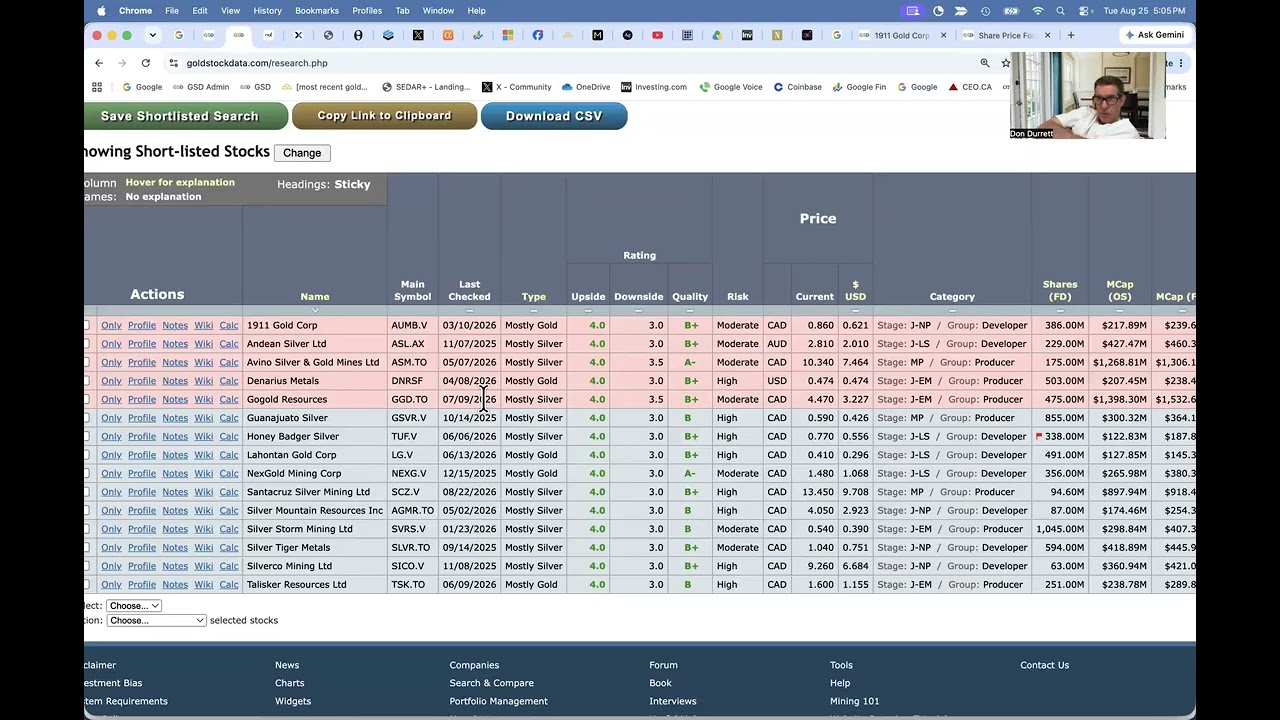
Don Durrett's 15 low-hanging-fruit names share a single thesis — execution on planned growth at $200 silver and $7,000 gold unlocks 5-20x upside across the list. Junior miners with low insider ownership become prime hostile takeover targets once their assets are de-risked, so a defensive merger often precedes the rerate. The market is still leaving the second-mine pipeline at NexGold and GoGold free, because the first project's standalone value already exceeds today's market cap. Canada's scarcity of new single-asset gold producers gives each one a permanent jurisdiction premium that U.S. peers cannot replicate. AISC (All-In Sustaining Cost — what it really costs to produce an ounce) is the single variable that decides whether each near-term producer on this list rerates or fades.

Lab Report | Aug 13 Daily Market Overview & Deep Dive on AMEX, Pan American, Arizona, WRLG

Lab Report | Aug 13 Daily Market Overview & Deep Dive on AMEX, Pan American, Arizona, WRLG

CEO.CA
2 months ago 49:23

Key Highlights

detailed
  • Top point: West Red Lake Gold is refurbishing a mine shaft so underground material can be hoisted to the surface and moved straight to the mill, which the speaker says removes the repeated truck haulage that is required today.
  • He frames the shaft as the route into ground that past producers left unmined or sterilized, and notes that Q2 activity in the Red Lake complex is staying close to the shaft.
  • He acknowledges growing pains at a new mine with a troubled past, but argues the gold price has helped, now trading at about twice the level it did when the company went bankrupt four years ago.
  • His thesis is a valuation gap: WRLG is already producing from a high-grade orogenic system at Red Lake, yet on his Lassonde curve he would still plot it back inside the development window, so proving the mine can be run successfully is what would move the valuation up the curve.

Laboucan argues algorithmic trading keys off the day's headline narrative, not longer-term reality, which creates an opening for investors who look past daily swings. Turning a discovery into a mine takes 20 to 30 years, so gold, silver and copper supply cannot respond quickly to rising prices. Free cash flow - the cash that actually reaches the bank - is Laboucan's preferred measure, ahead of accounting earnings, at producers large and small. Mapping each name on the Lassonde Curve, he finds all four priced earlier than their actual development stage, a gap he frames as the opportunity. His gold case leans on debt stress: the yen carry trade - cheap Japanese borrowing funding US debt - keeps needing intervention that never lasts.

Summit Royalties – US$50 Million Revolving Credit Facility Sets Up Future Transactions and Growth

Summit Royalties – US$50 Million Revolving Credit Facility Sets Up Future Transactions and Growth

The KE Report
3 months ago

Key Highlights

detailed
  • Announced commercial production at Madsen in early 2026, and recent Q2 numbers suggest the asset is on track to meet or exceed full-year guidance
  • Q1 production numbers initially scared the market and pressured the share price, but the guest says the Q2 update has stabilized expectations
  • Described as a long-lived underground gold mine in Ontario that is still in ramp-up mode, with the operator guiding toward cash-flow positivity and Summit saying Madsen has performed to its initial expectations

Summit Royalties (TSXV: SUM) secured a US$50M revolving credit facility from National Bank of Canada to fund future royalty and stream acquisitions without diluting shareholders. Management plans to target cash-flowing or near-production royalties that fall below larger peers' minimum deal sizes, banking on multiple small accretive deals compounding NAV. Two development-stage assets — Copperstone (a 4% gold stream in Arizona) and Patangi in Brazil — are projected to drive revenue and GEO growth into 2027. Trading around 0.6x NAV means the credit line's all-in cost sits well below the company's implied cost of equity, making funded deals inherently accretive. Four producing royalties — Madsen (West Red Lake), Bombore (Orazone), Zancudo (Daenerys Metals) and Keysbrook (Iwatani) — still carry embedded growth as operators ramp up throughput.

West Red Lake Gold – Q2 Ramp-Up In Operations At The Madsen Mine Demonstrated Higher Gold Production

West Red Lake Gold – Q2 Ramp-Up In Operations At The Madsen Mine Demonstrated Higher Gold Production

The KE Report
3 months ago

Key Highlights

detailed
  • Williams points to Q2 2026 as the first clear step-change in the Madsen ramp-up: mined tonnage rose 46% to 75,524 tonnes from 51,616 tonnes in Q1, mined ounces rose 73% to 10,459 ounces from 6,033 ounces, and gold production rose 51% to 8,576 ounces from 5,667 ounces, with mined grades also stepping up.
  • He argues the elevated all-in sustaining cost is a denominator problem rather than a cost problem — roughly 60% of costs are fixed, cost levels have been essentially flat for 12 months, so rising ounces should pull AISC down quarter by quarter toward guidance, with the rehabilitated shaft (targeted to hoist from the surface by around August 2026) as a second lever since trucking costs about four times shaft hoisting.
  • He describes a roughly one-year drill-to-mine 'conveyor belt' of zones: Triple-for-Seven, drilled in 2025, is being mined now; the 904 Zone, drilled this year, should see first mining in the second half of 2027; Fork, a roughly 50,000-ounce pod close to existing workings, is in early underground development contributing a couple of hundred tonnes per day; and Starratt-Olsen is being drilled this year with a possible 2028 mine plan.
  • A combined pre-feasibility study covering Madsen and Rowan is due by mid-September 2026, which he says will show roughly 60,000 ounces per year from Madsen plus 30,000–40,000 ounces per year from Rowan combining into a 120,000–130,000 ounce per year operation at 1,200–1,400 tonnes per day — mid-tier scale — with little remaining capex needed at Madsen; the mill averaged about 842 tonnes per day in Q2 and is targeted at roughly 1,000 tonnes per day in the second half of 2026.
  • He expects Madsen's grade to improve at depth as dewatering reaches Level 17 and moves into workings untouched since the 1960s and 1970s, leaving less remnant material, with Island Gold at Alamos Gold offered as the analogue for a remnant mine that got richer as it went deeper.

Madsen ramped up hard: Q2 mined tonnage rose 46% and mined ounces 73% quarter over quarter, with more step changes expected. AISC (All-In Sustaining Cost — what it really costs to produce an ounce) falls as ounces rise, since 60% of costs are fixed. Higher fuel prices barely dent Madsen's costs, because Ontario hydro power keeps underground diesel exposure small. A repeatable mine-development-to-production cadence, roughly a year from drilling to mining, feeds Madsen from 4447, 904, Fork and Starratt-Olsen. September's combined Madsen and Rowan pre-feasibility study targets 120,000-130,000 ounces a year, or mid-tier producer scale.

Why This New Copper Spinout Has Huge Upside

Why This New Copper Spinout Has Huge Upside

VRIC Media
3 months ago

Key Highlights

brief
  • The host names West Red Lake Gold Mines as one of the Fiore group's mine restart and development companies alongside Cambria and Selkirk Copper.

Cambria Gold Mines will spin its Mount Margaret deposit — a historical 570-million-ton resource at 0.72% copper equivalent — into a new US company, Freedom Copper. Abandoned after the Mount St. Helens eruption, the porphyry (a large copper system) remains open in every direction, and every 2010 hole ended in mineralization. Cambria shareholders keep 49.9% exposure plus a 15% dividend in the spinout, while Cambria focuses on restarting the Premier gold mine in British Columbia. The restart plan feeds one 2,500-tonne-per-day mill from four deposits, led by high-grade Red Mountain — 544,000 measured ounces near 9 grams per tonne. A planned $100 million raise funds about 100,000 meters of drilling toward a modern resource estimate, a PEA (early economic study), and US permitting.

Summit Royalties – Acquisition Of Star Royalties Is Complete, Bringing In A Significant Gold Stream

Summit Royalties – Acquisition Of Star Royalties Is Complete, Bringing In A Significant Gold Stream

The KE Report
3 months ago

Key Highlights

brief
  • Drew Clark says Summit holds a 1% royalty on the Madison mine, which is operated by West Red Lake Gold Mines.
  • He believes Madison is finding its footing and, as of the interview, was poised for a strong second half of 2026.

Summit Royalties closed its acquisition of Star Royalties, adding a 4% gold stream on the Copperstone project in Arizona to a 48-asset portfolio. A stream is an upfront payment plus an ongoing one (here 25% of spot for 4% of gold), giving Summit growth it did not fund. Mining Americas' new PFS (Pre-Feasibility Study — the detailed economics test before a build decision) supports construction, with first gold targeted by mid-2027. A royalty on Jaguar Mining's Pitangui project should start construction this year and ramp up in 2027, pairing with Copperstone for revenue growth. The guest argues Summit trades near 0.65 of net asset value, and closing that discount through research coverage would lower its cost of capital.

Gold's Pullback, a Hidden Debt Crisis, and the K-Shaped Economy | Michael Dehn - Total Metals

Gold's Pullback, a Hidden Debt Crisis, and the K-Shaped Economy | Michael Dehn - Total Metals

The Deep Dive
3 months ago

Key Highlights

brief
  • Dehn says he consulted for West Red Lake Gold Mines when the company holding the Great Bear property tried to merge with it.
  • He says he first drilled West Red Lake's Rowan property in 1997 and sat on its board of directors for almost 12 years.

Political brinksmanship adds noise to commodity prices, the guest argues, and tariffs hit many commodities while sparing gold. Wealthier investors keep adding gold and hard assets while stretched households sit out, a K-shaped divide now shaping commodity demand. Total Metals' Electro drilling cut high-grade mineralization — up to 30% zinc and over 3% copper — with copper in its own hanging-wall zone. The Pick Lake critical minerals project, bought for just over $2 million, carries a $13 million analyst valuation and near-20% zinc grades. Next 12 months: larger permits at High Lake, First Nations engagement starting July 7, and compiling West Hawk Lake's century-old exploration data.

The Next Gold Surge? What Most Investors Don't Understand | Ranj Pillai

The Next Gold Surge? What Most Investors Don't Understand | Ranj Pillai

Liberty and Finance
4 months ago

Key Highlights

brief
  • The guest names West Red Lake, part of the Fiore group, as a potential direct-shipping-ore partner located to the north of Seva's Northwestern Ontario property.
  • The host adds that West Red Lake has appeared on the channel before, describing its accelerated roadmap to restart an existing facility using infrastructure already in place.

Central banks in Poland, China, and Turkey are buying gold as insurance against geopolitical and financial instability, the guest argues. Institutional and family office capital for precious and critical minerals is still being structured rather than deployed, suggesting tailwinds. A lag between rising spot prices and mining equity re-ratings leaves value in junior miners, per the guest's experience. Seva Mining advances its Northwestern Ontario gold project through a DSO (direct shipping ore — selling unprocessed ore) model to cut upfront capital. The guest cites a 13,500 cubic meter gold stockpile and $9.5 billion of regional M&A since 2020 as near-term catalysts.

$15 Million in Gold Is Just the Beginning

$15 Million in Gold Is Just the Beginning

VRIC Media
4 months ago

Key Highlights

brief
  • The guest names West Red Lake as a potential processing partner for Seva Mining if ore is shipped north.
  • He refers to West Red Lake as another FURIA company and calls its mill shiny new.

Seva Mining's CEO frames the roughly $15 million gold stockpile on site as a base for modeling ten years of production. The strategy is DSO (Direct Shipping Ore — trucking ore to a third party's mill) rather than building a mill, keeping capex low. Existing infrastructure — a 20-kilometer road, a camp and transmission at its end — already cuts what the mine would have to build. The CEO says Seva is seeking a processing partner on Highway 71, either south at Rainy River or north with West Red Lake.

West Red Lake Gold Mines – Updated Rowan and Mt Jamie MRE Demonstrates Growth In Resources & Grade

West Red Lake Gold Mines – Updated Rowan and Mt Jamie MRE Demonstrates Growth In Resources & Grade

The KE Report
4 months ago

West Red Lake Gold's Rowan deposit grew Indicated resources by 70% to 334,825 ounces at 13.03 g/t Au, making it one of Canada's highest-grade undeveloped gold deposits. The company achieved this resource growth at a discovery cost of roughly C$17.60 per ounce, spending only C$3.5 million on 6,300 meters of drilling. An initial MRE (Mineral Resource Estimate — a formal calculation of mineable tonnes and grade) for the nearby Mt Jamie deposit added 85,198 combined ounces at grades above 11 g/t Au.

Shane Williams, CEO of West Red Lake Gold | Rule Symposium 2026: Rick Rule interviews

Shane Williams, CEO of West Red Lake Gold | Rule Symposium 2026: Rick Rule interviews

Rule Investment Media
5 months ago

Key Highlights

detailed
  • The guest says the Madsen mine went back into commercial production in January 2026, about two years after the asset was acquired, with roughly 40,000 ounces expected during 2026 ramp-up and nameplate capacity of 50,000-60,000 ounces a year reached by the end of 2026.
  • He puts the market capitalization at around C$320 million as of the late-May 2026 interview and argues that is cheap relative to the existing infrastructure, permitting and the Red Lake location.
  • West Red Lake paid Sprott Resource Lending $6.5 million plus a 1% NSR and shares for Madsen, which the guest values at roughly C$500 million: about C$350 million of prior capital spent building the mine, plus about C$170 million of tax losses, with a permit, built mine, tailings and water infrastructure in place.
  • Madsen came with 1.7 million ounces of resources averaging about 7 g/t, and the Rowan project acquired separately adds over 400,000 ounces at roughly 8 g/t in the same Red Lake area.
  • The growth plan is to use the existing Madsen mill, permit and tailings facility as a hub and consolidate nearby high-grade deposits that are individually too small to permit a mill, a path he sizes at about 150,000 ounces a year over roughly five years.

West Red Lake paid $6.5 million for a mine that had already absorbed about C$500 million, plus a 1% NSR royalty. The Madsen resource carries 1.7 million ounces at roughly 7 grams per tonne, high-grade underground material in Ontario's Red Lake belt. Commercial production restarted in January 2026, with about 40,000 ounces this year ramping toward a 50,000-60,000 ounce nameplate. A hub-and-spoke plan consolidates high-grade deposits near the existing mill, targeting 150,000 ounces of annual output. The guest argues development-stage gold producers have lagged bullion holders, leaving the roughly C$320 million market cap cheap.

Why Renegade Gold ($RAGE | $RENGF) Is Targeting Growth in Red Lake

Why Renegade Gold ($RAGE | $RENGF) Is Targeting Growth in Red Lake

Nordic Funds
5 months ago

Key Highlights

brief
  • The guest notes West Red Lake has announced commercial production at its Madsen facility.
  • Its Rowan project sits immediately adjacent to Renegade's Rebel deposit and is advancing toward a prefeasibility study; the CEO argues a hub-and-spoke system with mills needing feed takes shape as Rowan nears production.

Renegade Gold's new mineral resource estimate (MRE — the tally of ounces a deposit hosts) puts 807,000 ounces at Rebel, about half indicated. Drilling extended Rebel to 700 metres, and the guest argues orogenic systems (gold along deep structures) leave room to grow at depth. A 100,000-hectare land package ties up the Red Lake mine trend and underexplored belts, making Renegade a district-scale consolidation play. Kinross just committed $5 billion to its Great Bear project nearby, Evolution targets 200,000 ounces, and West Red Lake Gold has reached production. The CEO argues a roughly $20 million market cap underprices a high-grade 807,000-ounce deposit in a jurisdiction where producers actively seek mill feed.

Lahontan Gold's ($LG | $LGCXF) Path to Production | Don Durrett and John Feneck Interview

Lahontan Gold's ($LG | $LGCXF) Path to Production | Don Durrett and John Feneck Interview

Investor TV
5 months ago

Key Highlights

brief
  • Don Durrett says West Red Lake has had a hard time ramping up production — he expected a full ramp by Q1 2026, but it now looks stretched beyond that — which makes the market demand proof from other developers.
  • He argues those struggles are why stocks like 1911 Gold and Lahontan trade below value, with investors saying "show me that you can do it."

Lahontan Gold's mineral resource estimate (MRE — the updated in-ground ounce tally) slipped from April to next month; a PEA (preliminary economic assessment) follows in September. CEO Kimberly Ann targets pouring gold next year: permit in Q1, a four-to-six-month contract build, and a plant sized for a 100,000-ounce-per-year operation. Legacy heap-leach pads still hold about 200,000 ounces of already-crushed gold; roughly 110 sonic holes aim to move those ounces into the mine plan. AISC (All-In Sustaining Cost — what it really costs to produce an ounce) guidance of $1,000-$1,100 supports 9-14 month payback timelines in current models. The named risk is takeover: a major could pay roughly $600 million, about $300 per in-ground ounce, and still buy accretively.

Interview with Upside Gold CEO (April 29, 2026)

Interview with Upside Gold CEO (April 29, 2026)

Don Durrett
6 months ago

Key Highlights

brief
  • The host places West Red Lake among Canadian developers still working toward mid-tier status rather than having reached it.

Upside Gold is drilling toward a 2021 resource of 3.31 million gold ounces in southern British Columbia, targeting 30-40% growth. Growth rests on three pillars: historical drilling, 10,000 meters of new drilling, and adding never-credited copper and silver. Low-grade bulk mineralization near surface, with roughly 95% gold recovery in testing, underpins the open-pit optionality case. The host frames the shares at about $20 per ounce in the ground, far below recent Canadian and Guyana exploration deal prices. Management argues a refreshed resource estimate by early 2027 could revalue the project toward development-stage multiples.

Newsletter Favorites Sorted by Quality (April 2026)

Newsletter Favorites Sorted by Quality (April 2026)

Don Durrett
6 months ago

Key Highlights

detailed
  • Don Durrett says West Red Lake has to expand production and that this is the key to the story.
  • He is confident they will do it.
  • He expects the downside rating to reach 3.5 once production expands.
  • He also thinks it could move up to an A-minus.

Durrett ranks the 89 gold and silver stocks he owns on upside, downside risk, and company quality — a system investors can copy. His 'three-five' score marks a likely five-bagger — a stock he expects could multiply roughly five times from current levels. Only four holdings earn an A, reserved for low costs, clean balance sheets, and consistent execution — Australian mid-tier producers dominate the top. Country risk caps otherwise strong names: West African, Mexican, and Colombian exposure keeps ratings below top marks. He flags likely takeover targets among focused developers and producers still generating free cash flow.

Versamet Royalties – Acquisition of 3.52% Gold Stream At Eskay Creek, Production To Commence In 2027

Versamet Royalties – Acquisition of 3.52% Gold Stream At Eskay Creek, Production To Commence In 2027

The KE Report
6 months ago

Versamet Royalties acquires a 3.52% uncapped gold stream on the high-grade Eskay Creek project for $340 million, significantly boosting its production profile. The acquisition is expected to add 10,000 GEOs annually starting in 2027, increasing Versamet's total output by approximately 50%. Management highlights the torque royalty companies can achieve through strategic debt financing and partnerships with strong operators like Skeena Resources.

Articles

Want the full picture on more companies?

Be one of the first.

A room for resource investors taking shape now — independent, spam-free, no hype.

Join the founding community on Discord