Christopher Ecclestone
Principal & Mining Strategist | Hallgarten & Company | Critical Metals and Mining Equities Analyst
"Institutional-grade mining equity research across critical minerals, battery metals, and gold with a contrarian edge"
Biography
Christopher Ecclestone is a principal and mining strategist at Hallgarten & Company, the boutique research and investment firm he founded in 2003. He is known for institutional-grade equity research on small and mid-cap mining companies, with particular depth in critical minerals, battery metals, and gold. Based in London, Ecclestone publishes the Hallgarten Model Resources Portfolio, which applies a rigorous framework to a basket of mining equities across multiple commodity cycles.
Before founding Hallgarten & Company, Ecclestone built his career in emerging markets. He founded and led research at the Buenos Aires Trust Company from 1991 to 2001, covering Argentine equities during a period of significant political and economic disruption. He then served as head of research at an economic think tank in New Jersey before establishing Hallgarten in New York and later relocating the practice to London. He has served as a director of Mediterranean Resources, a TSX-listed gold company with operations in Turkey, and joined the board of Global Energy Metals, giving him direct operating-company experience alongside his research work.
Ecclestone evaluates mining opportunities through a fundamentals-driven lens. His coverage spans lithium, rare earths, tin, tungsten, graphite, nickel, cobalt, antimony, and gold, with a recurring focus on metals tied to electrification and energy transition supply chains. He prioritizes projects with realistic economics, assesses jurisdictional risk carefully, and is willing to take contrarian positions — for example, arguing that gold underperformed during the 2022 inflation spike despite what he called a "perfect set-up." His reports combine top-down commodity thesis writing with bottom-up company analysis, and he is known for publishing on companies that larger sell-side desks overlook.
Resource investors should follow Ecclestone for his early identification of critical minerals trends and his willingness to challenge consensus narratives. He has written about tin's resupply deficit, uranium's macro tailwinds, and what he terms "peak climate hysteria" as a driver of certain battery metal valuations. His research is widely cited in mining media including Kitco, InvestorIntel, and Streetwise Reports, and he regularly presents at industry events such as Mines and Money London and the Future Minerals Forum in Riyadh.
Videos (3)
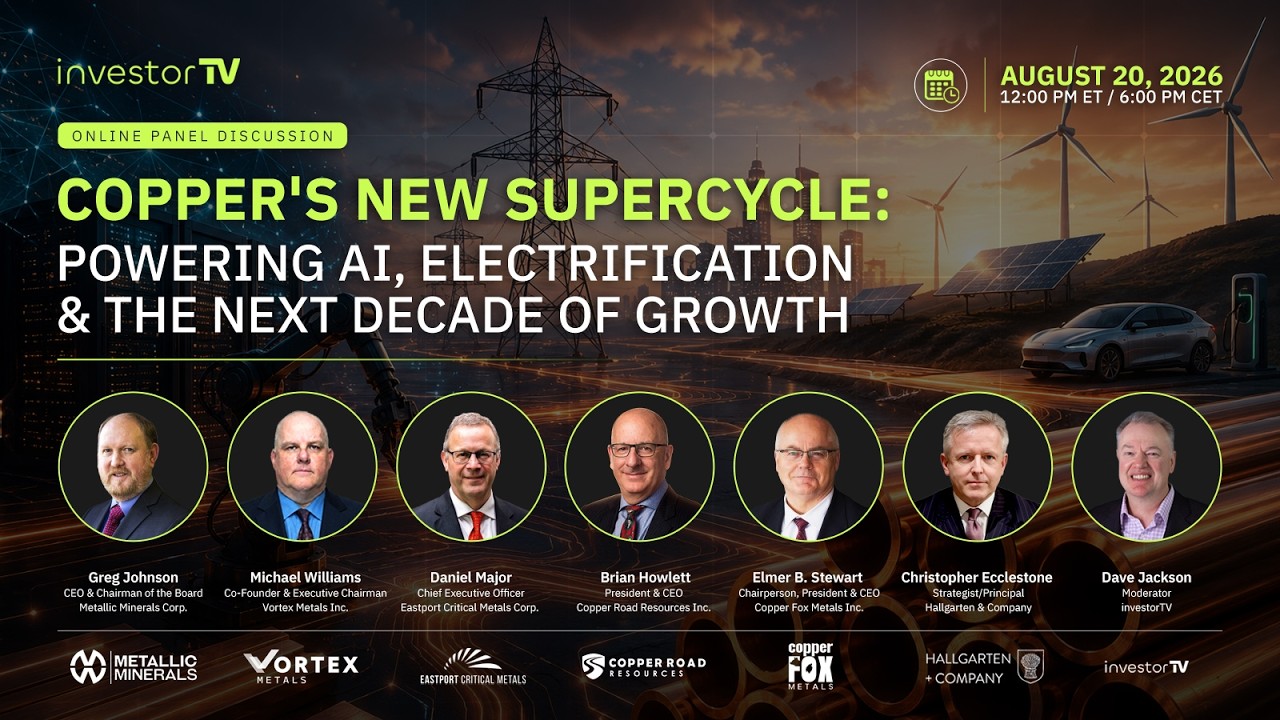
Copper's New Supercycle: Powering AI, Electrification & the Next Decade of Growth | August 20, 2026
- Top takeaway Ecclestone frames the current copper cycle as 'different from the previous ones' — more generalized (African industrialization, India, Latin American infrastructure) and no longer dependent on a single China-driven catalyst, with a 'critical metals' drumbeat behind it.
- He says the supply gap is real and 'the Jeremiahs have been proved right,' but pushes back on the 20-year discovery-to-production narrative — arguing that much of that timeline reflects management market-timing (waiting for higher prices or a major's cheque) rather than permitting.
- He describes a structural shift from the 'age of dinosaurs' (giant Chilean/Atacama-style mines) to a new 'age of mammals/woolly mammoths' — smaller, mid-sized deposits with long lives but no Oyu Tolgoi on the horizon.
- He argues that some advanced copper juniors 'want Rio Tinto to buy them' and are happy to sit on proven assets while blaming permitting, suggesting long lead times reflect valuation strategy more than regulation.
- On underrated copper regions, Ecclestone highlights Argentina as 'the new Chile,' the US (Laramie Province in Arizona and other re-openable belts), and broadly Africa as the location with the most serious underexplored upside.
The copper supply gap needs roughly 20 new mines by 2035, yet each large project takes five-plus years to permit and build. Junior miners trade near one-third of last-cycle highs while producers have doubled, a setup Greg Johnson compares to 2002-2003. Retail investors overweight headline drill intercepts and miss the scale, follow-up drilling, jurisdiction, and management track record. Lower-profile jurisdictions like Botswana, Colorado, and Argentina may trade at unjustified discounts to Ontario and Nevada, panelists argue. This copper cycle is broader-based than 2000-2008, driven by electrification, AI data centers, and urbanization across Africa, Asia, and Latin America.

Hallgarten & Company's Christopher Ecclestone Shares His Thoughts on Inflation
- Top takeaway The guest argues that actual inflation is far higher than official figures show, saying politicians and bureaucracies cannot be trusted when they put the rate at 2.5%.
- He describes inflation as very difficult to kill, and traces it to the pandemic period when money was cranked up and pumped straight into economies.
- He calls the view that that liquidity would not create inflation "inflation 101", presenting it as a predictable policy mistake rather than a surprise.
- He backs the argument with what people see on the ground — supermarket prices, renting apartments and buying houses — and notes the public does not believe the official numbers.

Hallgarten & Company's Christopher Ecclestone on Critical Minerals, Inflation, and Mining Trends
- Top takeaway Argues that China's dual-use metals import bans, pandemic logistics breakdowns, and the war-era failure of US supply reliability have exposed Western vulnerability, and that Europe must now rebuild its own mining and metals capacity instead of relying on long supply lines and cheap imports.
- Contends real inflation runs far above the official 2.5% — households see 5-10% — that pandemic-era money printing created a hard-to-kill problem, and that unchecked US deficits mean the US dollar is due a dramatic downward 'wake-up moment' against better-managed currencies.
- Calls gold and silver 2025 fads that failed both their inflation-hedge and safe-haven tests: as of the interview (July 2026) gold had lost over 20% while many gold equities fell about 40%, and silver had dropped from over $100 to about $50, with retail investors the main casualties.
- Warns that government money is spawning far too many rare earth and lithium companies — the world needs only about five or six rare earth producers — so investors should avoid oversupplied last-trend stories, take profits early, and look for the next trend.
- Tells Scandinavian investors to focus on uranium — Sweden should re-enter uranium mining as Europe faces distant-supply dependence on Kazakhstan and there is not enough uranium for a coming nuclear buildout — and sees the copper space as good even as the energy transition loses shine on fading 2030 EV targets.
Western mining decline since the 1980s left supply chains fragile; pandemic disruptions and China's dual-use metal bans finally forced a reckoning. Specialty metals run in boom-bust fads — rare earths lost 90% of sector capital — so investors must seek the next trend, not the last. The guest argues official inflation understates reality, and uncontrolled US deficits set the dollar up for a dramatic downward move. Gold and silver, 2025's retail fad, failed as hedges and safe havens — gold lost over 20% of its value. For Scandinavian investors, he favors Sweden and Finland as Europe's returning mining countries — uranium and copper included — while avoiding oversupplied fads.
Key Quotes
"With spiking inflation and the Russia-Ukraine war, gold should have performed better this year."
— Kitco interview at Mines and Money London 2022
Key Works
Hallgarten report initiating coverage on Alphamin Resources and the tin supply deficit thesis
Hallgarten portfolio update examining battery metal valuations and energy transition commodity trends
Specializations
Disclaimer: Christopher Ecclestone has NOT endorsed this platform and is not affiliated with Pixys in any way.