Darius Dale
CEO & Founder | 42Macro | Macro Risk Framework Specialist
"Quantitative macro regime analysis and the Growth/Inflation framework for asset allocation"
Biography
Darius Dale is the CEO and Founder of 42Macro, an independent macroeconomic research firm that provides institutional-grade risk management frameworks for investors. His approach centers on systematic, quantitative analysis of macroeconomic regimes, helping investors position portfolios according to the prevailing market environment rather than relying on narrative-driven forecasting.
Dale's methodology, known as the Growth and Inflation framework, categorizes market conditions into distinct regimes that dictate optimal asset allocation strategies. This process-driven approach appeals to investors seeking to remove emotional bias from decision-making, particularly during periods of elevated macro uncertainty. His research covers equities, fixed income, currencies, and commodities through the lens of these macro regime shifts.
While Dale is not a specialist in mining or commodity equities specifically, his macro regime analysis has direct implications for resource investors. Gold, silver, and broader commodity allocations are heavily influenced by the growth and inflation dynamics he models. His framework helps investors understand when macro conditions favor hard assets versus financial assets—a critical input for timing exposure to precious metals and mining stocks.
Dale appears regularly on financial media platforms including Thoughtful Money, where he joins a rotating cast of macro thinkers to debate market outlooks. His willingness to engage with diverse perspectives—from deflationists like Lacy Hunt to contrarians like Ed Dowd—demonstrates an intellectual flexibility that investors find valuable when navigating complex macro environments.
Videos (9)

Luke Gromen & Darius Dale: Which Inning Are We In?
- Top takeaway Outlines a five-stage Treasury paradigm framework — A (fiscal dominance / too many bonds), B (stasis), C (grow/run it hot), D (default via debasement / money printing), E (major political realignment and total war) — placing the current moment in the 3rd-4th inning of C and the 7th-8th inning of a bond-market crisis he expects to trigger D by end of 2027 / sometime in 2028.
- Calculates a 10-year Treasury fair value of 5.77% as the mean of five models — yield curve 5.20%, inflation expectations 5.74%, term premium 5.99%, real yield 6.13%, and nominal-GDP spread 6.27% — arguing Bessent is 'panicking' at current 4.7% levels and that AI hyperscaler debt financing will accelerate the drift toward that fair value.
- Expects a simultaneous equity, gold, and Bitcoin bubble through roughly mid-2027 to mid-2028 as Paradigm D is pulled forward by the bond reckoning, accelerating annual debasement rates to 10-20% for stocks and gold and 45-50% for Bitcoin versus the dollar.
- Argues the Fed should hike rates now to preserve Paradigm C, but ultimately expects it to lose the long end and resort to yield curve control via balance-sheet expansion, dismissing stablecoins as a solution — either they strengthen the dollar and compound the problem, or they fail to attract enough foreign surplus capital to matter.
- Notes that roughly 85-90% of US federal tax receipts come from workers (63% individual income taxes plus 33% payroll), so AI-driven labor displacement will shrink the tax base and likely trigger redistributive policies — including AI capex taxation — coming out of the 2028 election.
Gromen and Dale argue US true interest expense at 105% of receipts already signals a fiscal crisis several innings along. Dale's Paradigm A to E framework tracks fiscal dominance into debasement and political realignment; a bond market crisis could trigger Paradigm D by 2028. Fair value on the 10-year sits around 5.87% per Dale's models, but life insurers cannot rotate from private credit into Treasuries at any yield. Both guests see AI capex driving a productivity boom and major risk-asset gains before a bond reckoning forces yield curve control. Allocations lean into scarce assets: Gromen targets roughly 40 percent gold and gold miners with about 15 percent electrical-infrastructure equities; Dale expects bubbles in equities, gold, and Bitcoin.

The Treasury May Have Just Saved The Market From A 20% Correction
- Top takeaway He warns that the modest monetary-policy tailwind is likely to invert into a meaningful headwind around the October 2026 FOMC meeting if the Fed raises the funds rate and continues balance-sheet tightening.
- He frames the summer-1998 analog — a roughly 19% correction from July through November after a 21% rally into the July peak, followed by a 27% rebound to close up about 20-something percent by year-end — as the most likely downside market dynamic if that policy inversion occurs.
- Darius Dale argues the Fed must 'bend the knee' to the bond market or be forced into it, with Treasury refunding dynamics a critical swing factor over the coming month.
- He believes risk assets remain structurally supported by the spread of policy, the core drivers of the macro economy, and the liquidity cycle, with the uptrend expected to continue.
- He sees Treasury Secretary Bessent's dovish Q3 2026 refunding as a potential off-ramp that lets the market generally trend higher through year-end rather than suffer the seasonally weak September-October swoon.
Treasury's bill-heavy Q3 funding plan reduces long-end yield pressure and could keep the bond market stable even as the Fed tightens. The setup may let Bessent backstop financial conditions while giving Warsh room to lift rates without triggering a 1998-style correction. If the offset holds, the guest expects risk assets to keep trending higher into year-end instead of repeating the summer '98 dip-and-rally pattern.

Fed To Drop Market By 20%? | Darius Dale
- Top takeaway Dale argues the Kevin Warsh Fed must hike at least once and probably twice to restore neutral-rate credibility, or the bond market will force its hand toward the print playbook.
- He frames the structural backdrop as a geopolitical supply-demand imbalance in Treasuries, with hyperscaler CapEx projected at $800 billion in 2026 and $1.2 trillion in 2027 crowding out buyers, alongside weakening foreign demand from Japan, China, and the broader global south.
- Dale warns that without Fed action, term premium reverting toward its pre-GFC mean would push 10-year yields toward 5.7%, and failure to regain inflation credibility could put 30-year yields near 6%.
- He sees a roughly 15-20% summer-of-1998-style correction risk into the September and October FOMC meetings as the Fed plays action pass, but expects the Run It Hot uptrend to resume if the Fed does not kill the business cycle.
- Dale flags that his 42 Macro KISS and Dr. Mo quantitative models have de-risked independent of his fundamental views, an early mechanical confirmation of the storm clouds he sees in the data.
Darius Dale sees a 15-20% 1998-style stock correction as likely, with the Fed tightening this fall to appease the bond market before easing in 2027. He argues the Fed should use balance-sheet tightening over rate hikes, targeting the long end without crashing rate-sensitive sectors of the economy. Hyperscaler borrowing and slowing global savings growth now compete for capital, pushing the market-implied neutral rate higher by 50 to 75 bps. The Paradigm C run-it-hot regime appears to be peaking in 2026, though 42 Macro's macro weather model still signals a net-positive outlook for risk assets. New Harbor partners flag August as the smart window for Roth conversion planning before IRMAA Medicare surcharges hit later in the year.

The Next Market Risk Is Core Inflation
- Top takeaway Argues there is still material risk the Fed tightens monetary policy over the medium term, calling it the next one to two quarters, but says the policy rate is not the appropriate tool and the balance sheet is more likely to be used to target excess demand.
- Says the Fed may tighten now to regain credibility on fighting inflation, which would leave it scope to ease policy later by much more than is currently priced in.
- Assesses that Warsh and his FOMC colleagues made the appropriate choice to hold off on hiking a couple of weeks ago, buying time to separate the energy supply shock that has reversed materially in recent weeks from core inflation dynamics.
- Says the drivers of the nominally hot economy theme he introduced back in April of last year, namely monetary easing, pro-cyclical fiscal stimulus, a nationwide deregulatory push and a tight labor market, are still there and still contributing upside to core and underlying inflation.
- Frames the next trade as where sticky inflation settles: if the rate of disinflation is not acceptable to FOMC policymakers, he expects a totally different inflation conversation two to three months from now, once the energy price disinflation has run its course.

Longtime Bull Warns "High" Risk Of Market Correction Soon | Darius Dale
- Top takeaway The guest argues the risk of a 1998-style market correction is still high over the next one to two quarters as of this July 2026 interview, while stopping short of calling it a certain outcome — he frames it as the probability of a risk-off market regime rising.
- He expects material risk of the Fed tightening monetary policy over the next one to two quarters if disinflation disappoints, and says any tightening would more likely come through shrinking the Fed's holdings than through the policy rate, because he sees the excess demand driving this inflation concentrated at the top of the income distribution.
- He argues the Fed's five task forces will add up to a more dovish outcome than is currently priced, and reads the near-term hawkish tone as a setup — tightening now to regain credibility on inflation so policy can be eased much further later.
- His published model portfolio is roughly 60% global equities, 30% gold and 10% bitcoin, but with the gold and bitcoin signals turned off the allocation has drifted heavily into cash and the Treasury curve; he says the model is up mid-single digits and trailing the S&P 500 as a result.
- Looking further out, he expects a very positive 2027 for financial markets followed by a secular bear market into 2028, which he thinks would be painful but prolonged — somewhere between the six years it took to recover from the financial crisis and the 16 years after the dot-com bubble.
Guest Darius Dale still sees high near-term correction risk while arguing the Fed should tighten via its balance sheet now. Term premium sits far below its long-run mean; reduced Fed communication could push the 10-year Treasury yield well above 5%. Foreign central banks now hold about 13% of Treasuries, down from 40% in 2008, leaving commercial banks to absorb Fed runoff. Gold and Bitcoin trades have paused under Fed tightening risk; debasement-driven buying should return within two to three quarters. His risk system trades regimes fast rather than predicting them, and his highest-probability outlook is a secular bear market in 2028.
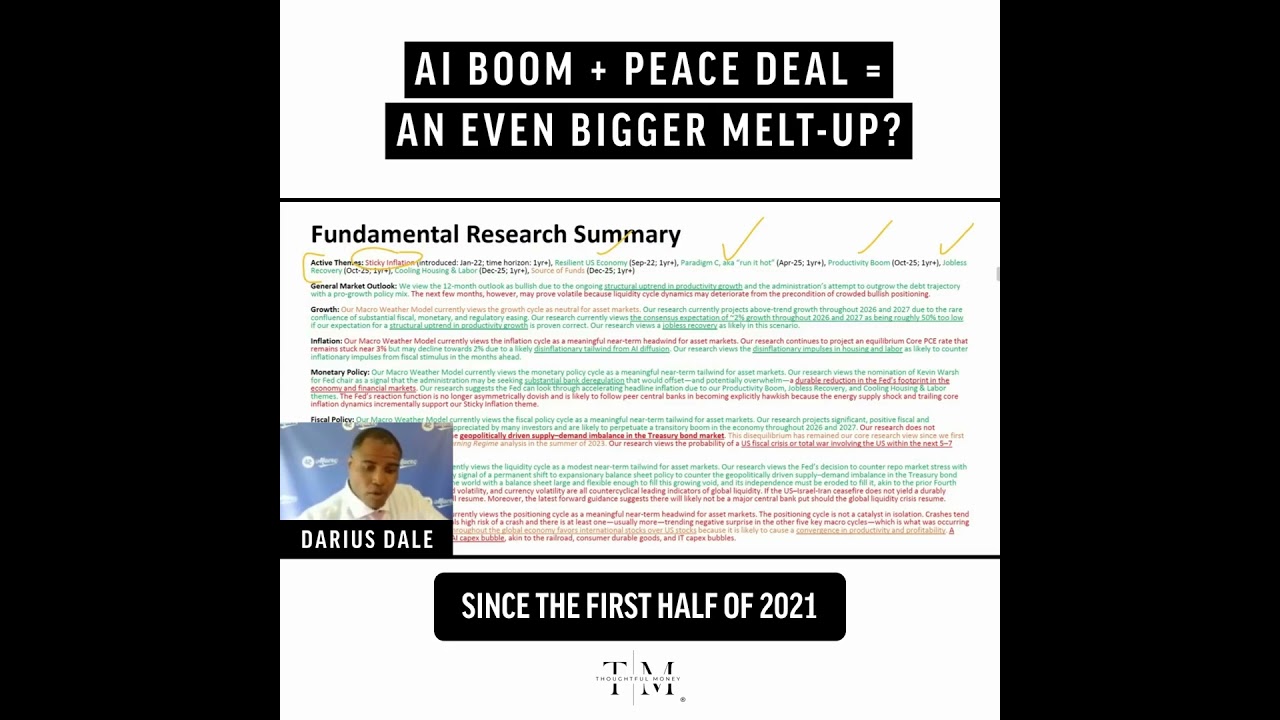
AI Boom + Peace Deal = An Even Bigger Melt Up | Darius Dale
This Trigger Could Send Stocks Bubbling Sharply Higher | Darius Dale
Federal Reserve under Kevin Warsh may look past inflation, potentially sparking a late-1990s style stock market bubble. 42Macro's Global Macro Matrix shows a confirmed Reflation regime with 77% signal strength following an April risk-on pivot. KISS model allocations currently favor stocks, gold, and Bitcoin, while warning of crowded bull risks at current positioning levels.

Here's The Latest Outlook From Lacy Hunt, Ed Dowd, Lyn Alden + A Dozen Other Experts
Highlights from the Spring 2026 Thoughtful Money conference featuring 15+ expert speakers discussing macroeconomic trends and recession risks. Lacy Hunt delivered the keynote address, followed by presentations from Ed Dowd, Luke Gromen, Brent Johnson, and Lyn Alden among others. Jeff Clark provided a bonus video focused specifically on gold and silver mining stocks for resource investors.

"Meaningful Tailwinds" To Push Stocks Higher Over Coming Months? | Darius Dale
Darius Dale's macro model forecasts meaningful tailwinds for risk assets, expecting stocks to push higher over coming months. International equities, cyclicals, and small cap stocks are positioned to outperform based on the current market outlook. The 42Macro KISS model provides specific portfolio allocation recommendations for investors to navigate the anticipated bull market.
Key Quotes
"We are in a regime that is producing meaningful tailwinds for risk assets, and investors should be positioned accordingly until the data tells us otherwise."
— Thoughtful Money interview
Key Works
Macro risk management research platform providing regime-based asset allocation frameworks for self-directed investors
Specializations
Disclaimer: Darius Dale has NOT endorsed this platform and is not affiliated with Pixys in any way.