Frank Trotter
Co-Founder | Battle Bank | Banking and Precious Metals Lending
"Pioneering precious metals-backed lending and online banking innovation"
Biography
Frank Trotter is a banking entrepreneur and co-founder of Battle Bank, a financial institution that serves precious metals holders and crypto-adjacent clients. He is best known in resource investing circles for building a bank that specifically addresses gaps traditional banks ignore — including lending against physical gold and silver. His perspective matters to commodity investors because he operates at the intersection of precious metals ownership, liquidity, and modern banking infrastructure.
Trotter's career in financial innovation spans decades. He co-founded what is widely cited as the first online bank, giving him hands-on experience with how technology reshapes access to capital and financial services. At Battle Bank, he has built products that let precious metals owners access liquidity without selling their holdings — a service few mainstream banks offer. This gives him a practical, market-level view of how gold and silver function as collateral and how metals investors manage their positions.
His approach centers on identifying structural gaps in financial markets. In interviews and public appearances, Trotter has explained that traditional banks rarely accept physical precious metals as collateral in a streamlined way, leaving metals holders with limited options for liquidity. Battle Bank fills that gap. He also closely follows the development of stablecoins (digital tokens pegged to the U.S. dollar) and their potential to reshape how depositors hold and move money — a topic with direct implications for investors who hold gold and silver as hedges against banking-system risk.
Resource investors should pay attention to Trotter's commentary on banking stability, precious metals-backed lending, and the competitive pressures that stablecoins and digital assets place on traditional deposit systems. His insights are particularly relevant for those who hold physical metals and want to understand how evolving financial infrastructure affects the utility, liquidity, and strategic value of their commodity positions.
Videos (2)

The Next Financial Crisis Is Already Building | Frank Trotter - Battle Bank
- Top takeaway Trotter sees the next financial crisis already building, comparing today's private credit lending to the years before 2008 when credit deteriorated for a long time 'until it did,' and warns a private credit and private equity unwind could be 'another 2008.'
- He argues private credit escapes the classified-loan write-off discipline that regulators force on banks, letting lenders keep extending money to weak borrowers, so the share of companies that never recover will decide how bad it gets.
- He views major banks as legally capitalized but 'a little tight,' pointing to commercial real estate exposure and private credit exposure as threads that could unpull the system.
- On AI valuations, he expects the market to go from the Meg 7 to a Meg 10 over the year ahead by adding SpaceX, Anthropic and OpenAI, with one of the three likely to fail at least in valuation terms.
- He announces that Battle Bank opened fully to the public on the day of the interview, welcoming US and Canadian customers to an online digital bank with checking, multi-currency accounts and precious metals buying, storage and lending.
Private credit mirrors the years before 2008: weak loans get extended instead of written off, so losses build unseen, Trotter warns. Banks meet legal capital minimums but stay thinly capitalized; commercial real estate and private credit are the threads that could unpull the system. US stablecoin rules ban interest and ignore precious metals, which the guest says will block mainstream adoption until yield arrives. Adding SpaceX, Anthropic, and OpenAI to the mega-cap roster means one AI valuation likely resets, hitting consumer wealth. Battle Bank opened to the public, offering self-directed investors multi-currency accounts plus gold, silver, platinum, and palladium with storage and credit.
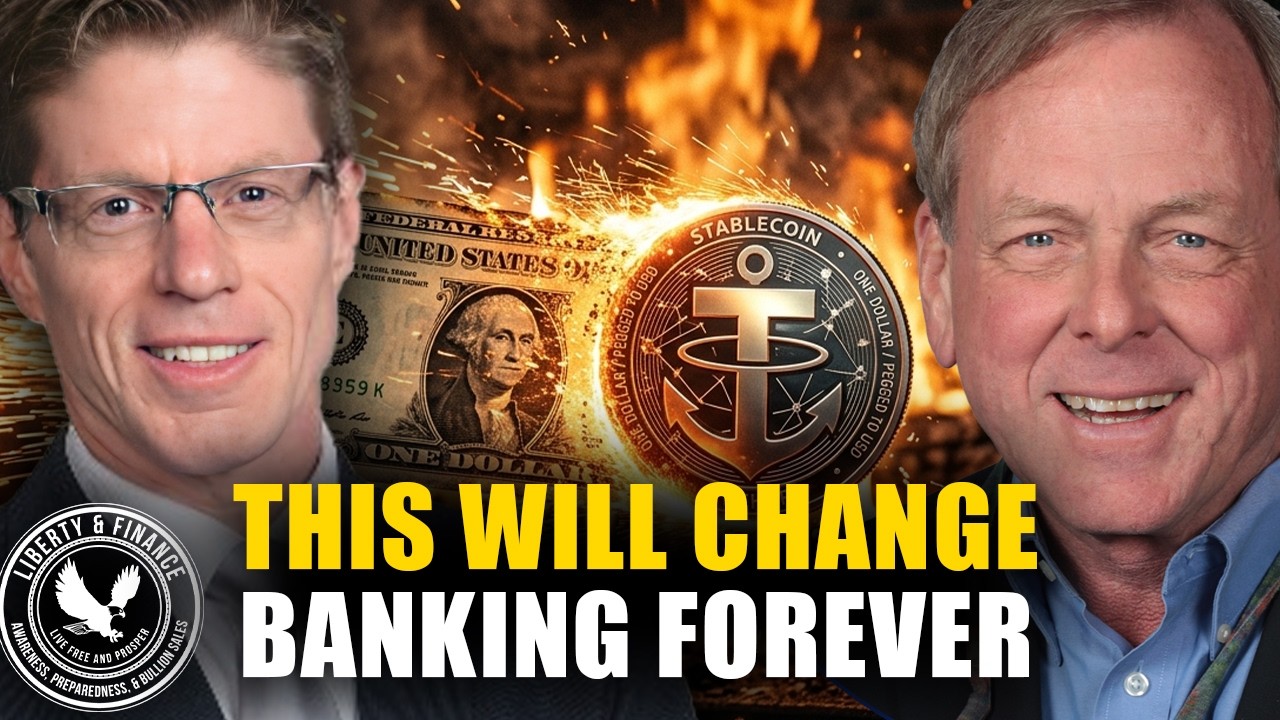
The Next Banking Crisis? What Stablecoins Mean For Your Money | Frank Trotter
- Top takeaway Trotter warns that big banks operate with only about 4-6% capital against multi-trillion-dollar balance sheets, amid vacant commercial real estate — where a $5 million building can be worth zero with no buyers — and large derivative books, saying he is 'not terrified yet' but expects stormy seas if the bubble pops.
- He argues stablecoins are the next step in payment evolution — instant, irrevocable, available around the clock, and free of Fed, card-network, and bank fees — with a bright future but broad adoption five to ten years out, 'not for everybody' on day one.
- He faults the Genius Act for barring banks from paying interest on stablecoins, suspecting big banks lobbied for the ban so issuers can earn roughly 3.6-4.5% on Treasury and deposit reserves at zero cost, and wants a competitive market that pays consumers.
- He calls financing the U.S. deficit an explicit Treasury motive behind the Genius Act, since issuers must hold Treasuries or bank deposits, but says stablecoin demand cannot cover a roughly $2 trillion annual deficit or fill the gap left by China and Japan.
- He wants to issue tokenized stablecoins 100% backed by stored gold, silver, platinum, or palladium — currently not allowed under the Genius Act — and notes Tether's owners buy precious metals and mining companies as personal investments.
Large banks run on 4-6% capital against multi-trillion balance sheets; the guest warns thin cushions and commercial real estate losses could bite in a downturn. The Genius Act (the US law letting banks issue stablecoins) forces issuers to hold Treasuries, an explicit federal push to finance deficits, the guest says. Savers should verify FDIC insurance (the federal deposit backstop) limits and study bank financials rather than chase high rates at unfamiliar banks. Tether's owners are buying precious metals and mining companies, and the guest wants digital coins fully backed by stored metals. The guest expects stablecoins to become one more everyday payment option alongside cards and PayPal, with mainstream adoption five to ten years out.
Key Quotes
"What we do is sort of look for places where there's a hole in the market. One of those holes is borrowing against your precious metals."
— Orion's The Weighing Machine podcast
Key Works
Interview covering stablecoins, banking-system risk, and implications for precious metals holders
Disclaimer: Frank Trotter has NOT endorsed this platform and is not affiliated with Pixys in any way.