James Rickards
Economist & Author | Former LTCM Counsel | Monetary Policy Commentator
"Macro-driven gold price forecasting and analysis of systemic financial risk"
Biography
James Rickards is an economist, attorney, and author who advises resource investors on how monetary policy and systemic financial risk affect gold and other hard assets. He is best known for his long-standing forecast that gold will reach $10,000 per ounce — a call rooted not in resource supply trends but in his analysis of the international monetary system.
Rickards began his career as a lawyer before serving as legal counsel during the 1998 collapse of Long-Term Capital Management (LTCM), a hedge fund whose failure nearly triggered a systemic financial crisis. That experience shaped his conviction that the global financial system remains structurally fragile and that gold serves as essential protection against monetary instability. He detailed this framework in several books, including Currency Wars (2011), The Death of Money (2014), and The New Case for Gold (2016).
His approach to gold investing is macroeconomic rather than mine-focused. Rickards builds his price targets from monetary base expansion, central bank gold reserves, and the historical mechanics of currency resets. He has argued that gold's most dramatic price moves often come in the final phase of a bull market, when monetary stress accelerates. For mining investors, his work offers a framework for understanding the macro tailwinds that can drive demand for gold equities — even though he rarely discusses individual mining companies or project-level economics.
Investors should understand the limits of his analysis. Rickards does not evaluate mining assets, assess management teams, or compare individual gold producers. His $10,000 gold target has been repeated across multiple years without precise timing, and some of his broader crisis predictions have not yet materialized on the timelines suggested. That said, his arguments connecting central bank behavior, geopolitical conflict, and gold demand remain a useful macro overlay for investors who want to understand why institutional capital flows into precious metals — and when those flows might intensify.
Videos (2)
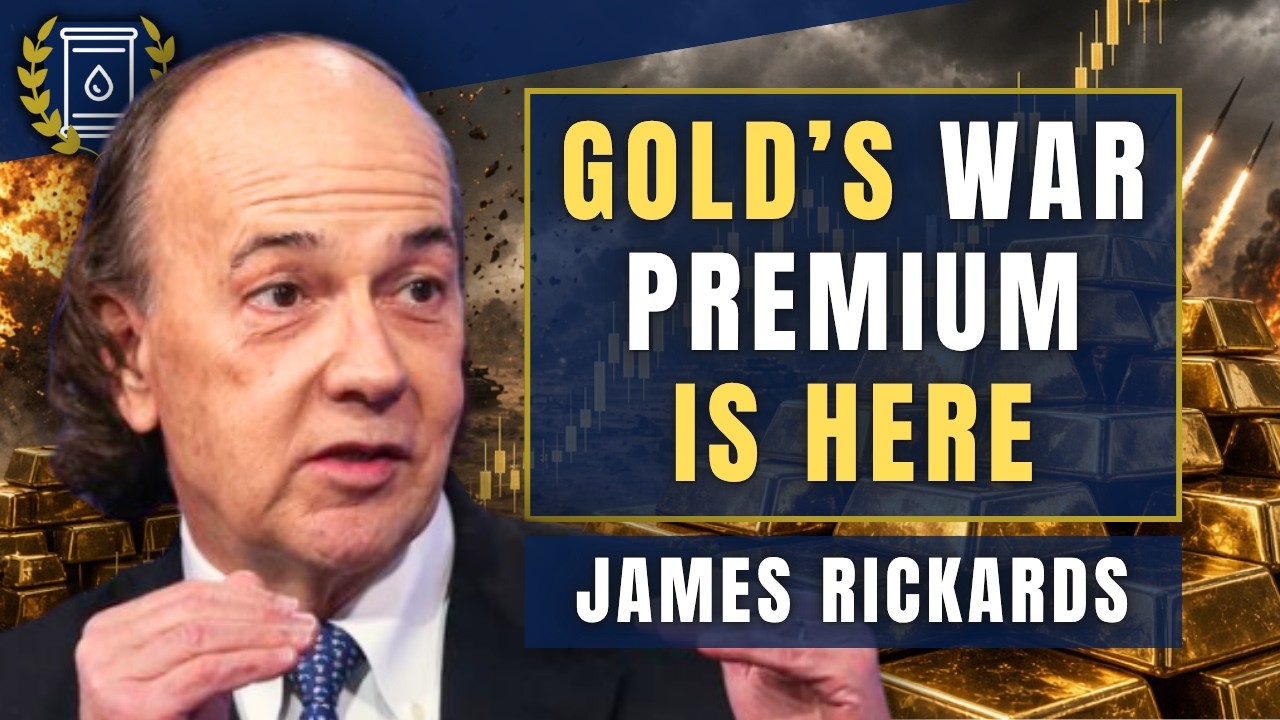
Middle East War Escalation to Drive GOLD Prices 'Significantly Higher': James Rickards
- Top takeaway Rickards argues gold is set to move significantly higher from around $4,300, calling the pullback from ~$4,500 normal volatility and pointing to the $3,900 level holding as a firm base, with central bank buying still intact and Iran-driven geopolitical risk as the key driver.
- The guest argues the true oil price is roughly $150 a barrel, not the ~$105 Brent futures print, citing crack spreads near $60 and wet-cargo spot prices around $140 driven by Iran's hold on the Strait of Hormuz and Houthi control of the Red Sea / Bab el-Mandeb.
- Rickards is bullish on silver, citing both precious-metal tailwinds and structural industrial demand from AI-driven data-center buildouts by Microsoft, Amazon, Meta, Nvidia and others, since silver is used in electronics, circuits and semiconductor production.
- He pushes back against the 'end of the dollar' narrative, arguing rising Treasury yields reflect a global dollar shortage (Japan and China selling Treasuries to defend their own currencies) rather than a flight from USD, and dismissing BRICS payment rails as a substitute for U.S. Treasury markets.
- Rickards walks through the Fed's gold certificate — about 8,100 metric tons at the legacy $42.22/oz valuation — arguing the U.S. legally cannot sell gold below this level and that revaluing to roughly $4,300 could create about $1 trillion in Treasury cash without issuing new debt.
Rickards argues the Middle East conflict, central-bank buying, and dollar weakness will drive gold significantly higher from around $4,300. The guest says silver has both monetary and industrial tailwinds and typically catches up to gold after it starts moving. Rickards says rising US Treasury yields reflect a foreign dollar shortage, not a flight from the dollar, since central banks sell Treasuries to obtain dollars. He calls the dollar's reserve status durable and BRICS-replacement talk hype because no rival bond market has the depth or rule of law to compete. Rickards notes the US could mark the Fed's gold certificate to roughly $4,300/oz and unlock about $1 trillion in Treasury cash without new debt.

$10,000 GOLD By Year-End 'Intact' as Crisis 'Worse Than 2008' Incoming: James Rickards
- Top takeaway The guest calls the recent gold correction a good entry point and says his intermediate target of $10,000 an ounce, late this year or early next, is still intact after gold fell from a January high near $5,355 to around $4,000.
- He attributes the drawdown to a dollar shortage rather than inflation or central-bank allocation: countries including Turkey, Russia and, to some extent, China sold gold to raise dollars to buy oil after the Persian Gulf blockade, and stop-loss and trend-following selling then extended the decline.
- Applying Jim Rogers' rule that nothing in commodities rises without a 50% drawdown, together with fractal scale invariance, he calculates roughly $3,600 from the $5,355 peak and says gold reaching that level would not surprise him.
- He argues central banks are buying gold mainly as a geopolitical hedge, because physical bullion in a country's own vaults cannot be frozen or seized by the US the way Western holdings of Russian reserves were, and says the US has moved from freezing assets to trying to seize them.
- He expects a financial crisis greater than 2008 and one becoming bigger than the Fed, and would hold 10% gold, 30% cash and Treasury notes as rates fall toward 1-2%, while avoiding AI, hyperscalers and software in favour of energy, defense, healthcare and mining.
Gold's drawdown looks like a dollar-liquidity squeeze rather than a fundamental break: central bank buying, flat mine supply and inflation concerns all held. The guest argues gold passed Treasuries as a share of global reserves because the price roughly tripled, not because central banks bought dramatically more. A 50% drawdown rule borrowed from Jim Rogers and extended with fractal scale invariance frames the correction as normal commodity cycle behavior. He reads escalating backstops, Treasuries guaranteed at par and deposits insured without limit, as signal that a crisis bigger than the Fed is near. His defensive allocation: 10% gold, 30% cash for optionality, income-producing real estate and short-dated notes, avoiding AI and software names.
Key Quotes
"$10,000 is still a realistic estimate."
— Miles Franklin interview on gold's year-end price target
"We probably have an acute global financial crisis coming anyway."
— USAWatchdog interview with Greg Hunter
Key Works
Book analyzing how competitive currency devaluation impacts gold and the international monetary system
Book on systemic financial risk and gold's role as a hedge against monetary collapse
Book outlining the argument for gold as monetary insurance, aimed at both individual and institutional investors
Specializations
Disclaimer: James Rickards has NOT endorsed this platform and is not affiliated with Pixys in any way.