Jeff Currie
Chief Strategy Officer, Carlyle Energy Pathways | Former Global Head of Commodities Research, Goldman Sachs | Macro Commodities Strategist
"Identifying the post-2020 commodities supercycle driven by chronic supply underinvestment"
Biography
Jeff Currie is one of the most influential commodity market strategists of the past two decades. He spent 27 years at Goldman Sachs, ultimately serving as Global Head of Commodities Research, where his reports on energy, metals, and agriculture shaped how institutional investors positioned billions of dollars. He now serves as Chief Strategy Officer at Carlyle Energy Pathways and has co-founded an oil and gas company, putting his market analysis directly into practice.
Currie's career is defined by two major calls that moved markets. In the 2010s, he correctly argued that oil prices would stay "lower for longer" as U.S. shale flooded supply and kept prices depressed. Then in late 2020, he made one of the earliest and most prominent calls for a new commodities "supercycle" — a multi-year period of rising prices driven by chronic underinvestment in supply. That thesis, rooted in the idea that years of capital starvation in oil, metals, and mining had created structural deficits, became the dominant framework institutional investors used to think about resources.
His approach is decidedly macroeconomic. Currie tracks the interplay between physical supply constraints — inventories, spare capacity, and the cost of bringing new production online — and financial conditions like interest rates, inflation, and the U.S. dollar. He focuses heavily on oil, where he currently warns that global inventories are approaching minimum operating levels, but he also covers gold, copper, and broader commodity indices. For mining investors, his value lies in connecting the dots between Federal Reserve policy, energy markets, and the metals that underpin the global economy.
Today, Currie argues that the commodity supercycle remains in its early innings despite near-term volatility from geopolitical conflicts and central bank decisions. His warning that Asian oil markets are hitting "tank bottoms" (minimum storage levels at which operations can still function) illustrates the physical tightness he sees across commodity markets. Investors should follow Currie not just for his specific price targets, but for his framework on how capital flows, underinvestment, and structural deficits drive the resource sector.
Videos (2)
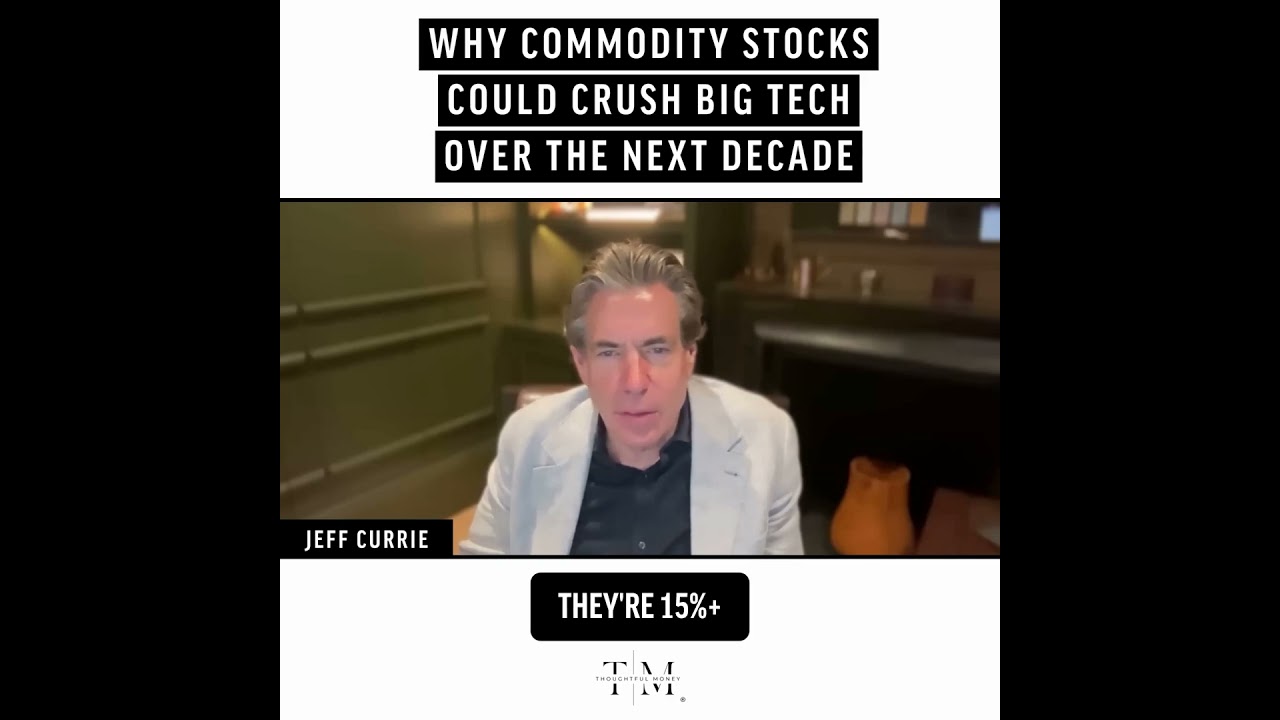
Why Commodity Stocks Could Crush Big Tech Over The Next Decade
- Top takeaway Argues (June 2026) that commodity investment has been insufficient for nearly a decade: global energy CapEx is running around $400 billion a year versus the roughly $750 billion needed, while inventories and underground reserves are being depleted and prices are not high enough to fix it.
- Calls for rotating trillions of dollars of capital from the new economy into the underinvested old economy — his "Revenge of the Old Economy" thesis — spanning oil and gas ("molecules") and metals ("atoms") that feed growing demand for electrons.
- Sees a 2014 mirror image in reverse: shale producers then reinvested 120% of earnings just before oil collapsed from $110-120 to $33, and he believes Big Tech's surging capex is approaching the same overinvestment signal.
- Contends free cash flow yields — even at Google — are likely to go negative while energy companies yield 15-plus percent, so rising returns on capital should favor oil producers over tech, a view he says would get him booed off stage today.
- Recalls that the early-2000s rotation into commodities was forced by the dot-com collapse rather than fresh enthusiasm for oil, and expects the same exit dynamic: once investors realize it is time to leave tech, they will run — the question is who gets to the door.
Energy capex (capital spending) of roughly $400 billion a year falls well short of the $750 billion needed, the guest argues. A decade of underinvestment has drained oil inventories and reserves, leaving energy and metals supply unable to respond as demand grows. Energy producers earn free cash flow (cash left after spending) yields above 15 percent while Big Tech's AI outlays may push even Google's negative. Tech's AI spending echoes shale producers who reinvested over 100 percent of earnings before that cycle collapsed, the guest warns. Commodity rotations historically started only after a tech bust forced capital out, so the guest expects a sudden rush rather than a gradual shift.

The Oil Bull Market Is Just Getting Started – Jeff Currie
- Top takeaway Currie argues inventories are critically tight — the US SPR is at a 43-year low, commercial inventories are below the five-year band, and draws of 5-6 million barrels per day point to 'day zero' around mid-July during peak demand.
- He doubts the peace deal's sustainability, saying insurers, ship operators, and crews may not return to the Gulf and that shut-in wells across Iran, Kuwait, and Iraq could take months to a year to restart, with possible permanent damage of up to 20% of capacity.
- He sees chronic underinvestment — sector capex around $400 billion a year versus the roughly $750 billion needed — as the core bull case, calling it the 'Revenge of the Old Economy' and urging a rotation of trillions from tech into molecules and atoms.
- As of mid-June 2026 he calls current prices a strong buying opportunity: oil near $80 is below his roughly $85 fair-value floor, company shares have erased all their war gains, and he recommends owning the sector beta for dividends and cash flow rather than chasing alpha.
- He flags copper as 'the new oil,' the strategically most important commodity for electrification, noting it held around $13,600 after spiking to an all-time high near $14,000 earlier in the year.
Jeff Currie argues the US-Iran peace deal is unsustainable, and oil inventories remain on track to hit critical lows (day zero) around mid-July. Shut-in Gulf wells may take months to restart, with falling reservoir pressure risking permanent loss of up to 20% of pre-war production capacity. Chronic underinvestment since 2014 leaves sector capex near $400 billion a year, far below the roughly $750 billion needed to sustain and grow supply. Currie prefers oil equities over crude itself: producer shares have erased all war gains while fundamentals are now worse than before the conflict. He calls copper the new oil for electrification and urges substantial investor exposure to molecules and atoms alongside their dividends.
Key Quotes
"The commodity supercycle is still in its early innings."
— Kitco News interview, May 2026
"Oil markets are nearing minimum operating levels in Asia, with Europe likely next and the U.S. potentially facing shortages by July."
— CNBC interview, May 2026
Key Works
Detailed interview laying out the bull case for oil based on structural supply deficits and underinvestment
Macro Voices podcast appearance discussing capital rotation into commodities and the supercycle thesis
Disclaimer: Jeff Currie has NOT endorsed this platform and is not affiliated with Pixys in any way.