Leigh Curyer
CEO & Founder | NexGen Energy | Uranium Mining Pioneer
"Leading development of the Arrow uranium deposit, one of the highest-grade uranium discoveries in decades, and championing uranium's role in the global energy transition."
Biography
Leigh Curyer is the Founder, President, and Chief Executive Officer of NexGen Energy Ltd., one of the most significant uranium development companies in the world. Under his leadership, NexGen has advanced its flagship Rook 1 project in Saskatchewan's Athabasca Basin, home to the Arrow deposit—one of the largest and highest-grade uranium deposits ever discovered. Curyer has positioned NexGen at the center of the global nuclear renaissance, advocating for the critical role uranium will play in meeting rising energy demand and decarbonization goals.
Curyer's vision for NexGen is anchored in the belief that a severe uranium supply gap is emerging. Years of underinvestment in new uranium production, combined with accelerating demand from nuclear power reactors worldwide, have created what he describes as an increasingly obvious structural deficit. He has publicly stated that the permitting and development of new uranium mines has not kept pace with growing consumption, and that prices must rise significantly to incentivize the production required to fuel the global nuclear fleet. NexGen's Arrow deposit, once in production, is expected to supply approximately 25–30% of the world's mined uranium, making it a potential kingmaker in the global uranium market.
A distinguishing feature of Curyer's approach has been NexGen's disciplined, multi-year permitting process. He has emphasized that the company's seven-year permitting timeline has left the Rook 1 project unusually well prepared for construction, a critical advantage in an industry where regulatory delays can derail projects. This methodical strategy extends to NexGen's contracting approach, which is designed to capture value while maintaining flexibility in a rising uranium price environment.
Prior to founding NexGen, Curyer built extensive experience in the resources sector, with a particular focus on uranium and energy commodities. His deep understanding of the nuclear fuel cycle, from exploration through production and offtake agreements, has made him a sought-after voice in the uranium investment community. He regularly appears on financial media outlets including BNN Bloomberg and industry podcasts to discuss uranium market dynamics and NexGen's progress.
For mining investors, Curyer represents one of the most important figures in the uranium sector. His company controls what may be the most consequential undeveloped uranium asset on the planet, and his commentary on uranium supply-demand fundamentals is closely watched by institutional and retail investors alike. As nuclear energy experiences a global resurgence driven by energy security concerns and decarbonization mandates, Curyer's insights on uranium pricing, project development, and contracting strategy carry significant weight in the resource investment community.
Videos (4)
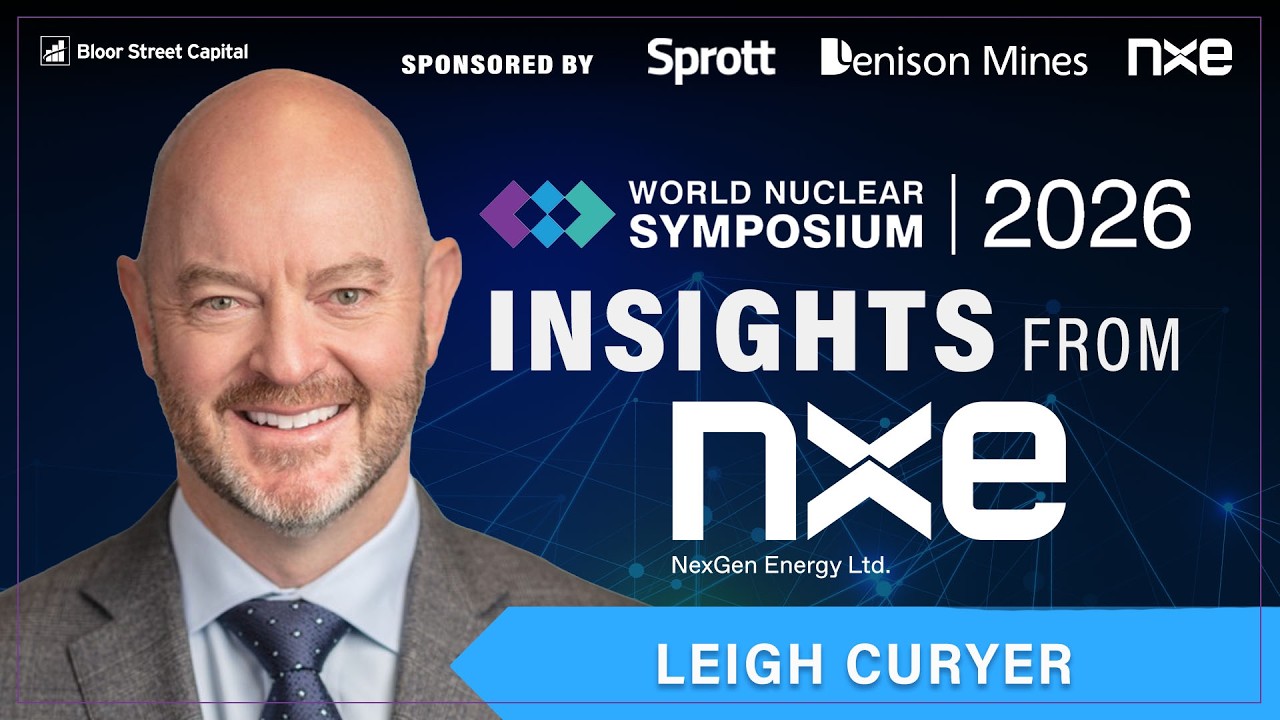
NexGen Energy Update: World Nuclear Symposium 2026 Insights
- Top takeaway Frames uranium as a supply-side story, claiming a new floor around $85 per pound driven by scarcity of mine supply and rising sovereign-risk concerns, with upward price pressure clearly evident as of September 2026
- Argues NexGen is positioned to be a top-10 global mining company by after-tax cash flow at the current spot uranium price once in production, alongside elite environmental and social performance
- States NexGen is the world's most levered company to the future price of uranium, and that its contracting strategy is designed to maintain that status
- Argues inflation's impact on operations is immaterial because of the project's strong economics, while emphasizing strict cost discipline across the organization
- Expects steady news flow through year-end 2026 from construction progress, drilling at PCE, ongoing contracting negotiations, and potential increased utility buying in the spot market during the northern-hemisphere winter
NexGen's Arrow Mine started construction August 13 after final federal permit; first production is targeted in roughly four years. About $1B in treasury covers operations into late 2027, with the $2.2B Canadian capex balance to be funded by mid-2027. PCE exploration now runs five rigs, building out a second deposit alongside the Rook I development. Contracting has signed more than 11.3 million pounds so far in 2026, with additional offtake talks in progress. Investor takeaway from the World Nuclear Symposium: tight uranium supply and Canadian sovereign-risk appeal are drawing fresh global interest.

The Uranium Supply Gap Is Getting Harder to Ignore | Leigh Curyer
NexGen Energy received final federal approval for its Rook I uranium project, transitioning the company from a multi-year permitting phase into a 48-month construction execution phase. CEO Leigh Curyer highlights a growing global uranium supply deficit, noting strong offtake interest from utilities across the US, Europe, and Asia for future production. The emerging PCE discovery near the main Rook I project offers significant long-term resource expansion upside and enhances the company's overall asset value.

NexGen Energy Update | Leigh Curyer and Jimmy Connor
- Top takeaway Curyer argues uranium prices will move 'significantly past $100 USD per pound' because major producer all-in costs (including sustaining capex) are already approaching $70 USD/lb, and only one of the mid-2000s top five uranium mines remains in production today.
- He argues NexGen will rank 'in the top 10 mining companies worldwide on an after-tax cash flow basis' at current uranium prices, since Arrow mines only about 1,300 tons of ore per day thanks to very high ore grade.
- He commits publicly to an offtake strategy that keeps NexGen fully exposed to the uranium spot price at delivery rather than locking in fixed prices with utilities.
- He frames the uranium supply side as 'very fragile,' citing recent Kazakhstan-China and Cameco-India utility deals and the absence of new projects outside NexGen and Denison, and says contracting urgency among utilities is 'elevating'.
- He presents the seven-year permitting timeline as a strategic advantage, saying it allowed NexGen to plan construction in detail, attract strong labour interest (over 400 applicants for recent roles), and align with local communities ahead of the build.
NexGen is fully permitted and has begun construction at Rook I in Saskatchewan, targeting first production in 2030 after a roughly 48-month build. Rook I economics look sharp: $1.5B US capex, $800M already funded, sub-12-month payback at spot, and up to 30M lbs/year (~20% of global supply). NexGen's Patterson Corridor East (PCE) discovery 3.5 km from Arrow has four rigs active and could 'completely change the economics' as Phase 2. Management expects uranium prices to push well past $100/lb as major-producer incentive prices approach $70/lb and supply stays tight. Saskatchewan provincial bodies are co-running training programs in local communities and Saskatoon, drawing 400+ applicants for 16-20 recent roles.

Virtual Nuclear Energy & Uranium Conference | Learn the Benefits of Nuclear Energy
- Top takeaway Curyer reports Arrow received final federal approval about two weeks before the conference, construction is underway, and the 48-month build targets first production in 2030.
- He argues NexGen offers the greatest exposure of any company to a rising uranium price: Arrow is permitted for up to 30 million pounds a year — about 20% of global mine supply — with capex paid back in under 12 months at the current spot price.
- He contends the major producers' all-in incentive cost is approaching $70 a pound, so the uranium price must move significantly past $100 and go substantially higher unless new supply arrives.
- He says utility urgency is elevating as large state deals (Kazakhstan-to-China for around 20 million pounds, plus Cameco-India) remove pounds from the market, while the supply side beyond NexGen and Denison is fragile.
- His strategy is maximum exposure to the future price: no fixed-price offtake lock-ins, over half a dozen contracts in advanced negotiation, and a non-dilutive prepayment (under 2% of Arrow's resource at the $109 five-year price) to close the roughly $800 million funding gap.
Uranium's term price (the long-term reference price) holds near $90 per pound, its highest level since 2008, anchoring a firm spot market. Producers are holding output flat while utilities and state buyers like India return, signaling intensifying competition for future pounds. Denison Mines has started construction at Phoenix, the first new Canadian uranium mine approved in over 20 years, targeting production by mid-2028. NexGen says fully permitted Arrow will produce up to 30 million pounds annually — about 20% of world mine supply — with construction underway. Contract terms are shifting toward sellers: ceilings near $150 per pound, some deals with no cap at all, ending the $30 fixed-price era.
Key Quotes
"The supply gap in uranium is only becoming more obvious. Years of underinvestment have resulted in a steep run-up that we predict will continue in the sector."
— BNN Bloomberg Interview
"The seven-year permitting process left the project unusually well prepared for construction."
— The Deep Dive Interview
"NexGen's Rook 1 project will potentially supply 25–30% of the world's mined uranium supply."
— World Nuclear News Podcast
Key Works
In-depth interview covering uranium supply-demand fundamentals, NexGen's permitting progress, and contract strategy for the Rook 1 project.
World Nuclear News podcast discussing the Rook 1 project's potential to supply a significant portion of global uranium demand and the broader market outlook.
Detailed discussion on NexGen's exploration success, the growing need for uranium fuel, and the tightness in the current uranium supply chain.
Specializations
Disclaimer: Leigh Curyer has NOT endorsed this platform and is not affiliated with Pixys in any way.