Peter Tchir
Head of Macro Strategy | Academy Securities | ProSec Investment Thesis Creator
"Creating the ProSec (Production for Security) macro investment framework linking geopolitical risk to commodity and mining opportunities"
Biography
Peter Tchir is the Head of Macro Strategy at Academy Securities, where he has developed one of the most compelling macro frameworks for resource and commodity investors in the current geopolitical era. His "ProSec" (Production for Security) thesis argues that the world is transitioning into a pre-war footing, where nations are prioritizing domestic production of critical materials, energy, and technology over cost-optimized global supply chains. For mining and commodity investors, this framework identifies a multi-year secular tailwind for rare earth minerals, base metals, energy resources, and the junior miners positioned to supply them.
Tchir's ProSec trade encompasses sectors vital to national security, including rare earth minerals, semiconductors, energy, defense materials, and biotech. He has argued that increased military spending in the US and Europe, combined with reshoring imperatives driven by tensions with China and supply-chain disruptions, creates immense opportunities in commodity-producing companies. His analysis of shifting US procurement spending patterns suggests that government contracts and subsidies will continue flowing toward domestic mineral production and processing capacity.
A frequent contributor to TheStreet Pro and a regular commentator on financial media, Tchir brings a macro strategist's perspective to commodity markets rather than a pure resource-sector lens. This gives his analysis unique value—he connects geopolitical shifts, fiscal policy, and defense spending directly to the investment case for metals and mining companies. His work has been featured on Bloomberg, Forbes, ZeroHedge, and in extensive interviews with Adam Taggart's Thoughtful Money platform.
For mining stock investors, Tchir's relevance lies in his ability to articulate why the current geopolitical environment is structurally bullish for certain commodities. He has specifically highlighted the risk of underestimating China's resolve in competing for resource dominance, suggesting that Western nations will be forced to invest heavily in alternative supply chains for critical minerals. His framework provides a top-down macro justification for bottom-up investments in rare earth explorers, uranium miners, base metal producers, and energy material companies.
Videos (4)
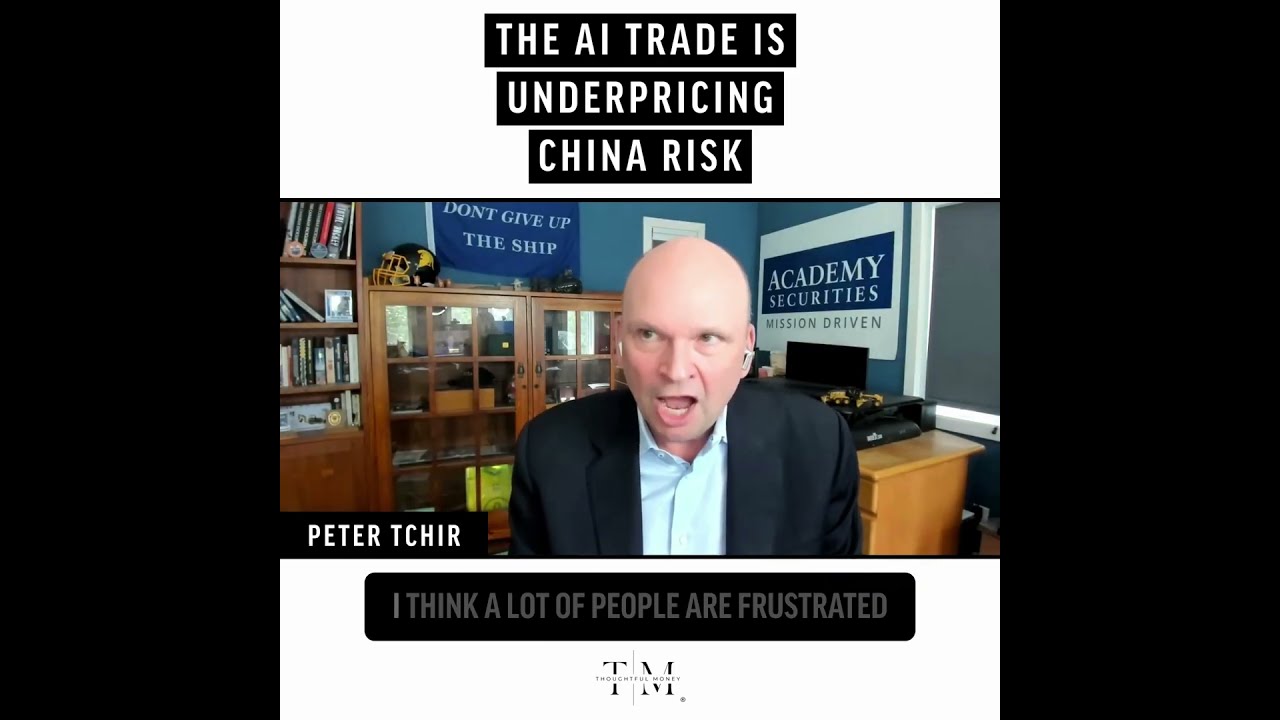
The AI Trade Is Underpricing China Risk
- Top takeaway Argues the AI trade is underpricing China risk, drawing a parallel to 2005 when cheap imports entered through the back door and hollowed out US industry.
- Says the promised AI productivity 'holy grail' has not panned out — compute costs are climbing because of data center and chip bottlenecks, and companies still need staff to fact-check AI output.
- Warns LLMs may converge to similar capability levels and that distillation/IP theft is undermining the US AI moat.
- Highlights structural US bottlenecks — electricity constraints and NIMBY-style rules — as advantages China does not share, and notes that China could mobilize a much larger engineering workforce if given marching-orders direction.
- Wants to underweight the AI sector while overweighting other areas, citing how dependent current US equity valuations are on AI-related capex delivering returns.
The AI trade may be underpricing China's ability to deliver capable models at a fraction of Western compute costs. Western AI capex is hitting compute, chip, and power bottlenecks that Chinese rivals don't face in the same way. If LLMs converge to similar capabilities, AI competition will pivot from raw intelligence to price. Companies adopting cheaper foreign AI must weigh who gains long-term access to proprietary corporate data. A huge share of US market cap rests on AI capex earning attractive returns, making sector disappointment systemic.

The Market Is Mispricing The Inevitable | Peter Tchir
- Top takeaway Tchir pitches his 'ProSec' (production for security) thesis: de-globalization is inevitable, large asset managers remain in denial, and the US government is finally using its procurement power — DOD data centers, 100% drone tariffs, seven-year defense contracts and the MP Materials price floor — to underwrite domestic capacity
- He argues the Fed under Kevin Warsh will not hike because today's inflation is driven by the Iran war and AI/data-center capex rather than loose policy, and he expects Warsh to broaden data inputs beyond official BLS metrics toward PCE, Trueflation and real-time rent signals
- He prefers long-dated US hyperscaler corporate debt (Google, Amazon, Microsoft) over Treasuries, arguing these firms now function like high-quality sovereigns and offer excess spread in the 6% area on long-dated paper — the LQD-over-TLT trade he is 'incredibly comfortable' with
- He sees the biggest winners of de-globalization as commodities processors and refiners rather than raw extractors, noting the US has not built a brand-new refinery in roughly 40 years and that China controls about 90% of rare-earth processing despite only about 60% of extraction
- He warns that cheap Chinese AI compute via model distillation is a real threat to US AI valuations and could trigger a broader market reckoning given AI's outsized share of market cap and capex — he wants to be underweight semiconductor-leveraged ETFs like SOXL and overweight energy and high-quality corporate credit
ProSec (production for security) assets look mispriced — most asset managers still haven't accepted the end of globalization, and governments are using their wallets more directly to support domestic production. Tchir expects Kevin Warsh's Fed to look past BLS data and skip hikes; today's inflation sources (Iran war, AI data-center buildout) won't respond to rates. 10-year US yields look range-bound at 4.5–5%; Middle East buyers are fading, and high-grade corporates like LQD compete with Treasuries for safe-haven capital. Processing and refining drive commodity returns in the ProSec era — Australia just announced its first new refinery in 60 years; the US hasn't built one in 40. Cheap Chinese compute from distilled LLMs threatens OpenAI and Anthropic's economics, putting the over-extended AI capex trade at risk.

Geopolitical Risk = Massive Opportunity: The ProSec Trade Explained | Peter Tchir
Peter Tchir discusses the ProSec trade, focusing on production for security sectors essential to reshoring and national defense. Geopolitical risks from COVID and conflicts in Ukraine and Iran have highlighted the critical need for supply chain resilience. The analysis evaluates the practical performance of the ProSec trade against its theoretical promise in current market conditions.

Is 'National Security' The New Investing Priority? | Peter Tchir
Peter Tchir advocates for the ProSec trade, focusing on sectors essential to national security like defense, energy, and minerals as globalization ends. Massive increases in military spending by the US and Europe create strong tailwinds for companies in defense, electricity generation, and critical minerals. South America and Mexico are highlighted as top investment destinations, while Europe is described as struggling with structural economic challenges.
Key Quotes
"The biggest opportunity is ProSec, this production for security, and the biggest threat is underestimating China's resolve and willingness to continue to compete with us."
— SIFMA Panel Discussion
"ProSec – Investing in a Pre-War World. Reshoring critical industries and building resilient supply chains has become essential amid rising geopolitical tensions."
— Thoughtful Money Interview
"I know National Production for National Security (or ProSec) isn't as catchy as Mag 7 or BRICs, but while we wait for someone to come up with a better way to describe the phenomenon that is developing, we will continue to use that."
— Academy Securities Report via ZeroHedge
Key Works
In-depth interview with Adam Taggart exploring how the ProSec trade creates tailwinds for rare earth minerals, semiconductors, energy, and defense-related commodities.
Analysis of how changing US government procurement patterns are creating investment opportunities in domestic commodity production and critical mineral supply chains.
Video presentation detailing the ProSec investment framework and its implications for commodity-focused portfolios amid escalating global tensions.
Podcast discussion on TheStreet Pro covering the ProSec theme, companies positioned to benefit, and how the framework aligns with midterm election dynamics.
Specializations
Disclaimer: Peter Tchir has NOT endorsed this platform and is not affiliated with Pixys in any way.