Richard Wolff
Professor of Economics Emeritus | University of Massachusetts Amherst | Marxist Economist
"Marxist economic critique and advocacy for worker cooperatives"
Biography
Richard D. Wolff is an American Marxist economist and professor emeritus of economics at the University of Massachusetts Amherst. He is best known for his critique of capitalism and his advocacy for worker cooperatives as an alternative economic model. His work focuses on macroeconomic analysis through a Marxist lens, examining systemic crises, inequality, and the structural dynamics of capitalist economies.
Wolff earned his economics credentials at Harvard, Stanford, and Yale during the Cold War era. He has spent his academic career teaching and writing about Marxist economic theory, which he argues was deliberately excluded from mainstream American economic education. He co-founded Democracy at Work, a nonprofit that promotes worker self-directed enterprises, and hosts the weekly radio and podcast program Economic Update, which reaches a broad audience with left-economic commentary.
Wolff's analytical framework centers on long-wave economic shifts rather than commodity-specific analysis. He does not specialize in mining, metals, or natural resource investment. His commentary touches on inflation, monetary policy, U.S.-China relations, and the decline of American economic dominance — themes that can provide macro context for commodity investors, but his work does not offer project-level or sector-level resource analysis.
Resource investors following Wolff can extract useful perspective on how systemic economic transitions — such as dedollarization, trade realignment, and shifts in global production — may affect commodity demand and pricing over long horizons. However, his commentary should be treated as macro-level background rather than investment guidance. He does not analyze individual mining companies, mineral deposits, or commodity supply-demand fundamentals.
Videos (3)

The System After Capitalism
- Top takeaway The speaker is confident the working class will figure out how to do better than capitalism, just as people moved past slavery and feudalism before it.
- He concedes capitalism did good things and was better than slavery and feudalism, while stating he is not an admirer of it.
Richard Wolff credits capitalism as progress over slavery and feudalism, but rejects calling it the final answer in economic organization. He sees a repeating historical pattern: people in each system eventually organize something better for themselves. He is very confident today's working class will build a successor to capitalism, just as earlier systems were surpassed.

Richard Wolff: The Truth About Why Socialism Is On The Rise In America
- Top takeaway Top point: his central claim is that the employer/employee split works like master and slave. He says a very small group of major shareholders and owners walk away with the profit while everyone else they hire gets a wage, and that for a socialist this looks, smells and talks 'an awful lot like master and slave. Lord and serf.'
- He calls meritocracy a moral myth and argues it from his own record. He went to Harvard, Stanford and Yale and holds a PhD in economics from Yale, but says nothing happens there that doesn't happen everywhere and that the schools have simply paid for a good reputation.
- He credits the 1930s coalition of unions, communists and socialists with forcing the New Deal. They told Roosevelt that 40 million people would vote against him unless he acted, and he delivered Social Security, the first minimum wage in 1938, unemployment compensation and a federal jobs programme hiring 15 million unemployed, paid for by taxing corporations and the rich. He says inequality dropped like a stone after 1929.
- He argues that has been rolled back since 1945 and gives the federal minimum wage as the measure: it is $7.25 as he speaks, last raised in 2009, while prices rose every year for the 16 or 17 years since. He says that is why the gap keeps widening and why Black workers suffer most.
- Inheritance is what makes the gap permanent in his account. The estate-tax-free threshold was $600,000 when he was young and is about $25 million today for a couple, and he argues the money matters less than the position it buys: the baby born next door to the wealthiest children may be worried about whether there is enough food in the can, and that inequality of starting point breeds envy, bitterness and anger.
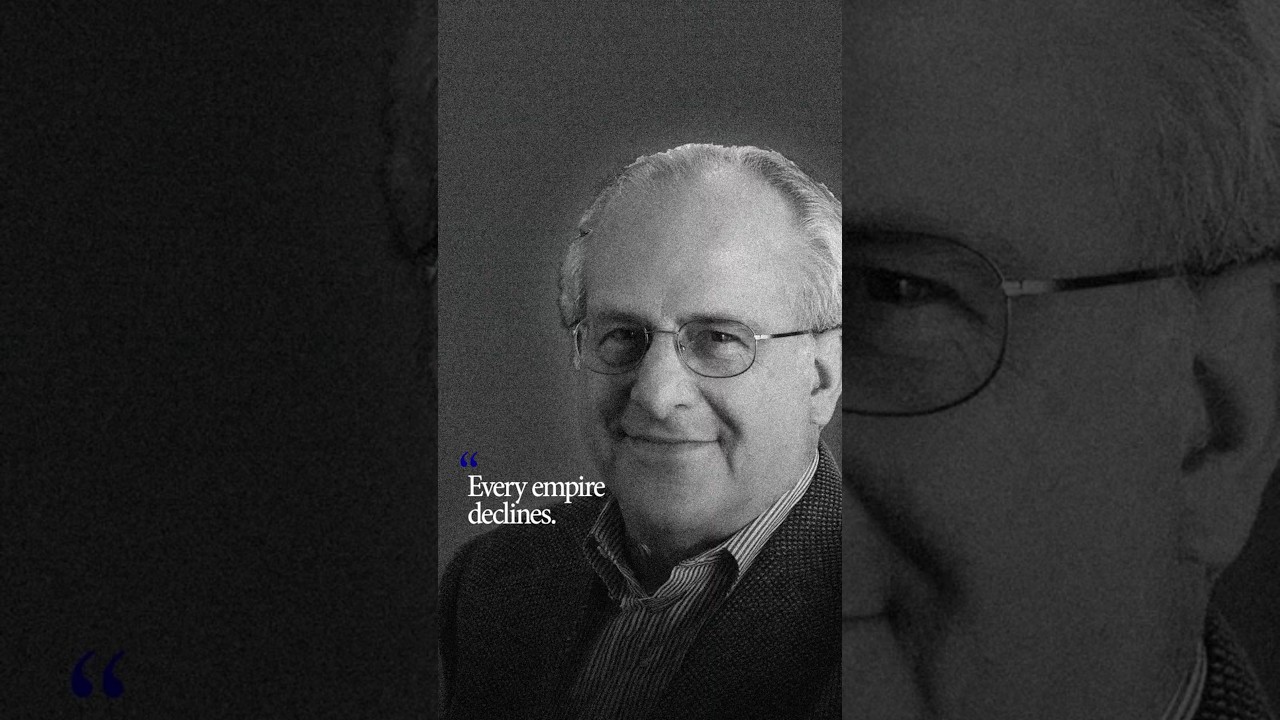
Why Empires Fall Faster Than Expected
- Top takeaway Argues the United States inherited the global position the British empire once held and is now in decline, following the same rise-and-fall pattern as past empires.
- Traces global currency dominance shifting from the British pound in the 19th century to the US dollar in the last century.
- Warns that empires — British, French, German, Roman, Greek — died suddenly, going from empire to ruin rather than fading gradually.
- Contends Americans can still work the situation out, but only if the country admits and faces its problems.
- Says the hardest obstacle is that the country prefers to pretend its problems are already solved or do not exist.
Wolff argues empires throughout history — British, French, German, Roman, Greek — collapsed suddenly once dominance peaked, not gradually. He traces global currency leadership shifting from the British pound in the 19th century to the US dollar in the last century. Wolff contends the United States inherited Britain's global position and is now declining — on the harder road down the same cycle. He argues recovery requires admitting the problem, yet Americans prefer pretending the issues are already solved or do not exist.
Key Quotes
"The decline of the American empire is underway and it is happening much faster than most people expected."
— The Creative Process interview
Key Works
Book advocating worker self-directed enterprises as an alternative to traditional capitalist corporate structures
Weekly syndicated program covering economic analysis, capitalism critique, and current events from a Marxist perspective
Book examining the history, theory, and contemporary relevance of socialist economic systems
Specializations
Disclaimer: Richard Wolff has NOT endorsed this platform and is not affiliated with Pixys in any way.