← All Experts

Rob Stevens

Geologist | Educator | Copper & Gold Deposit Specialist

"Translating deposit geology into practical investment insight for copper and gold investors"

Educator

Biography

Dr. Rob Stevens is a geologist and mining educator who helps investors understand the technical fundamentals that drive resource stock valuations. He is best known for making complex deposit geology accessible — breaking down why ore type, mineralogy, and processing methods matter to an investment thesis.

Stevens focuses on the geological characteristics that determine project economics. In his coverage of copper deposits, for example, he explains the critical distinction between sulfide and oxide ores: sulfide ores (copper bonded with sulfur) account for roughly 80% of global copper production and require pyrometallurgy (smelting), while oxide ores are processed via hydrometallurgy — a water-based method using heap leaching, solvent extraction, and electrowinning (electroplating copper from solution). This is not academic trivia. Oxide projects typically require less grinding, simpler processing, and lower capital expenditure (capex — the upfront cost to build a mine), which can make smaller projects economically viable earlier.

His approach emphasizes that ore type drives processing choice, and processing choice drives costs. Sulfide deposits, while accounting for the majority of production, generally require more complex and capital-intensive flowsheets (the sequence of processing steps). Oxide deposits, often sitting atop deeper sulfide mineralization, can offer lower-cost entry points but may lack valuable byproduct credits (additional recoverable metals like gold or molybdenum that improve project economics). Stevens walks investors through how these geological realities flow directly into the financial models that underpin a project's NPV (Net Present Value — what a project's future cash flows are worth today).

For resource investors, Stevens provides the geological literacy needed to read technical reports and evaluate management claims. His work helps investors ask better questions: What is the ore type? What processing does it require? How does mineralogy affect recoveries and costs? These fundamentals separate projects that work from those that look good on paper but struggle in production.
Videos (1)

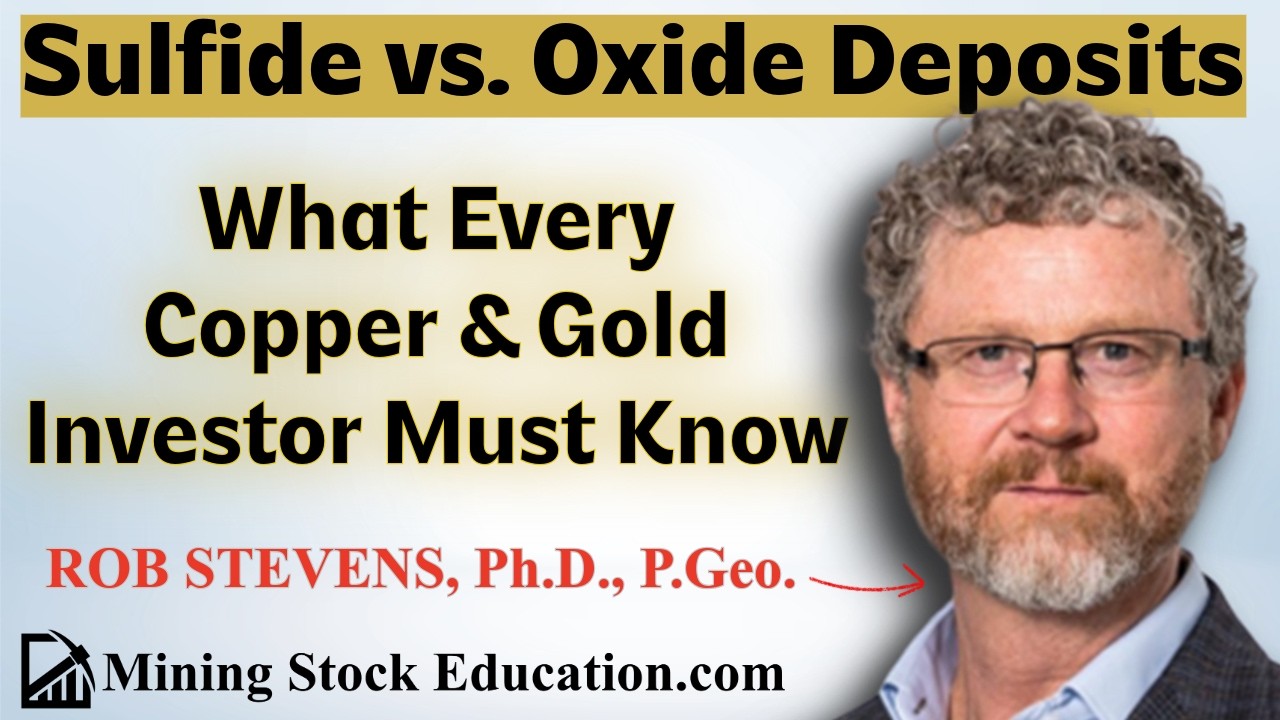
Sulfide vs. Oxide Deposits: What Every Copper & Gold Investor Must Know with Dr. Rob Stevens

Sulfide vs. Oxide Deposits: What Every Copper & Gold Investor Must Know with Dr. Rob Stevens

guest Jul 15, 2026
  • Top takeaway His central argument is that when a company presents an oxide deposit in a positive light as the better target, he broadly agrees. On average oxide deposits are cheaper to mine and process, with no grinders or flotation cells, usually heap leaching rather than a mill, and for copper the option to produce cathodes on site rather than send concentrate to a smelter.
  • He is careful to limit that to copper and gold, pointing out that iron ore and uranium oxide deposits are primary rather than weathering products, so the same economics do not apply to them.
  • He immediately qualifies his thesis with recovery, which he calls the downside. Oxide processing can recover as low as 60%, and he cites 65%, 70% gold recovery for some heap leach gold projects against over 90% from a conventional mill on the same deposit type. He argues the lower costs can still justify the lower recovery.
  • His signature mechanism is supergene enrichment. Copper leached out of the upper deposit redeposits at what was historically the boundary between an oxygen-rich and an oxygen-poor environment, which builds a high-grade zone over the original deposit. He notes that if such a zone sits near the top it can be mined early in the mine life.
  • His closing advice to investors is to always check the metallurgy, namely how the ore will be processed, the capital costs of the processing plant and the recoveries, plus the value of secondary minerals. He warns that the common junior story of oxides funding sulfide capex can be promotional, calling it "not a savior for a crappy deposit" and telling juniors to use a skeptical eye.

Oxide copper and gold deposits skip grinding and smelting, cutting the capital and operating costs a mine must carry. The trade-off is recovery: oxide heap leaching can return as little as 60% where a conventional mill can exceed 90%. Supergene enrichment zones gather leached copper near the surface, building high-grade ore that can be mined early in mine life. Refractory ore locks metal inside minerals conventional processing cannot break, often forcing a roaster or pressure oxidation step. The guest urges investors to demand standalone economics before crediting an oxide cap with funding a deeper sulfide mine.

Showing 1–1 of 1 videos

Key Works

Educational breakdown of how copper ore types differ geologically and economically, and why investors should care when evaluating copper and gold projects

Specializations

GoldCopperDeposit GeologyOre ProcessingTechnical Due DiligenceMining Education

Disclaimer: Rob Stevens has NOT endorsed this platform and is not affiliated with Pixys in any way.