Robert Vallis
President & CEO | Tiger Gold Corp. | Mining Executive & Deal Architect
"Major mining M&A expertise and leading Tiger Gold's Quinchía Gold Project in Colombia"
Biography
Robert Vallis is the President and CEO of Tiger Gold Corp. (TSXV: TIGR), a gold exploration and development company focused on the Quinchía Gold Project in Colombia's prolific Cauca Gold Belt. Vallis brings a rare depth of major-mining deal experience to the junior sector, having played key roles in some of the most significant M&A transactions in gold mining history. His track record includes involvement in Barrick Gold's US$9.5 billion acquisition and integration of Placer Dome, as well as the US$3.9 billion joint acquisition of Osisko Mining's Canadian Malartic mine—one of Canada's largest gold operations.
At Tiger Gold, Vallis is advancing the Quinchía project with a strategy centered on resource expansion and de-risking already defined mineralization. The project hosts multiple known mineralized targets, and Vallis has emphasized the significant upside potential at depth, noting that understanding the source of the mineralization is what truly excites the team. His approach combines the disciplined capital allocation mindset of a major mining executive with the agility required in the junior exploration space.
Vallis has been an active presenter at major resource investment events, including the Metals Investor Forum in Vancouver, where he has engaged with prominent mining analysts and newsletter writers such as Jeff Clark of Paydirt Prospector. His presence at these forums reflects his commitment to transparent investor communication and his understanding of what retail and institutional investors look for in junior gold stories. He has also presented at the Emerging Growth Conference and participated in interviews with outlets such as Kitco News and The Northern Miner.
For mining investors, Vallis represents a unique proposition: a CEO who has operated at the highest levels of major gold mining M&A and now applies that strategic acumen to building a junior gold company from the ground up. His experience structuring and executing multi-billion-dollar transactions gives him a sophisticated understanding of what creates real value in gold projects—knowledge that is directly relevant to Tiger Gold's efforts to define and scale its Colombian assets.
Videos (6)
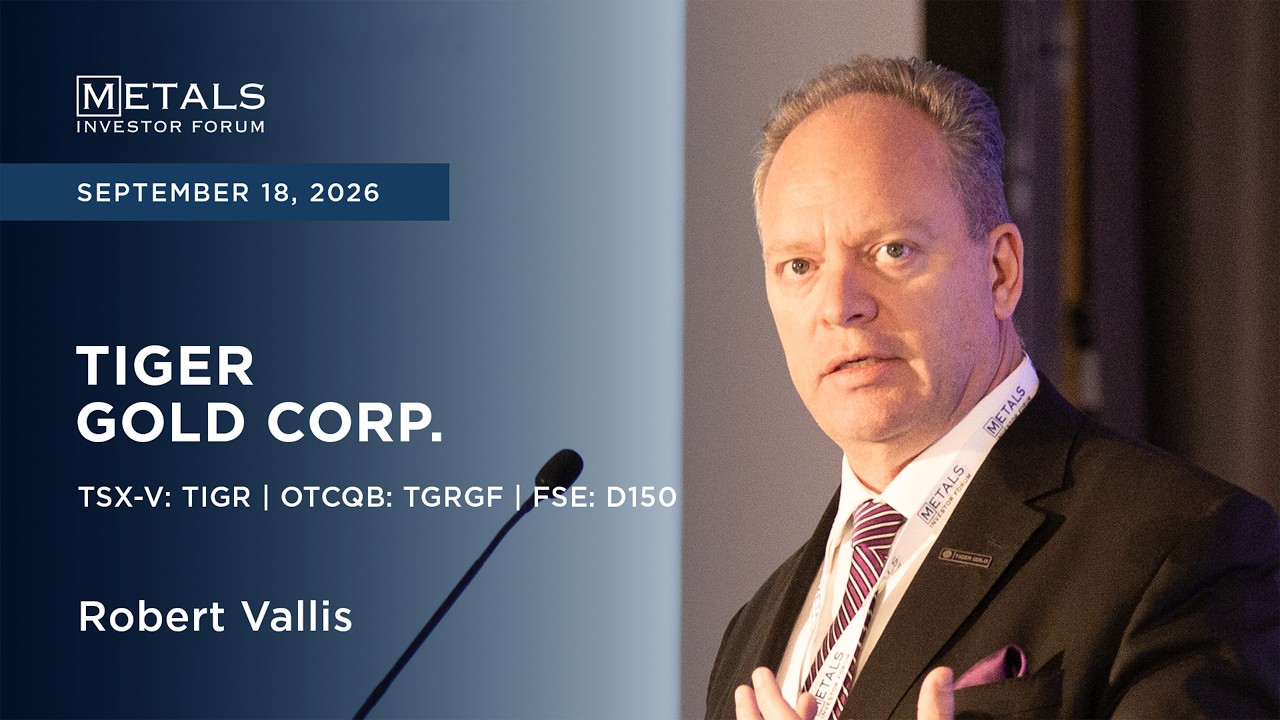
Robert Vallis of Tiger Gold Corp. presents at Metals Investor Forum in Vancouver | Sep 2026
- Top takeaway Vallis argues Tiger Gold trades below peers despite an expanding resource, and that Q1 catalysts — two MREs and a PEA update — should force a re-rate.
- He contends adjacent discoveries like Seabell create the district-scale potential that senior producers prize, feeding centralized infrastructure at lower cost.
- He stresses return on invested capital: $45 million raised has gone into full property ownership and 18,000-plus drilled meters, with every dollar meant to return multiples.
- He frames Colombia's gold belt as an emerging tier-one jurisdiction, citing a mining-supportive government and infrastructure enablers like highway access, grid power, and a nearby town of 50,000.
CEO Robert Vallis says Tiger Gold has doubled its market cap since listing and runs three drill rigs across its Colombian gold projects. Vallis targets doubling resources from 2 million to at least 4 million ounces by year-end, with two new MREs (Mineral Resource Estimates) due in Q1. The speaker cites a PEA (Preliminary Economic Assessment) showing over $500 million post-tax NPV and 36% IRR at $2,650 gold. 15,000 meters of the expanded 19,500-meter drill program targets Seabell, a new discovery the speaker sizes at least as large as Tesorito (1.5 million ounces). Vallis argues Colombia is an emerging tier-one gold jurisdiction, citing neighbors Aris Mining's Marmato and Collective Mining's discoveries.

Robert Vallis of Tiger Gold Corp. talks to Robert Sinn | Metals Investor Forum Sept. 2026
- Top takeaway Vallis argues the Mid-Cauca Belt package offers an unmatched combination of geologic endowment, surface-near mineralization and infrastructure enablers, and that Tiger Gold's targeted 100% resource increase in under a year exceeds anything in its peer group.
- He frames Q1 2027 — a Tesorito MRE upgrade, a Seabell maiden resource at measured/indicated, and an updated PEA — as the catalysts that will move the market past Colombia's legacy jurisdictional discount.
- He points to copper traces and brecciated mineralization encountered at depth as evidence of a porphyry feeder system, with Tesorito deep holes returning 3 g/t at 800-900m versus 0.6-0.65 g/t higher up.
- He defends Colombia's risk profile — citing lower geopolitical risk over the last 10-12 years, a strong government framework, foreign investment inflows, and Iris mining producing 250K oz/year 25km to the north (scaling to 500K by end-2026).
- He plans to drill the deeper porphyry target from end-2026 while running three drills at Seabell and moving next door to Chuskel once the Seabell maiden-resource drilling is complete (targeted early November 2026).
Tiger Gold's CEO argues the market is mispricing the Quinchía project, pointing to a path toward 4–5 million ounces and full existing infrastructure. A 22,000-metre drill program targets a maiden Ceibal resource by early November, with two resource updates and a refreshed PEA due in Q1 next year. The 2025 PEA outlines 1.4 Moz life-of-mine production at roughly 140,000 ounces a year for the first five years and a US$534M base-case NPV. Vallis frames Colombia as a transformed jurisdiction, citing a nearby producing peer at 250,000 ounces a year and rising foreign investment as evidence. Drilling beneath Tesorito hit grades up to 3 g/t with copper traces at 800–900 metres, hinting at the porphyry feeder system beneath the district.

Gold Prices Are Turning Projects Into Billion-Dollar Assets | Robert Vallis - Tiger Gold
- Top takeaway The guest argues gold's structural bull case is intact: a global move away from the US dollar, unprecedented Chinese central-bank buying, and gold's safe-haven role point to higher prices ahead despite recent volatility.
- He frames Tiger Gold's Kinchia project as uniquely infrastructure-advantaged, citing competitive hydro power, paved road access, transmission through the site, water, and skilled labor, which lowers capital and operating cost risk.
- The guest outlines a goal of roughly doubling Tiger Gold's current 2 million ounce compliant resource within a year, driven by infill drilling at Tesorito and aggressive step-outs at Seibel, with holes 14-16 still pending as of September 2026.
- He lays out a 12-month catalyst stack, including a resource update late 2026 / early Q1 2027, a major PEA upgrade, and pre-feasibility engineering starting around July 2027, which he argues should force a re-rate of an undervalued Tiger Gold.
- The guest is constructive on Colombia's new government, noting the prior left-leaning administration still issued six-plus mining permits, while deeper probes beneath Tesorito are returning rising molybdenum, copper, and breccia-style mineralization that could open a porphyry target.
Tiger Gold CEO Robert Vallis frames higher gold as a structural safe-haven bid, with China buying unprecedented amounts alongside other central banks. The Quinchía project's PEA (Preliminary Economic Assessment — a scoping-level mining study) implies a ~$2B post-tax NPV at near-current gold prices. Drilling at Ceibal and Tesorito aims to roughly double the current 2 Moz resource base; deeper probes are also testing for porphyry-style mineralization. Hydro power, paved roads, and skilled labor near Quinchía are pitched as construction enablers that lower unit costs for a planned ~140 koz/yr operation. The guest says the new Colombian government should add permitting stability, with foreign investment continuing to flow into the country's gold district.
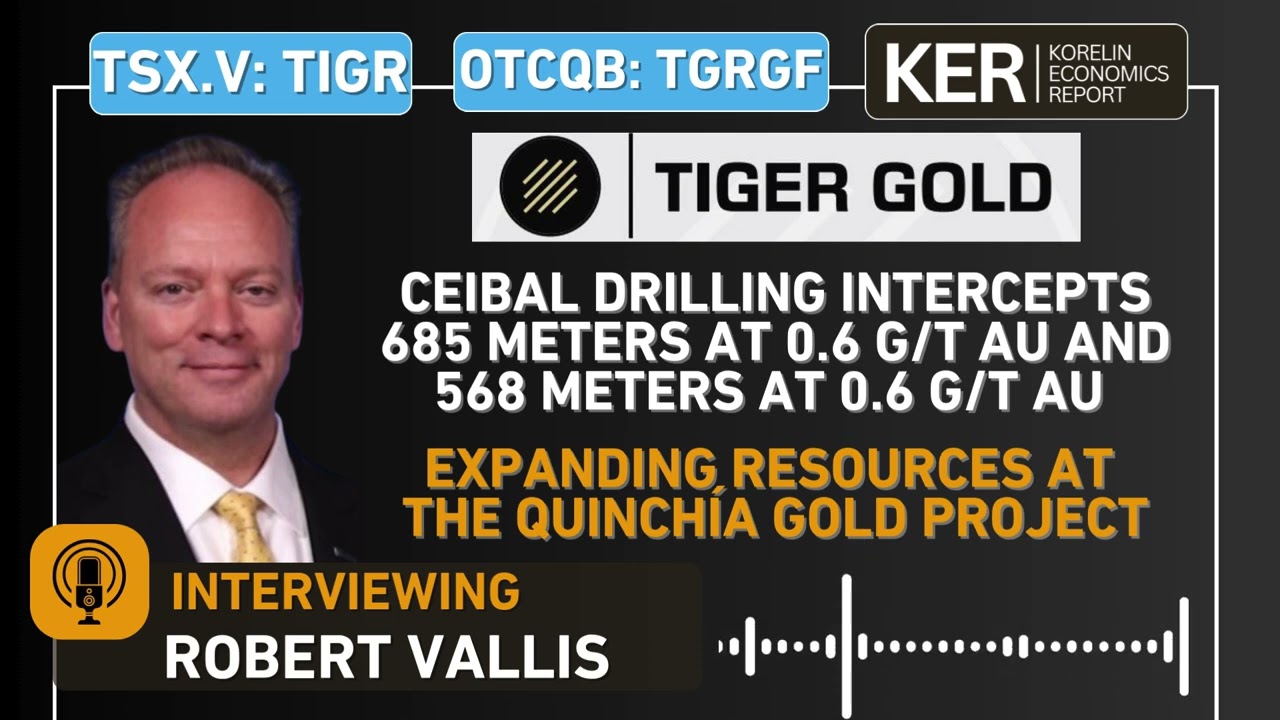
Tiger Gold – Ceibal Drilling Intercepts 685m at 0.6 g/t Au & 568m at 0.6 g/t Au Expanding Resources
- Top takeaway Argues the long, fully mineralized Ceibal intercepts show a deposit that could match or exceed Tesorito in scale and possibly grade, anchoring his thesis that Tiger Gold can double both its resource to over 4 million ounces and its production potential.
- Frames 2026 as the year to materially grow resources and says the company is deliberately 'forcing a re-rate' through catalysts rather than waiting for an organic one, calling the value proposition astounding with the existing PEA implying $1.2 billion at $3,700 gold.
- Lays out a staged path of a consolidated resource and updated PEA in Q1 2027, pre-feasibility from H2 2027, then feasibility and permitting, and expects most new ounces to land in the indicated category so engineering is not held up.
- Argues Ceibal is a low-grade porphyry-halo deposit overprinted by higher-grade epithermal veins and closer to surface than Tesorito, making the low strip ratio and efficient material movement key profit enablers.
- Advocates a sequenced 'peeling the onion' exploration strategy: finish Ceibal resource drilling by late October 2026, drill Chuscal with results around year-end, then test depth targets under the deposits and the fault-bounded corridor to the northeast.
Ceibal drill holes returned from-surface intercepts up to 685 metres at 0.6 g/t Au (grams per tonne), hinting at a system to rival neighboring Tesorito. Management is drilling to roughly double resources past 4 million ounces, targeting an updated resource estimate and PEA (preliminary economic assessment) in Q1 2027. Three pending 200-metre step-out holes (drilled outward to test a deposit's extent) will reveal whether Ceibal is larger than current drilling shows. Near-surface higher-grade veins inside a low-grade halo could hold the strip ratio (waste moved per ore mined) at or below Tesorito's 0.5-to-1. Beyond Ceibal, management points to porphyry potential at depth, the untested Chuscal gold-copper target, and 500,000 historic ounces at Dos Quebradas.

Robert Vallis & Jeff Clark discuss Tiger Gold at the May Metals Investor Forum
Tiger Gold Corp. is advancing its flagship multi-million-ounce Quinchía Gold Project located in Colombia's prolific Mid-Cauca gold belt. The company features an experienced multidisciplinary management team with backgrounds from major mining companies like Barrick and AngloGold Ashanti. Management emphasizes building long-term shareholder value through strategic exploration and development in a top-tier Colombian gold district.

Robert Vallis of Tiger Gold Corp. presents at Metals Investor Forum in Vancouver | May 2026
Robert Vallis, CEO of Tiger Gold Corp., presents the company's investment thesis at the Metals Investor Forum in Vancouver. The forum highlights companies vetted by newsletter writers for excellent management, strong financials, and promising properties. Investors gain exclusive access to directly question management teams, a critical step in evaluating junior mining investments.
Key Quotes
"What's feeding this mineralization at depth is what really excites us."
— Kitco News interview on Tiger Gold's Quinchía project upside potential
"Tiger is led by President and CEO, Robert Vallis, who brings a strong record of strategic leadership and execution in the mining sector, including his role in the US$9.5 billion acquisition and integration of Placer Dome by Barrick, as well as the US$3.9 billion joint acquisition of Osisko."
— Tiger Gold corporate presentation at Emerging Growth Conference
Key Works
Leading the advancement and resource expansion of the Quinchía Gold Project in Colombia's Cauca Gold Belt
Played a key role in one of the largest gold mining acquisitions in history, integrating Placer Dome's global assets into Barrick Gold
Involved in the joint acquisition of Osisko Mining, which controlled the Canadian Malartic mine, Canada's largest gold operation
Specializations
Disclaimer: Robert Vallis has NOT endorsed this platform and is not affiliated with Pixys in any way.