
Gold Fields Limited
GFIGold Fields Limited (GFI) is a globally diversified gold producer with a strong portfolio of operations spanning South Africa, Ghana, Australia, Peru, and Chile. Following the transformative acquisition of Yamana Gold in 2023, the company has solidified its position as a top-tier global gold major, boasting a highly diversified asset base that mitigates single-asset and single-jurisdiction risk. The company is focused on generating robust free cash flow from its established operations, including the highly mechanized South Deep mine in South Africa and the expanding Salares Norte operation in Chile.
Operationally, Gold Fields demonstrates competitive cost structures and disciplined capital allocation. The management team, led by CEO Mike Fraser, is actively transitioning the company's portfolio weighting toward more favorable Tier 1 and Tier 2 jurisdictions while optimizing the performance of its legacy Tier 3 and Tier 5 assets. The successful ramp-up of the Salares Norte gold-silver mine in Chile is a critical near-term catalyst, expected to significantly boost the company's overall production profile and lower all-in sustaining costs (AISC) due to the high-grade nature of the deposit.
Financially, Gold Fields maintains a healthy balance sheet characterized by manageable leverage and strong operating cash flow generation. This financial flexibility allows the company to sustain a competitive dividend yield, fund organic growth projects, and pursue value-accretive M&A opportunities without jeopardizing its investment-grade credit ratings. The stock offers investors a compelling mix of stability, growth, and exposure to the gold price, trading at a reasonable valuation relative to its senior gold producer peers.
However, investment risks remain, primarily centered around jurisdictional challenges. The company retains significant exposure to operational and political risks in South Africa (Tier 5) and Peru (Tier 3). Additionally, the integration and ramp-up risks associated with the Salares Norte project, particularly concerning water access and high-altitude operations, require close monitoring. Despite these challenges, Gold Fields' diversified portfolio and strong cash-generating capabilities position it well to capitalize on a favorable gold price environment.
Data Quality
Market Cap
$474.39B
Total valuation
Stock Price
$32.24
▼ 1.26% today
Free Cash Flow
N/A
Annual
Financial Position
-$1.76B
Net debt position
PEG Ratio
ⓘN/M
Not meaningful
Analysis
Score Interpretation
Hover any criterion below to reveal its full rationale, key metrics, strengths, concerns, and source documentation.
Criterion Detailed Analysis
Recommendation
Gold Fields (GFI) is a solid, diversified major gold producer offering investors a balanced mix of stability, growth, and competitive valuation. The company's strong portfolio of global assets, anchored by the massive South Deep mine and the high-growth Salares Norte project, provides a reliable production base and significant organic growth potential. The stock is attractively valued, trading at a discount to its NAV and offering a healthy free cash flow yield.
However, the investment case is tempered by significant jurisdictional risks, particularly the company's exposure to South Africa's challenging operating environment and political uncertainties in Peru. While management is actively mitigating these risks through geographic diversification, they remain a drag on the company's valuation. The successful ramp-up of Salares Norte is critical; a smooth transition to steady-state production will likely serve as a positive re-rating catalyst. Overall, Gold Fields is a quality gold major suitable for investors seeking leveraged exposure to the gold price with a moderate risk profile.
Red Flags
| Criterion | Severity | Score | Description |
|---|---|---|---|
| jurisdiction | High | 5.50 | Significant exposure to Tier 5 (South Africa) and Tier 3 (Peru, Chile) jurisdictions introduces political, operational, and infrastructure risks. |
| management_team | Low | 7.00 | CEO Mike Fraser is relatively new to the position, having taken over in 2024, which introduces a degree of execution risk during the leadership transition. |
Scenario Analysis
Bull Case
Bull case assumes gold prices exceed $3,000/oz driven by aggressive central bank buying and a weak US Dollar. Salares Norte successfully ramps up to full capacity, significantly boosting production and lowering consolidated AISC. Political conditions in South Africa stabilize, leading to a re-rating of the stock's jurisdictional discount.
Base Case
Base case assumes gold prices remain stable around $2,650/oz. The company meets production guidance and Salares Norte ramps up according to plan with minor delays. The stock provides a steady dividend yield and modest capital appreciation.
Bear Case
Bear case assumes a drop in gold prices below $2,200/oz due to a strong global economy and rising real interest rates. Operational challenges at Salares Norte persist, and escalating infrastructure or political crises in South Africa severely impact production and costs.
Audit Trail
| # | Source |
|---|---|
| 1 | Gold Fields 20-F Annual Report (2023): Financial statements, properties, operational data |
| 2 | NI 43-101 Technical Reports: Resource estimates for South Deep, Salares Norte, and Australian assets |
| 3 | Q4 2024 Trading Statement: Preliminary production and cost figures |
| 4 | Company IR Presentations (2024): Management strategy, project updates, reserve data |
Financials
Core Metrics
Annual Production
N/A
Troy oz per year
Revenue
$6.10B
Fiscal year 2026
Net Income
-$345.00M
Annual
Enterprise Value
$476.15B
Net debt: $1.20B
Adj. EBITDA
$3.50B
EV/EBITDA 136.04x
Income & Cash Flow
Waterfall · Revenue to Free Cash Flow
Key P&L Ratios
N/A
Free Cash Flow Generated
Balance Sheet & Leverage
Capital Structure
- Equity $8.80B
- Long-Term Debt $0.00
- Short-Term Debt $0.00
- Cash & Equivalents $440.00M
Leverage & Coverage
$1.20B
Net Debt (Strong)
Cash Uses & Returns
- Capital Expenditures $870.00M
- Dividends Paid $400.00M
- Share Buybacks $0.00
- Interest Expense $71.20M
- Debt Repayment / Other $1.86B
Profitability & Returns
Returns
Margins
Liquidity & Coverage
Yield
Valuation
Valuation Multiples
Share Structure & Ownership
Share Structure
- Outstanding 895.00M 895.00M
- Options 10.00M 10.00M
- RSUs 15.00M 15.00M
- Warrants 0.00 0.00
Per-Share & Buyback Metrics
$0.00
Remaining Buyback Capacity
Health Indicators
Strength across all solvency and liquidity metrics
25.0% of 1.0x threshold
11.4% of 3.0x threshold
64.7% of 3.0x target
50.0% of 48 months target
18.7% of 15% threshold
Asset Pipeline
Jurisdiction Exposure
Geographic distribution of mining properties · Equal-weighted (no NPV data)
- Peru20.0% · Tier 3 · 1 property
- Australia20.0% · Tier 1 · 1 property
- Chile20.0% · Tier 2 · 1 property
- South Africa20.0% · Tier 5 · 1 property
- Ghana20.0% · Tier 3 · 1 property
Operating Mines
Distribution across development stages · Equal-weighted (no NPV data)
- Production (Steady-State)80.0% · 4 Assets
- Production (Ramp-Up)20.0% · 1 Asset
Cost Structure
All-in Sustaining Cost (AISC) breakdown • Peer-leading efficiency
$1,350/oz • 100%
Cerro Corona
Granny Smith
Salares Norte
South Deep
Tarkwa
Information
Key Information
Legal Entity
Gold Fields Limited
Sector
Precious Metal
Founded
March 17, 1980
Employees
6,560
Reporting Currency
USD
Contact Phone
27 11 562 9700
Website
www.goldfields.comHeadquarters Address
150 Helen Road , Sandton 2196 , ZA
Identifiers
Commodity Portfolio
Liquidity
- Avg dollar volume (50d)
- —
- Last trade date
- Jul 29, 2026
- Days since last trade
- 75
- Last evaluated
- Oct 12, 2026 10:30 PM
Stock Exchanges
Organization
Management Team
Mike Fraser
Chief Executive Officer
Insider Ownership
5.00%
Martin Preece
Chief Operating Officer
Insider Ownership
2.00%
Industry Partnerships
AngloGold Ashanti
Joint Venture
Project: Iduapriem Mine
Ownership: 50.0%
Source: 10-K, Joint Venture Agreements
Partner Market Cap
$10.00B
Chart
Interactive chart powered by TradingView. Use the chart tools to analyze price trends.
Videos
Lab Report | Sep 30 Deep Dives on ICG, Arizona Gold & Silver, and Hercules
Key Highlights
detailed- The host walks through Gold Fields' roughly US$27.1 billion cash-and-shares offer for Northern Star — a 22% premium with US$5 billion of claimed synergies — which Northern Star's management rejected as 'highly opportunistic'.
- Gold Fields is South Africa-based but, per the host, said it would seek an Australian listing as part of the pursuit.
- Because the offer was weighted toward shares, the host expects any sweetened bid to add more cash, addressing Northern Star's dilution concerns.
- He cites the Gold Fields bid as one of the few realistic large-scale deals left and does not expect a broad consolidation wave among the majors as of September 30, 2026.
A takeover wave looks unlikely: majors are too large and targets too scarce, so expect equity stakes in juniors rather than mergers. ICG Silver & Gold hit 24.3 metres of 10.14 grams per tonne gold in Nevada; its C$19 million market cap still prices it as a concept. Arizona Gold & Silver keeps hitting gold-rich breccia at Philadelphia; the payoff comes when drilling reaches the boiling (bonanza) zone of the epithermal vein. Hercules Metals extended its Southern Flats porphyry copper hit in Idaho; George Ogilvie's new team must justify a $450 million valuation with deeper drilling. With 30-year yields near 5.5% and war-driven inflation, the host stays extremely bullish on gold, silver and copper equities.

Dave Erfle - Gold & Gold Stocks: Beaver Creek Recap, Metals Technicals, Recent M&A
Key Highlights
brief- The hosts say a potential combination between Gold Fields and Australian producer Northern Star is not working out.
Beaver Creek was record-busy and juniors arrived cashed up, increasingly choosing to build projects themselves rather than sell, reshaping takeover dynamics. Seniors have repaired balance sheets, paid down debt and paid dividends, so replacing depleted ounces through M&A becomes the logical next step. Artemis's takeover of Vista Gold values Mount Todd's 10.5 million in-ground ounces near $37 each, a take-under reflecting the deposit's hard-rock difficulty. Gold's pullback may extend toward $3,950-$4,000 support if inflation runs hot and hike odds build, with GDX 85 and GDXJ 110 gaps in play. Erfle screens explorers for district-scale land packages, serially successful management, and projects over 5 million ounces that could attract a major.
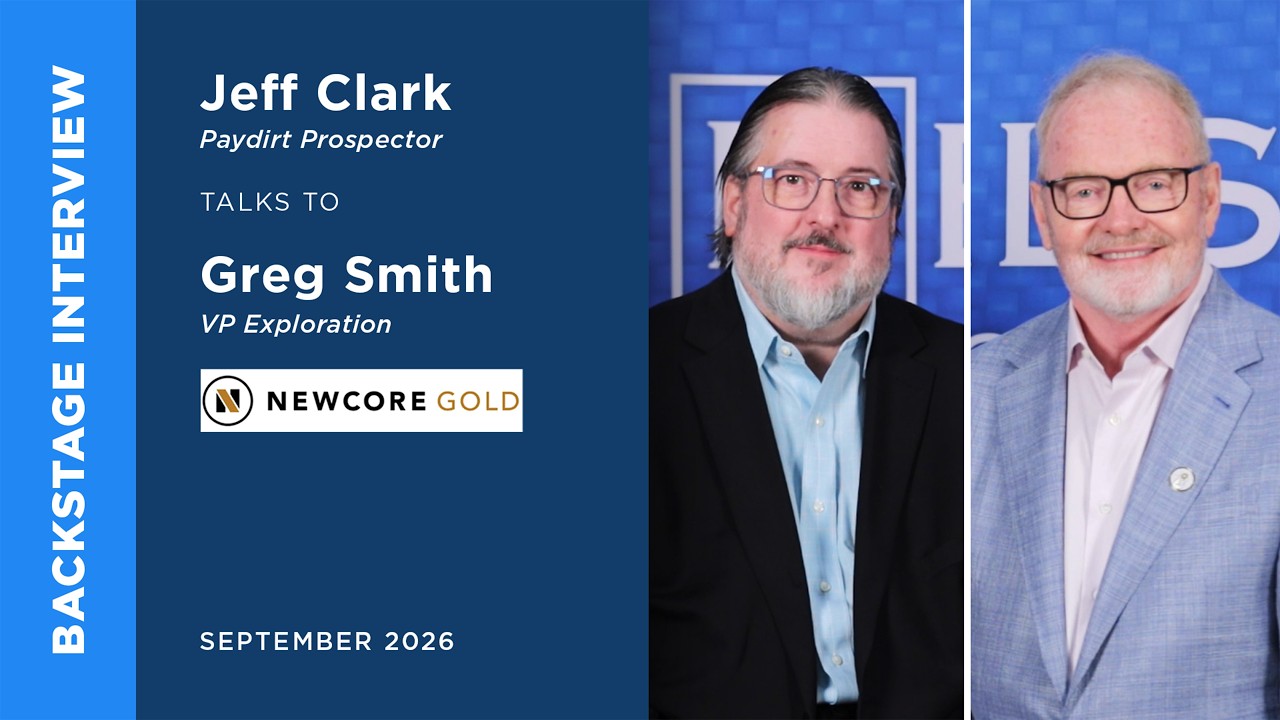
Greg Smith of Newcore Gold Ltd. talks to Jeff Clark | Metals Investor Forum Sept. 2026
Newcore is fully funded through its 80,000-metre Enchi drill program; 47,000 metres released and 16,000 metres remain by year-end. Enchi's current resource base is 1.5Moz indicated and 600koz inferred; Greg cites a nearby mine as a deep-mining analogue. Greg argues Ghana is overlooked despite being Africa's largest and the world's sixth-largest gold producer, with majors operating successfully there. Management and the board hold ~12% of equity bought with their own cash while institutions hold ~55%, a structure Greg calls a conviction signal. Near-term catalysts are ongoing drill releases feeding an updated mineral resource estimate and a feasibility study targeted before end-2027.
AbraSilver Resource– A Series Of Key Project Milestones Achieved in 2026, Transitioning To Developer
AbraSilver has cleared its 2026 milestones with RIGI approval, environmental permits from both provinces, an updated MRE, and a DFS, fully transitioning Diablillos to active developer. The June DFS shows a 3B base case after-tax NPV at a 41.9% IRR and 20/oz AISC, placing Diablillos among the lowest-cost silver projects globally. A July 50M raise including a Kinross placement funds early works; a larger debt/stream package is targeted before year-end ahead of a Q2 2027 FID. New Executive Chair Marie Inkster, COO Jeremy Weyland, Project Director John Naisbitt, and Director Wendy Kaufman add construction expertise to the team. A Phase 2 PEA on heap leaching 130Mt of previously classified waste, plus throughput doubling studies, point to upside beyond the base case DFS.
Canada Holds The Ultimate Energy Card In This Trade War
Key Highlights
detailed- The host says Gold Fields declared a 132% increase in its interim dividend, following a surge in free cash flow driven by higher realized gold prices and production ramping up at its Solaris Norte mine.
- More than 60% of first-half free cash flow, as of late August 2026, was returned to investors.
- The share buyback program was raised to $1.25 billion.
- The host frames this as an industry trend: producers prioritizing organic production growth and direct capital returns instead of dilution-funded consolidation at expensive valuations.
Silver takes the spotlight as compounding industrial deficits meet green energy, AI infrastructure and widening supply constraints. Canada's trade-war strength is cheap, clean hydro power: the U.S. imports roughly 70% of its primary aluminum from Quebec smelters it cannot quickly restart. Gold Fields raised its interim dividend 132% and lifted buybacks to $1.25 billion, returning over 60% of first-half free cash flow. State money is moving downstream of the mine: a $500 million U.S. DOE round funds lithium extraction, cobalt refining, graphite substitutes and battery-scrap recovery. Two porphyry stories are scaling: Corcel hit anomalous copper, gold and molybdenum at Yuma King, while Lundin Gold's Ecuador footprint hit 1.6 km along strike.

Founders Metals - 100% Antino Ownership, Gold Fields Investment, High-Grade Drill Results
Key Highlights
brief- Gold Fields increased its strategic stake in Founders Metals to 19.9%, signaling confidence in the Antino project's exploration success to date
- The guest argues the increased investment reflects Gold Fields' view of the Antino property moving forward and Founders Metals' team's ability to unlock its value
Founders Metals hit 28 meters of 14 g/t gold in a step-out hole at Upper Antino, signaling open-pit mineralization extends below 250 meters depth. The company consolidated 100% royalty-free ownership of the Antino Gold Project, while Gold Fields raised its strategic stake to 19.9%. Three parallel NW-SE structural trends host a string of pearls of targets including Upper Antino, Antino West, Maria Geralda, and DaVinci. Property-wide auger drilling and deep-auger pre-screening identified Antino North, Antino Northeast, and new shear-zone targets across the 100,000-hectare land package. Four drill rigs are turning with a potential fifth rig coming in fall, advancing both greenfield exploration and step-out drilling on known deposits.

Live Q&A with Rick Rule and Steve Barton
Key Highlights
brief- Rule cites Gold Fields (alongside B2Gold) as a major shareholder of Founders Metals, providing 'adult supervision,' technical expertise, and auction tension — Rule says he has 'high regard' for the people
Rick Rule frames currency debasement and a structural copper deficit as multi-year themes, and treats the uranium pullback as a buying window rather than a topping signal. Two majors as shareholders of a junior like Founders Metals create real auction tension if a discovery is made, plus adult supervision and a tighter effective float. Rule sizes lithium as a processing-bottleneck story, not a raw-material shortage, and flags direct lithium extraction from oil and gas brines as the long-term threat to hard-rock producers. Abitibi 'orphan' deposits such as Emperor Metals can now monetize via nearby mills, removing the capex bar that once left them undeveloped in past cycles. Rule is constructive on Cameco, Origin Royalties, Alamos, Emperor, B2Gold, and Cheniere; he is cautious on lithium juniors and explicitly refuses to time the uranium market.

Elemental Royalty Corp – Visual Tour Through The Key Producing and Development Royalty Assets
Key Highlights
brief- On the Laverton slide, Bell points to Gold Fields' Granny Smith mine as a world-class asset sitting adjacent to the ground Genesis is now exploring.
Discovery optionality is why investors own royalties: counterparties spend hundreds of millions exploring ground where Elemental holds a royalty slice. The net asset value per share trend is the best single KPI for comparing royalty companies and exposing dilution discipline. Cornerstone assets keep compounding: operator expansions at Timok, Caserones, Karlawinda, and Laverton grow resources and production without extra royalty cost. Recent catalysts include the US$25 million Chapi copper financing, the pending Vizsla Royalties acquisition, and first Russell index inclusion. Underwriting stays conservative: modeled production is delayed one to two years beyond operator timelines, and buybacks signal shares trade below NAV.

Pitch Rick Ep #1 - Versamet Royalties
Key Highlights
brief- The CEO lists Gold Fields among the senior producers whose overlooked royalty portfolios Maverix acquired from during his Maverix years.
The CEO argues the value of Versamet's producing royalties alone exceeds its roughly $1.2 billion market cap, before counting development assets. Royalties (cuts of production, not mines) give Versamet 90% operating margins with eight staff; it trades near 10 times cash flow, well below larger peers. Gold-equivalent production has doubled annually from 5,000 ounces in 2024 and should reach a 35,000-ounce run rate once the Eskay Creek stream starts in 2027. The $360 million Eskay Creek stream was priced tightly, but Skeena's planned mine-plan upgrade could materially lift the stream's net present value. With about $370 million of debt repayable from under three years of cash flow, officers and directors own over 10% of shares.

David Lotan Shows You How to Make Junior Mining Millions: Aurion & Fox River Buyouts Explained
Key Highlights
brief- Lotan notes Gold Fields agreed to buy Yamana but ended up having to step back and let Agnico and Pan American Silver complete the purchase.
Guest David Lotan built most of his Aurion and Fox River stakes buying public shares, arguing open-market bargains beat private deal access. Aurion Resources sold to Agnico Eagle Mines for C$481 million ($2.60 per share cash); Fox River Resources followed at C$94 million ($1.10 per share). Lotan ties the decade-long wait to consolidation among major gold producers; rising mid-tier buying power finally revived takeovers of juniors. The multiyear Aurion-Rupert standoff shows embarrassed, hostile bidders can drag out timelines and destroy value on both sides of a takeover fight. Management teams that refuse warrants (rights to buy future shares cheaply) and protect capital structures earn the investor trust that pays off at exit.
Sean Roosen, CEO of Osisko Development Corp. | Rule Symposium 2026: Rick Rule interviews
Key Highlights
brief- The guest says Osisko Mining 2, which he credits to John Brzezinski leading it, was sold to Gold Fields in 2024 for $2.18 billion.
Osisko Development is in pre-construction on Caribou Gold, targeting 200,000 ounces a year from 2028 in central British Columbia. Phase one costs $653 million against $3.2 billion of net present value at $4,500 gold, clearing a 2-to-1 value-to-capital test. Roosen says the company trades near $1.4 billion, raised $885 million since spring 2025, and needs $350 million at final decision. The Osisko playbook — buy low, build, sell — turned an $88,888 property purchase into a $4.1 billion sale to Agnico. The host frames permitted depth as the edge, since new ounces drilled below existing workings skip most approval work.
Jason Kosec and Jonathan Awde of Hemlo Mining Corp. | Rule Symposium 2026: Rick Rule interviews
Key Highlights
brief- Kosec cites the recent technical report Gold Fields published on its Windfall project as support for his claim that building a mine like Hemlo today would cost over $2.5 billion.
A veteran management team bought Hemlo — Canada's preeminent historic gold mine — from Barrick, betting decades of underinvestment left value behind. The mill runs at 3,800 of 10,000 tons per day; a planned $130 million investment aims to lift output toward 200,000 ounces a year. Barrick ran Hemlo as a rounding error — about 5% of output — spending $2 million on exploration where the new owners plan $38 million. The sellers' technical report shows a 14-year mine life, about 140,000 annual ounces, and $1.1 billion NPV5 (value discounted at 5%) at $2,610 gold. A 130,000-metre drill program targets an updated technical report in mid-2027; management says it has over $40 million of its own money invested.

Jason Attew, President & CEO of OR Royalties | Rule Symposium 2026: Rick Rule interviews
Key Highlights
brief- In early 2026, OR Royalties acquired a portfolio of eight royalties from Gold Fields for $115 million, anchored by a 1.5% royalty on the San Gabriel asset in Peru that the guest says will pay OR immediately.
- The guest frames the Gold Fields purchase as one of four royalty deals totaling close to half a billion dollars executed in the six weeks before the interview, with sell-side analysts rating the 2026 deals as above-average returns well above OR's cost of capital.
OR Royalties holds royalties rather than streams in safe jurisdictions, earning near-97% cash margins because royalty holders receive revenue without paying mine costs. Its cornerstone royalty is a 5% NSR (net smelter return — a cut of mine revenue) on Canadian Malartic, with operator guidance of life to 2060. CEO Jason Attew grades every acquisition on a per-share basis and walked away from 2025's $9.3 billion royalty deal wave rather than overpay for scale. Four early-2026 royalty deals — from Gold Fields, in Ghana, and at Nevada's Spring Valley — deploy about $500 million from a debt-free balance sheet. Attew argues OR still trades below mid-tier and senior peers on most financial metrics, with catch-up expected as commodity-price-adjusted per-share growth delivers.

'Never Been More Bullish' - 'Unbelievably CHEAP' Gold & Silver Stocks Set to Rip
John Feneck and Don Durrett see massive undervaluation in gold and silver stocks, describing them as unbelievably cheap and set to rip higher. The experts open up their portfolios to reveal top stock picks in the precious metals sector they believe are currently on sale. Discussion covers the macro backdrop for precious metals, geopolitical risks like the Iran war, and specific gold and silver stocks to watch.
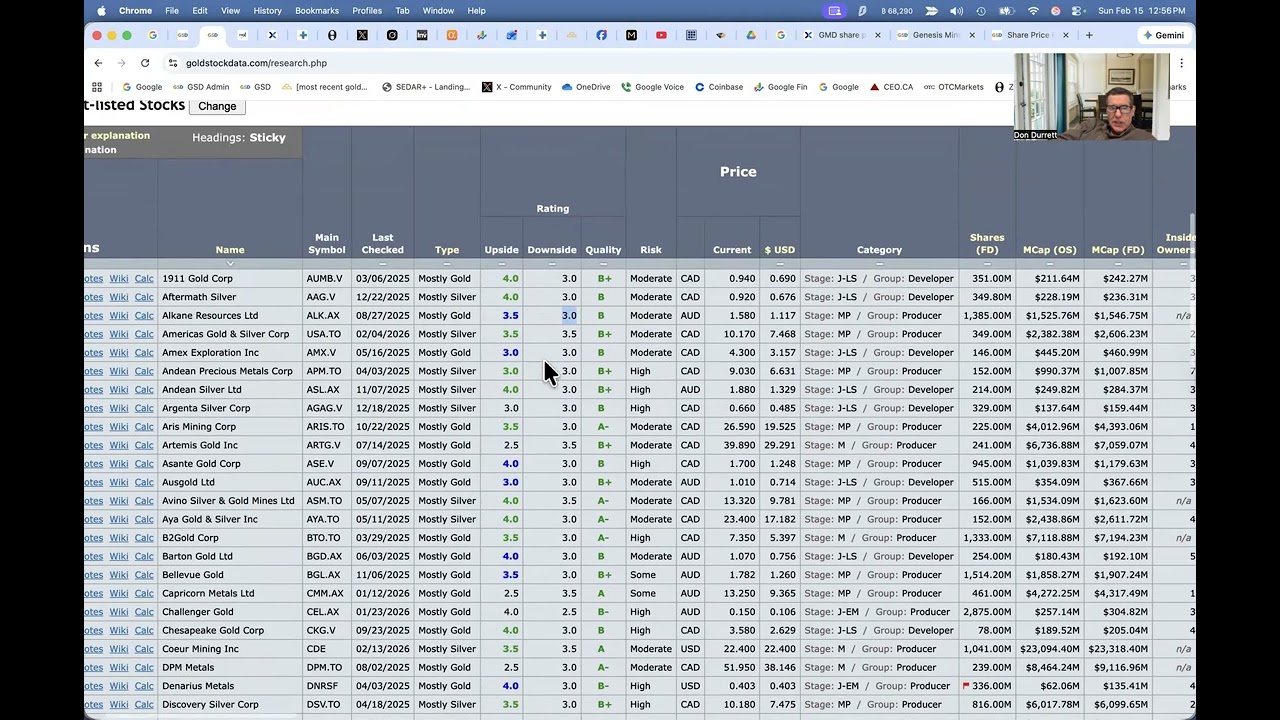
Newsletter Favorites Overview (Feb 2026)
Key Highlights
brief- Don names Gold Fields among the majors he hopes will not acquire IAMGOLD, since a bigger buyer might have to sell assets afterward.
Durrett argues there is limited time left to buy gold and silver producers while they are still cheap, expecting one more significant dip. His Newsletter Favorites list leans on quality Canadian and Australian mid-tier producers, which he expects to re-rate as the bull market warms up. Companies whose second and third projects get no market value offer free upside — you pay for the first asset and get the rest for nothing. Cheap forward free-cash-flow multiples persist in West Africa and among silver producers, where weak sentiment discounts heavy leverage to metal prices. Australian producers like Ramelius reaching major-sized valuations is, in his view, the first sign the junior gold bull market is broadening.

Founders Metals - Antino Project: Expanding Gold Mineralization & The Project To 100,000 Hectares
High-grade 'kicks' within Lower Antino's broad 90-meter intercept at 1.02 g/t gold signal a bulk-tonnage target with significant room to grow. Antino's expansion to 100,000 hectares consolidates an entire Suriname greenstone belt (ancient volcanic rock that hosts large gold systems), giving Founders Metals district-scale optionality. A $55 million treasury and $35–$37 million 2026 exploration budget let Founders Metals drill aggressively across the expanded district. Founders ranks Upper Antino first for resource work, then Lower Antino, then a 5 km northern auger anomaly (a soil-sampling target) — the property's largest.
Articles
No articles available
Published articles for this company will appear here
Want the full picture on more companies?
Be one of the first.
A room for resource investors taking shape now — independent, spam-free, no hype.