Grant Williams
Financial Advisor & Strategy Advisor | Co-Founder, Real Vision | Macro Commentator
"Co-founding Real Vision and his macro-driven bullish thesis on gold amid the changing world order"
Biography
Grant Williams is a widely respected financial advisor, portfolio and strategy advisor, and co-founder of Real Vision, the financial media platform he launched to provide in-depth, long-form interviews with the world's most influential investors and thinkers. With decades of experience in financial markets, Williams has built a reputation for connecting macroeconomic dots in ways that few others can, particularly when it comes to precious metals and the structural vulnerabilities in the global monetary system.
Williams is perhaps best known in commodity circles for his articulate and persistent bullish case for gold. He has argued that the weaponization of the U.S. dollar—particularly the freezing of Russia's foreign reserves—fundamentally altered the trust underpinning the global financial architecture, setting the stage for a sustained repricing of gold. His analysis draws on historical monetary regimes, central bank behavior, and the shifting geopolitical landscape to explain why gold's rise, in his view, has only just begun. He has appeared extensively on platforms such as MacroVoices, Palisades Gold Radio, and The Jay Martin Show to discuss these themes.
Beyond gold, Williams covers silver market dynamics, currency regime shifts, and the broader commodity complex through a macro lens. He has participated in high-profile conferences alongside figures like Rick Rule, Lyn Alden, Luke Gromen, and Brent Johnson, where he has shared his outlook on the changing world order and its implications for resource investors. His podcast, The Grant Williams Podcast, features wide-ranging conversations that explore the fringes of finance, often touching on mining, commodities, and natural resource investing.
Williams' investment philosophy centers on understanding the structural forces reshaping global finance rather than chasing short-term price action. He frequently references Albert Edwards' "Ice Age" theory and the deflationary undercurrents that could drive further monetary intervention and, consequently, higher precious metals prices. For mining stock investors, Williams provides the macroeconomic context that helps explain why capital flows into gold and silver are accelerating, and why the current cycle may differ materially from previous bull markets.
Videos (5)

Grant Williams: Gold, Bonds and Bessent
- Top takeaway Says the key takeaway is that a 40-year investment regime has not just changed but reversed, so what worked from 1980 through 2020 — including the standard 60/40 portfolio — is unlikely to work over the next 40 years.
- Sees gold as the stabilizing anchor of a shifting financial-system architecture and argues its importance is rising by the day — visible in central bank buying, repatriation demands, and official sector purchases — even while the price moves sideways.
- Argues gold demand is need-driven rather than price-driven: ultra-wealthy family offices are already allocating because they feel they must own it, and the final 'I just need to own it' phase is when prices move explosively.
- Expects financial repression as the likely path — yield-curve caps, mandated treasury holdings for pension funds, and stablecoin rules such as the GENIUS Act to create bond demand — because growth, default, and inflation leave policymakers only bad options.
- Warns the numbers have outgrown old fixes: roughly $27 trillion of US debt must be rolled over within about 18 months, interest costs already run about $1.3 trillion, and a TARP-sized bailout would not move the needle today.
Williams argues gold's sideways price misses the point: central-bank buying and repatriation (countries demanding their gold back) show its monetary role rising. Family offices now buy gold out of perceived necessity, not valuation; Williams says that scramble for ownership, not price, ultimately drives the move. Low rates, if they return, mean either a deflationary slump or yield curve control (capping bond yields, Japan-style), not a clean return to normal. After 20 years of debt and zero rates, policymakers are past the exits; of growth, inflation, and default, inflation is the path being chosen. Bessent's 'I am the house' Treasury remarks and Trump's $5,000 dividend pledge signal weakness to Williams, who expects financial repression (forced buying of government debt).
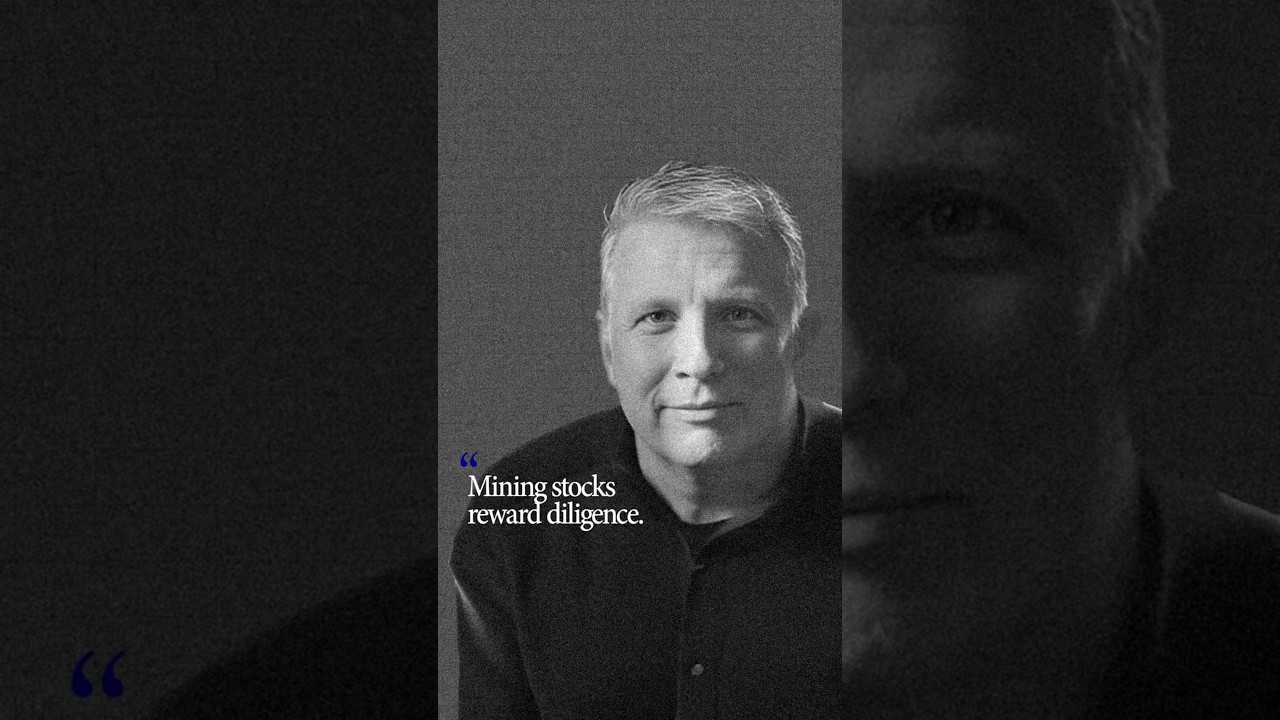
Find Conviction in Mining Stocks
- Top takeaway The guest argues that deep knowledge of a mining company — not a tip or a number on a screen — is what lets an investor see when its price is fundamentally wrong and makes it one of the easiest things to buy.
- He stresses that mining companies are more complex than other investments, with many things that can go wrong, so investors must diligently weed out companies that are not a safe home for their capital given their risk tolerance.
- The guest notes that junior miners and exploration companies can still do very well, but only for investors prepared to accept volatility that human behavior drives to extreme highs and extreme lows.
- He points out that many executing mining companies are now producing enormous amounts of free cash flow, have lowered their debt, and have good management in place.
Grant Williams argues mining demands more diligence than following the commodity price: many things can go wrong and many companies compete for capital. Junior miners and exploration companies can swing to extreme highs and lows, with volatility amplified by human behavior. Executing miners with strong free cash flow, lower debt and good management become easier to buy when you truly know them. Deep company knowledge lets you recognize when the market price is simply wrong, and those mispricings are the easiest things to buy. Conviction comes from staying on top of a company, not from a tip somebody gave you or a number on a screen.

Navigating Bull Markets: When to Buy In - And When To Sell Off | Grant Williams
- Top takeaway His top point: decide why you own precious metals before you react to the price. Bought to protect purchasing power, the pullback from roughly $5,500 to $4,000 an ounce as of mid-2026 is a return toward trend; bought on momentum and expecting $7,500, he says you should already have sold.
- He argues the metals are not in a bear market, just correcting from a move far ahead of trend — gold took about 6,000 years to clear $3,000, and $4,000 was written off as a gold-bug fantasy for the previous 25 years.
- His sell signal is attention, not price: when precious metals become the story everywhere and everyone asks whether to buy, he treats that as the moment to lighten up and hold dry powder, and he counts himself among investors willing to leave the last 20% of a bubble on the table.
- On mining equities he says price is the outcome, not the input, citing John Burback's line that price is a liar — you must weed out companies that are not a safe home for your capital, and he notes many producers now generate large free cash flow with lower leverage and good management, which makes quality names after a selloff the easiest buys.
- His macro view: US debt and deficits are unmanageable and must resolve through a growth miracle, which he thinks unlikely, or a controlled inflate-away; he still sees an upside bias for equities on abundant liquidity and the expectation that central banks step in, while watching real rates as the key gold driver and warning the Fed cannot cut rates to service $1.3 trillion of annual interest without unleashing inflation.
Gold's pullback from $5,500 looks like a return to trend, not a bear market, argues guest Grant Williams. He says broad attention to a metal's price is a signal to trim and hold dry powder - cash kept to buy weakness. Mining equities sit below the metals, but he warns they carry far more operational risk than buying metal itself. He argues real interest rates are the key driver of gold, and any thesis built on lower rates is already in trouble. Silver remains his currency-debasement hedge at a low cost basis, held regardless of the round trip from $120 to $60.

Gold Is Not Just a Momentum Trade
- Top takeaway Argues the reason for owning gold matters more than short-term price action: investors accumulating it to hedge inflation, preserve purchasing power and cushion their portfolio are being well served, and he expects that to continue over time.
- Says that as of July 2026, momentum traders who bought gold purely on price breakouts and expected a run to $7,500 should have sold already, because the momentum has gone out of the move.
- Acknowledges investors who bought near $5,500 may be stressed, framing that anxiety as a sign they never understood why they own gold in the first place.
Your reason for owning gold should dictate when you sell: momentum buyers exit when momentum fades, while purpose-driven accumulators hold. Grant Williams tells traders who bought the breakout expecting $7,500 that the momentum trade is over and they should have sold. Buyers accumulating gold to hedge inflation and preserve purchasing power are being served, and the speaker expects that to continue.

Here's The Latest Outlook From Lacy Hunt, Ed Dowd, Lyn Alden + A Dozen Other Experts
Highlights from the Spring 2026 Thoughtful Money conference featuring 15+ expert speakers discussing macroeconomic trends and recession risks. Lacy Hunt delivered the keynote address, followed by presentations from Ed Dowd, Luke Gromen, Brent Johnson, and Lyn Alden among others. Jeff Clark provided a bonus video focused specifically on gold and silver mining stocks for resource investors.
Key Quotes
"When U.S. Treasury sanctions froze Russia's reserves, something snapped in global finance. Gold is rising because trust is collapsing."
— Pinnacle Digest interview on gold, war, and what comes next
"Gold's rise has just begun. There are very smart people that make a cogent argument as to why this could go on for a materially extended period of time."
— MacroVoices podcast appearance
"The buy-the-dip era may be over. The structural forces reshaping currencies and trust in the monetary system are fundamentally different now."
— Pinnacle Digest interview
Key Works
Biweekly podcast featuring long-form conversations about macroeconomics, precious metals, and the shifting financial landscape
Financial media platform co-founded by Williams providing in-depth video interviews with leading investors and market thinkers
Widely-read newsletter covering macro themes, gold, and unconventional thinking about financial markets
Specializations
Disclaimer: Grant Williams has NOT endorsed this platform and is not affiliated with Pixys in any way.