Robert Eckford
CEO | RUA Gold | Chartered accountant rebuilding a historic New Zealand gold district
"CA-trained CEO rebuilding the Reefton gold district for RUA Gold"
Officer Roles
Biography
Robert Eckford is CEO of RUA Gold Inc, a junior gold explorer (TSXV: RUA, OTCQX: NZAUF) advancing the historic Reefton goldfield on New Zealand's South Island. For resource investors he matters because he is leading the rebuild of a district that historically produced more than 2 million ounces of gold — and his financial background shapes how that rebuild is funded and reported.
Eckford is a Chartered Accountant (CA ANZ) with a career spent inside mining finance. He progressed from audit and consulting work to senior executive roles in junior and mid-tier mining, and joined RUA Gold as Chairman before stepping into the CEO role. That pathway — auditor to executive-track mining leader to operator-in-chief — is unusual for a junior-mining CEO and shows up in the company's disciplined approach to capital and disclosure.
At RUA Gold he leads work across two district-scale New Zealand gold projects: the Reefton Goldfield on the South Island and the Glamorgan Project in the Hauraki Goldfield on the North Island. Under his tenure the company has run aggressive drill campaigns — at one point 10 drill rigs turning at Reefton — and is working toward first production in 2026 while broadening its investor base from Australasia to North America and Europe.
For junior-mining investors, the signal is the combination: a CA-trained CEO running a district-scale exploration story who treats dilution, drill-budget pacing, and AISC discipline (All-In Sustaining Cost — the total cost to keep a mine producing per ounce) as non-negotiable. That lens matters when most junior gold stories live or die on capital structure, not drill assays.
Videos (14)

Rua Gold ($RUA | $NZAUF): Unlocking Reefton’s Historic Goldfield
Reefton's Old Creek targets first antimony-gold concentrate by mid-2028 from a 25,000 oz/year starter mine with $130M CapEx. Nine undrilled historic mines at Reefton support a hub-and-spoke expansion that could roughly double throughput. Antimony co-product (25% antimony, 80 g/t gold) drew metal trader Mercuria into a $5M strategic investment. New Zealand's fast-track permitting compresses mine approvals to about six months; application is due October. Three oversubscribed, warrant-free raises let Rua Gold fund the permitting path with minimal dilution overhang.

Robert Eckford: Why Gold Will Keep Running for Another 5 Years
Robert Eckford argues gold has another 3-5 years of upside as US deficits persist across parties and central banks keep buying. Central banks are price-agnostic, multi-year gold buyers, and institutions that follow them push equities to catch up to the metal. Rua Gold ran a small PEA early so New Zealand would fast-track a six-month permit for Old Creek inside the Reefton district. A hub-and-spoke plan turns Old Creek into the first mine feeding a central mill, with Glamorgan as high-upside exploration leverage. Roughly $29.5M cash and no warrant overhang let Rua plan $130-150M of project financing and a 2027 Reefton build decision.

Gold & Silver Opportunities: Discovery, Development & Growth | July 16, 2026
- Top takeaway Eckford says his single most important milestone is having Rua Gold fully permitted within 12 months, starting with a mine permit submission at the end of October 2026 and completion by Q2 2027.
- He says jurisdiction is the decisive factor for investors and that New Zealand's differentiator is permits in six months, with the fast-track decision expected any day in July 2026.
- He takes a deliberately conservative view of antimony, modelling about $20,000 a tonne to reach the 70/30 revenue split and declining to forecast the price, while saying the project should stand on gold alone with antimony as a byproduct.
- Eckford says the antimony matters most because it places the project inside the critical minerals debate with China, giving it political support with domestic and foreign governments and project certainty that peers lack.
- He says the January 2026 raise was oversubscribed, with a book above $70 million against a $30 million target, and that institutions are sitting on surplus cash but are now very selective about where they deploy.
Central bank buying of over 850 tonnes took gold to record levels in January 2026, and the panel says producer margins sit at historic extremes. Silver is heading into a sixth straight year of supply deficit, with annual mine output falling from 1.2 billion ounces toward 800 million. Robert Eckford argues jurisdiction now outranks project size, and points to New Zealand's six-month permitting as the competitive edge. Peter Espig's rule: fund projects that are not yet cash generative with equity, and reserve debt for producing mines expanding output. Chris Kerlow uses a barbell portfolio — about 80% in large producers, 20% in juniors expected to generate most of the returns.

What's Behind the GOLD Crash? 'All the Fundamentals Still VERY Strong'
- Top takeaway Calling the fall in gold from its highs a healthy pullback rather than a broken trend, he argues the fundamentals are still very strong and says he is buying gold equities, Rua Gold included, at what he sees as discounted prices.
- He expects an extended Iran war to keep pushing fuel costs and inflation higher while central banks cannot lift rates to offset it, which he argues leaves holding gold as the only way to preserve value.
- He reads central bank buying of about 244 tonnes in Q1 2026, running ahead of the prior two quarters, as a structural shift away from the US dollar that will not reverse.
- He does not expect gold equities to catch up to the metal and is relaxed about it, arguing depressed valuations leave room for the consolidation and M&A the sector needs.
- Drawing on work in Australia, the DRC and South America, he warns that commodity booms invite higher taxes and a bigger state take, so he tells investors to be comfortable with the jurisdiction they back.
Robert Eckford calls gold's slide below $4,000 a buying opportunity, saying the pullback is healthy and the fundamentals behind it are very strong. Central banks bought about 244 tons in Q1, 17% more than Q4, and are shifting out of dollars into gold. War-driven inflation, not rate hikes, should send investors back to gold as the liquid holding that outpaces rising prices. Gold equities still lag the metal, with Newmont's multiple compressed toward six times earnings despite a 30-year mine life. Rua Gold targets a 2027 build at Auld Creek after a positive PEA, funded by a $33 million raise from institutional holders.
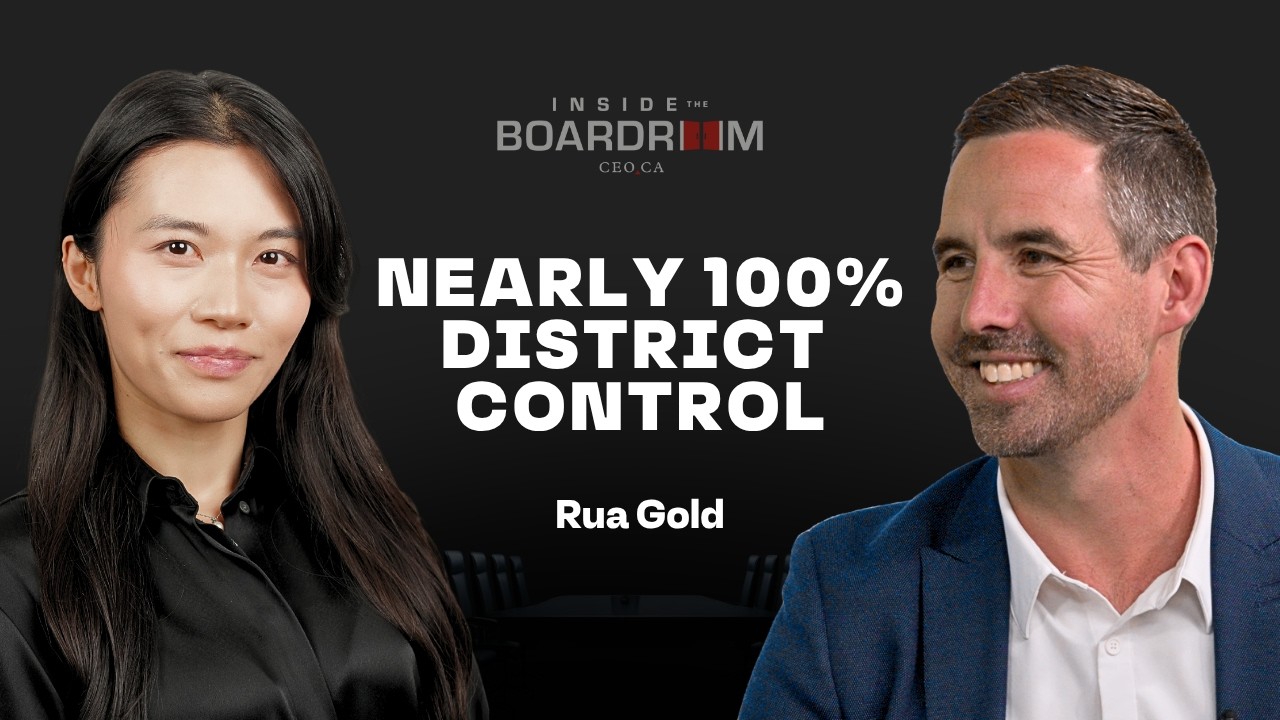
Rua Gold Anticipating July Decision on New Zealand Fast Track Qualification
- Top takeaway Makes the near-term permitting decision the crux of the investment case: an application for six-month permitted-project status is lodged with a result expected in early July 2026, followed by the pre-feasibility study and mine application by the end of October 2026.
- Concedes the Old Creek PEA is modest and 'not blowing anyone's socks off', arguing its real function is to demonstrate an economic project that creates jobs and foreign investment to the New Zealand government rather than to set the company's value.
- Claims investors are not capitalising the PEA economics at all, and reads strong support from larger institutions as validation that the company is delivering exactly what it said it would.
- Positions gold as the main revenue source with antimony as the permitting and diplomatic accelerant, noting New Zealand's resource minister used the company as its corporate example in a critical minerals roundtable attended by the US, Korean, Japanese and Australian representatives.
- Identifies the 7 November 2026 New Zealand election as the single biggest risk to the story and frames management's job as front-loading the mine application so the six-month process is secured before any change of government.
Roughly $130M capex, including a $30M contingency, against a market cap near $150M makes the starter mine financeable. The PEA (Preliminary Economic Assessment) shows a net present value of $40-45M at $3,300 gold, near $120M at spot. A 20,000-metre drill program extends the deposit from 200 to 500 metres deep ahead of a Q4 2026 pre-feasibility study. Antimony byproduct, not gold, is the permitting lever, and the guest says a starter mine could outproduce all of Australia. A six-month fast-track permit decision is expected in early July, with New Zealand's November 7 election the main schedule risk.

New Zealand’s Critical Mineral Story
Rua Gold started as a high-grade gold exploration project in New Zealand and has evolved into a combined gold-antimony story with strategic importance. New Zealand's more pro-mining government creates a favorable policy environment for mineral development and expanded land packages. Antimony's growing role as a critical mineral adds economic, political, and global significance to the project beyond its gold potential.

Why Drill For Five Years?
Rua Gold CEO Robert Eckford argues that proving up a smaller, high-grade resource first and moving quickly to production de-risks the project and generates internal cash flow. This faster path to production creates self-funding exploration, allowing the company to finance broader drilling across a much larger land package without relying on external capital. The strategy contrasts with the common junior miner approach of drilling for years before generating any revenue, which Eckford views as unnecessarily dilutive for shareholders.

Don’t Wait Longer - Rua Gold’s Perfect Timing
Rua Gold is advancing its Reefton project on New Zealand's South Island toward a PEA (Preliminary Economic Assessment — an early-stage study estimating project economics) in 2026, targeting low CapEx and fast cash flow from historic gold workings. New Zealand's fast-track permitting process and shifting political support for mining give Rua Gold a regulatory advantage, with the CEO citing strong backing from government, community, and local stakeholders. The company holds additional discovery upside at its Glamorgan project on the North Island, where pending drill permits could unlock a second value driver alongside Reefton's near-term production potential.

Management Teams Matter Most
Robert Eckford argues that strong management teams are the most critical factor for investment success in resource markets. Investors should prioritize backing proven operators who have successfully built, financed, and executed projects before. Experienced management teams protect their reputations and significantly reduce the operational risks associated with mining investments.

Rua Gold ($RUA | $NZAUF) Investor Webinar: Gold, Antimony, and New Zealand's Mining Renaissance
- Top takeaway His central argument is that the PEA is a floor, not the plan: he insists Rua Gold will not build the 200,000-ounce Old Creek starter mine as designed, and that the October 2026 PFS plus deeper drilling will show a much larger, multi-generational Reefton mine.
- He frames New Zealand's November 7 election as the driving deadline — the mine application must be in by October 31 so the project is locked into the six-month fast-track regime even if a less pro-mining government wins.
- He is personally working the critical-minerals channel: early-stage dialogues with Japanese, Korean and US offtakers on antimony offtake and possible floor pricing, with trips to New Zealand and Washington planned in the weeks after the webinar.
- He casts himself as a company builder rather than a long-term operator: he left Aris at $1.5 billion to join a $20 million company and argues a mining engineer should run Rua once it is a steady-state producer.
- He is candid about antimony price risk — at $15,000/t versus the $27,000/t base case the current Old Creek plan would not make money — and argues the answer is more ounces and throughput before any build decision.
A preliminary economic assessment (an early-stage mine study) shows Rua Gold's first 200 meters at Old Creek already generate a profitable starter mine. CEO Robert Eckford plans a pre-feasibility study by October, backed by a 20,000-meter drill program that is adding ounces and grade. New Zealand's six-month fast-track permitting drives the rush: the mine application is due 31 October, ahead of a 7 November election. Antimony (a critical metal China restricts) is about 35% of expected revenue and draws Japanese, Korean, and US offtake interest. Eckford warns the deposit stops paying if antimony falls to $15,000 per ton, and Glamorgan's epithermal upside remains undrilled with permits expected in Q2.

RUA Gold ($RUA) CEO Reveals High-Grade Gold, Fast-Track Permits & Near-Term Production Strategy
- Top takeaway Eckford argues New Zealand's six-month fast-track permitting changes project economics: it lets Rua permit a roughly 500,000-ounce Reefton resource straight into production instead of drilling for years, maximizing IRR and NPV in a way he prefers over US and Canadian grant programs that still leave projects waiting up to five years to permit.
- He lays out a two-track plan, de-risking Reefton toward cash flow while running a binary discovery drill campaign at Glamorgan, and says the board will decide after the first 5,000 meters up north whether to ramp exploration there or move Reefton toward project financing.
- He plans to fund much of the Reefton mine through non-dilutive antimony offtakes under confidentiality agreements with governments and offtakers, and expects to still hold C$15-20 million in cash in Q1 2027 after the first 5,000 meters of drilling and a submitted mine permit application.
- On the end game, he describes himself as a builder rather than a steady-state operator: Reefton is not for sale, but a tier-1 North Island epithermal would be joint-ventured or sold once its size and valuation are proven, and management and the board will eventually hand over.
- He makes the district-scale case that Rua's seven historic Reefton mines, all open and unexplored at depth, could hold around 5 million ounces by analogy with Enduro's 800,000-oz depth find, and says Old Creek is a multi-million-ounce deposit with a planned seven-year initial mine life intended to grow into a 40-50 year operation.
New Zealand's six-month fast-track permitting lets Rua Gold compress the explorer-to-developer timeline, turning a regulatory edge into faster time-to-value. A Reefton starter mine on roughly 200,000 ounces at 4.5 grams per tonne gold, with high-grade antimony, anchors the near-term production plan. Glamorgan, an undrilled epithermal (a hot-spring vein system that hosts tier-one gold deposits) beside Oceana Gold's WKP discovery, offers binary discovery upside. The antimony byproduct could fund the Reefton mine non-dilutively, with advance off-take discussions underway among governments seeking critical-mineral supply. A C$35 million treasury, 114 million shares out, and a board that has built eight mines support disciplined capital allocation toward production, not perpetual exploration.

Rua Gold's Path to Production
- Top takeaway Eckford argues Rua Gold's edge is permitting speed: prove up a small, high-grade deposit and use New Zealand's fast-track permit process to reach a permitted mine sooner than peers.
- He targets submitting a mine permit application by the end of 2026 and having a fully permitted mine ready for construction by April 2027.
- He expects to publish a PEA around May 2026 on the roughly quarter-million-ounce deposit the company is designing a mine around, and forecasts a positive NPV.
Rua Gold aims to prove up a small, high-grade deposit and outpace peers by using New Zealand's fast-track mine permitting process. Management plans to submit a mine permit application by the end of 2026 and be fully permitted for construction by April 2027. A PEA (Preliminary Economic Assessment — an early study of mine economics) is forecast next month, with management expecting a positive NPV (net present value).

Don Durrett & John Feneck Interview Rua Gold ($RUA | $NZAUF) CEO on Exploration Strategy
- Top takeaway Argues Rua's defining feature is a fast pathway to cashflow, with a PEA around May 2026, a mine permit application by end of 2026 and full permitting by April 2027, enabled by New Zealand's six-month fast-track permitting and a board and management team that has built mines eight times over.
- Frames the roughly 200,000 oz high-grade starter mine (circa US$90-110 million CapEx, about 200 jobs) as the piece that pays for the plant and covers costs, with every additional ounce, including depth below 200 metres, treated as upside.
- Positions Reefton's gold-antimony grades (over 1% antimony) as New Zealand's biggest known critical mineral deposit and a Western-supply story, pointing to New Zealand's new MSP membership and interest from Mercuria and Asian strategics.
- On political risk, argues a Labour-led government would slow permitting (perhaps 2.5 years versus six months) rather than stop the project, since the sub-hectare underground mine sits outside conservation land and the plant and tailings are being permitted with expansion capacity built in.
- Describes himself as a builder of right-sized mines, saying $90-110 million CapEx is his wheelhouse rather than a billion-dollar build, and calls a big North Island epithermal discovery 'elephant hunting country' that Rua would JV with a major rather than develop itself.
Rua Gold is fast-tracking a small, high-grade gold-antimony starter mine in New Zealand's Reefton district, targeting a fully permitted mine by April 2027. New Zealand's six-month permitting and a PEA (Preliminary Economic Assessment, an early study of mine economics) due within a month anchor the path to production. Grades above 1% antimony, roughly 20 times what the CEO cites at Perpetua's Utah project, would make Reefton New Zealand's biggest critical mineral deposit. About $63 million raised since October leaves a strong treasury and sticky institutional shareholders, including metals traders seeking future antimony offtake. Analysts see contained political risk: the pro-mining South Island and fast-track approval shield the project even if government changes, with $4,000-plus gold underpinning economics.

Rua Gold’s ($RUA | $NZAUF) 2026 Catalysts and Path to Production
- Top takeaway His central call is that Rua Gold will be on New Zealand's fast-track list by June 2026 and could hold a fully approved, shovel-ready starter mine by mid-2027, a pace he argues surpasses most junior mining peers.
- He argues Auld Creek's antimony is a durable second leg: about 90% of supply sits with China, Russia and Tajikistan, demand is price-inelastic because antimony is a small cost in larger products, and gold underwriting the mine keeps the byproduct viable even with prices back near $30,000/tonne from the $60,000 spike.
- He presents 2026 as news-rich: Rua hit all its Q1 catalysts, expects to meet Q2 targets, and will keep four-rig-scale drilling delivering a steady stream of exploration updates and intercepts through the year.
- He argues Rua's low-footprint underground approach — collaborating with the Department of Conservation on water testing and pest control — is affordable because roughly $1,600/oz AISC against $4,500/oz gold at the time of the interview leaves margin to give back to the region.
- On alignment, he says management owns much of the company and wrote checks into every financing, noting he took a pay cut leaving a producer like Aris Mining to build Rua for the equity upside.
New Zealand's fast-track permitting — proven by a 114-day mine approval — collapses the discovery-to-production timeline that typically stalls junior miners. Pairing gold with New Zealand's largest antimony inventory gives Auld Creek two revenue streams, with gold underwriting the mine while antimony adds critical mineral optionality. Antimony supply sits about 90% with China, Russia, and Tajikistan, while its small cost share in end products keeps demand price-inelastic. A planned 50,000-ounce starter mine with AISC (All-In Sustaining Cost — what it really costs to produce an ounce) near $1,700 versus $4,500 gold implies high margins. Institutional backers like Franklin Templeton and Eric Sprott, plus a no-warrant cap table with 41% institutional ownership, signal alignment ahead of 2026 catalysts.
Key Quotes
"New Zealand might just be the best mining jurisdiction in the world."
"New Zealand's underexplored potential for high-grade gold deposits combined with the government's pro-mining stance creates a favorable regulatory environment for explorers."
"We have 10 drill rigs turning at the moment"
Key Works
Advancing high-grade gold and gold-antimony exploration across multiple prospects in New Zealand's historic Reefton Goldfield
Key Rua Gold project in the Reefton Goldfield with significant gold-antimony mineralization potential
Specializations
Disclaimer: Robert Eckford has NOT endorsed this platform and is not affiliated with Pixys in any way.