Rory Johnston
Founder & Commodity Market Researcher | Commodity Context | Oil & Energy Specialist
"Data-driven oil market analysis and supply shock scenario modeling through Commodity Context"
Biography
Rory Johnston is the founder of Commodity Context, a data-centric, visualization-forward oil market research platform published on Substack. He has established himself as one of the most respected independent voices in global oil market analysis, known for combining rigorous data analysis with clear, accessible commentary on crude oil supply-demand dynamics, forward curves, and geopolitical risk.
Johnston's research focuses heavily on the intersection of oil supply constraints, demand destruction scenarios, and geopolitical disruption. He gained significant attention for his detailed analysis of how oil prices could surge to $200 per barrel or beyond under certain supply shock scenarios, walking through the mechanics of how lost production volumes force demand destruction at ever-higher price levels. His work has been featured on Bloomberg, where he outlined the case for extreme oil price outcomes based on fundamental supply-demand imbalances rather than speculation.
As a frequent guest on leading financial and commodity-focused podcasts—including MacroVoices, Palisades Gold Radio, Bankless, and others—Johnston has built a reputation for providing level-headed, data-driven analysis during periods of extreme market stress. His commentary on the Strait of Hormuz crisis, OPEC dynamics, and the Iran war's impact on global oil flows has made him a go-to expert for investors trying to navigate energy market volatility.
Johnston publishes thematic deep-dives, monthly data reports, and a weekly market wrap-up through Commodity Context, providing subscribers with institutional-quality oil market research. His approach emphasizes chart-driven analysis and forward curve interpretation, making complex market dynamics accessible to both professional and retail investors. For commodity and mining investors, Johnston's work is particularly valuable for understanding the energy cost inputs that affect mining operations and the broader macroeconomic environment that drives resource demand.
Videos (3)

Rory Johnston: What Everyone Is Getting Wrong About The Oil Price Amidst Iran War
- Top takeaway Argues that as of mid-July 2026 the real story is refined products, not crude: diesel crack spreads above $80 a barrel put diesel at roughly twice the price of crude, making crude arguably the loosest part of the oil complex.
- Says the post-ceasefire mini-glut is already over: Hormuz exits collapsed from about 15 million barrels a day in late June to 7.5 million, and with inbound empty tankers drying up he expects Gulf producers to load only as much cargo capacity as reaches the Gulf.
- Estimates the world is still in a couple-million barrel-a-day deficit even with every offset maxed out (Middle East loadings down 10 million bpd versus pre-war, China still down 5), and warns that sustained low Hormuz flows bring serious problems by September, with $200 oil possible again if China fully returns to the market.
- Calls China's reaction the biggest story of the crisis: a 5 million bpd (about 45 percent) crude import swing between February and June, larger than the IEA's record 400-million-barrel SPR drawdown, likely explained by unobserved refined-product stock releases and possibly a deliberate dry run of its 'Malacca dilemma' resilience.
- Contends strategic stocks are not inventory (an SPR release is a supply boost, refilling is a demand boost) and argues about 300 of the remaining 320 million US SPR barrels could still be drawn in a crisis, since the 252.4-million-barrel statutory floor only blocks non-emergency releases.
Prompt time spreads swung from $2 backwardation to contango and back within a month, volatility the guest calls unprecedented. Gulf loadings are capped by inbound empty tankers, not production: Hormuz exits fell from 15 million to 7.5 million barrels daily. China's 5 million barrel-a-day import swing, likely hidden product stock draws, did more than the entire IEA strategic release. Refining, not crude, is the real bottleneck: diesel cracks above $80 a barrel make diesel twice the price of crude. The world still runs a multi-million barrel daily deficit even with every offset maxed, risking $200 oil if China returns fully.
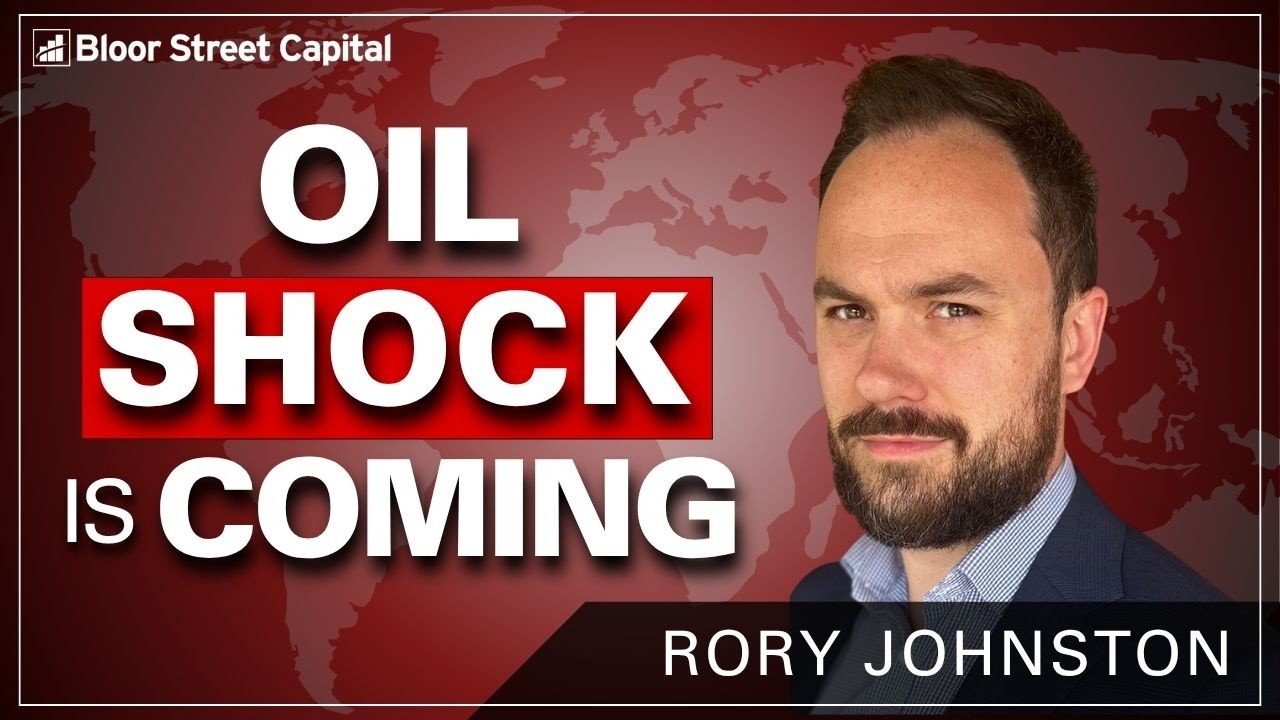
No Stopping Oil Price Shock | Rory Johnston and Jimmy Connor
About 13 million barrels a day remain shut in, yet WTI (the US crude benchmark) sits near $100 because inventories have not yet confirmed scarcity. Repeated White House posts knock $10-15 per barrel off crude within minutes, stopping traders from accumulating upside length while the deficit builds. Chinese refining data is the most bearish signal in the market: throughput has slumped while mobility stays strong, pointing to hidden strategic stockpile draws. The UAE left OPEC after absorbing over half of Iran's attacks and chafing at caps on its expanded capacity, leaving a more Saudi-led group. If the shut-in volumes stay offline past June, the guest expects Brent (the global crude benchmark) above $150 en route to $200.

$200 Oil and Impact on Global Economy | Rory Johnston and Jimmy Connor
- Top takeaway Argues oil near $100 is firmly too low given the Hormuz closure and expects a grind of $2–3 a barrel higher every day it persists.
- Sees the inflation-adjusted record near $200 a barrel reachable this year — possibly by end of April — if the strait stays closed two to four more weeks.
- Calls the IEA's 400-million-barrel release the largest in history but only a band-aid against a 15–20 million barrel a day loss.
- Says Russia is the war's biggest winner, with a year of sanctions pressure unwound in two weeks as every Asian buyer chases its barrels.
- Has never been more bullish on immediate energy exposure, but warns energy stocks don't do well in the recession-or-worse conditions a prolonged closure risks.
The Strait of Hormuz closure removes roughly 20 million barrels a day — about a fifth of global oil supply — rivaling peak-COVID demand destruction. Rory Johnston argues oil near $100 is firmly too low and sees the inflation-adjusted record near $200 as reachable this year if the closure persists. Refined products are cracking first: Asian jet fuel spiked past $200 a barrel, and diesel cracks near $60 imply $150–$160 effective costs. The IEA's 400-million-barrel release, the largest ever at roughly 3 million barrels a day, is a band-aid against a 15–20 million barrel daily loss. Johnston is at his most bullish ever on near-term energy exposure, but warns energy stocks do poorly in the recession-or-worse conditions this crisis risks.
Key Quotes
"We can't fill out much supply, which means that as long as those production assets remain shut in, we're going to need to destroy that volume of demand globally so the industry doesn't basically rip itself apart, and that means ever higher and higher and higher prices."
— Substack interview on oil market supply constraints
"If the situation continues, demand destruction will become inevitable, potentially forcing prices to astronomical levels."
— Palisades Gold Radio interview
Key Works
Data-centric, visualization-forward oil market research platform featuring thematic deep-dives, monthly data reports, and weekly market wrap-ups
In-depth discussion on crude oil forward curves, supply-demand dynamics, and potential upside breakout scenarios
Analysis walking through the scenario mechanics of how oil prices could reach $200 per barrel under extreme supply disruption
Specializations
Disclaimer: Rory Johnston has NOT endorsed this platform and is not affiliated with Pixys in any way.