B2gold Corp
BTGB2Gold Corp. operates as a gold producer with three operating mines in Mali, the Philippines, and Namibia. It operates the Fekola Mine in Mali, the Masbate Mine in the Philippines, and the Otjikoto Mine in Namibia. The company also has an 25% interest in the Calibre Mining Corp.; and approximately 19% interest in BeMetals Corp. In addition, it has a portfolio of other evaluation and exploration assets in Mali, Uzbekistan, and Finland. The company was incorporated in 2006 and is headquartered in Vancouver, Canada.
Score
—Data Quality
Market Cap
N/A
Total valuation
Stock Price
N/A
Latest close
Free Cash Flow
N/A
Annual
Financial Position
N/A
Cash position
PEG Ratio
ⓘN/A
P/E ÷ growth
Analysis
Subscribe to see the AI Analysis
Score breakdown, criteria, red flags, bull/base/bear scenarios.
SubscribeFinancials
Asset Pipeline
Subscribe to see the Asset Pipeline
Jurisdiction exposure, project portfolio, cost structure.
SubscribeInformation
Key Information
Legal Entity
B2gold Corp
Sector
Precious Metal
Founded
June 24, 2008
Employees
2,212
Reporting Currency
CAD
Contact Phone
16046012962
Website
www.b2gold.comHeadquarters Address
Park Place , Vancouver , BC V6C 2X8 , CA
Identifiers
Commodity Portfolio
Stock Exchanges
Organization
Chart
Interactive chart powered by TradingView. Use the chart tools to analyze price trends.
Videos
Lab Report | Oct 7 Deep Dives on Southern Cross, Goliath, Prospector Metals, and Vizsla
Key Highlights
brief- In the Prospector Metals discussion, the host notes B2Gold is a backer of the company.
Valuing drill intersections per gram of in-situ metal is a quick way to compare high-grade hits and bulk tonnage on equal terms. Closer-spaced infill drilling that lifts grades, as at Southern Cross Gold, signals a system improving like a mine rather than shrinking. Goliath's broad low-grade zones between high-grade veins could suit block caving, bulk underground mining at roughly open-pit cost. A mineral resource estimate published before the mining method is settled can cap a project's value; follow it quickly with economics. Sentiment lags the metals: gold, silver, and copper are in bull markets while junior mining equities still price like a bear market.
John Feneck: Why These Critical Metals Will Explode Higher, 'Uncharted Territory' For Gold
Key Highlights
brief- B2Gold's mine in Mali traded at a big discount to the majors and then rocketed higher once political risk in the country was resolved, according to the guest.
- He uses it to show when he is willing to take jurisdictional risk: only where he feels he has a leg up and knows the country well, rather than anywhere the resource happens to be.
The guest keeps gold's bull case intact through a painful consolidation, with $3,900–$4,000 support and $3,600 the next test if it breaks. He argues the Federal Reserve has no more bullets for aggressive hikes, calling current bond yields the highest since 2002. His portfolio uses GDX and GDXJ (gold miner sector ETFs) as a hub, then adds juniors and developers seen as eventual takeover targets. Critical minerals now make up roughly a quarter of his book, anchored by tungsten names as China supplies 81% of world output. He favours Nevada and Colombian explorers over riskier jurisdictions like the Congo, where nationalization concerns warrant a bigger discount.

Why Gold Producers Are Still Undervalued: Greg Orrell on This Cycle’s Missing Retail Money
Key Highlights
brief- The guest highlights B2Gold as a major taking positions in juniors like Snowline and in South America, though it has not yet executed a buyout of those positions
- B2Gold is also named as a potential acquirer of advanced projects such as Snowline
Gold decoupled from real yields after 2022 Russia sanctions triggered central bank reserve diversification — a structural shift Orrell expects to persist. Producers still trade below historical NAV multiples because investors haven't priced in $4,500-$5,500 gold; Orrell expects multiples to expand as skepticism fades. OCM Gold Fund holds ~20-23% senior producers, 10-13% exploration/development, ~5% royalties, 5-7% silver — trims losers and lets winners compound. Agnico Eagle leads capital allocation discipline; B2Gold holds junior stakes like Snowline Gold but hasn't executed buyouts, a stark contrast to past reckless exploration. With cash below 1% while retail liquidates, Orrell sees further upside — counter-cyclical positioning in a cycle still missing wider participation.

Live Q&A with Rick Rule and Albert Lu
Key Highlights
detailed- Rick rates B2Gold a 4, saying the only reason it is not a 3 is the management transition from retiring CEO Clive Johnson, whom he does not yet know as well as his successor
- Rick expects B2Gold stock to roughly double once it works through the cost overruns and delays at its Northern Canada project, drawing the analogy to Equinox eventual recovery after a similar stumble
- Rick says Johnson handled the Mali political turmoil by flying to Bamako personally and quietly negotiating a deal rather than criticizing the government in print, and got penalized for other operators problems
- Rick flags the open question on the intermediate-term development pipeline, naming Gramalote in Colombia, and says a Clive-led team would have muscled it through in a way the market would have hated and he would have liked
Oil setup toward 2029 reflects deferred sustaining capex of $1B per day, with Venezuela reopening adding limited supply. Value prospect generators by multiplying third-party drill spend by the carried interest, then subtracting G&A — the synthetic profit measure. Anchor mining NPV discount rates to the host sovereign rate plus a 3-4% risk premium; US, Canada, and Australia use the project WACC instead. Press winners by trimming as price approaches value — Rick cut Paladin at $1.25, $3, and $6, pausing whenever a smart new buyer emerged. Northern exploration stocks typically get crushed each winter without news; March or April entries exploit the seasonal weak-handed selling.

A $549M BET ON AUSTRALIA | OceanaGold x AusGold
OceanaGold acquires AusGold for $549M, gaining Katanning — a Western Australia open-pit gold project — as its fifth asset. All-stock deal at a 44% premium to AusGold 20-day VWAP; first gold slips from AusGold 2028 target to 2029. Katanning economics: 10.3-year mine life, 1.2Moz recovered, AISC near $1,590/oz, $354M pre-production capex, 1.1 g/t grade. Value hinges on re-rating from developer 0.4x NAV to producer 0.7x NAV — a ~1.7x lift on identical ounces. OceanaGold trades at ~$11,500 per guided ounce versus Lundin Gold $32,000 and Alamos Gold $26,100 — the gap the deal aims to close.

Live Q&A with Rick Rule and Albert Lu
Key Highlights
detailed- Rule argues B2Gold has reached nameplate but not yet economic completion at Goose, with the big capital spend now behind them; if Goose operates per the feasibility study, Rule expects cash to 'gush' through B2Gold.
- He says the rest of B2Gold's assets are performing very well, but flags 'off-balance sheet challenges' from ongoing disputes with the Mali government over the satellite deposits on the Fekola concession.
- Rule cites B2Gold alongside Equinox as a recent example of a gold producer that went 'way behind schedule, way over budget' at Goose in Nunavut — a textbook case of the leverage-during-construction risk he warns about.
- He says B2Gold is already selling at an attractive cashflow multiple, but that multiple is burdened by the Goose upfront capex that still needs to amortize meaningfully.
Reading offering documents and 10-Ks is essential; Rick Rule uses a condo contract story to illustrate capital stack diligence. Rick rates First Mining Gold's Spring Pole a 6, and Agnico Eagle's Radisson stake validates Abitibi infrastructure economics. Lotus Resources' Chialecra uranium deposit isn't buildable at $80/lb given East African political and economic challenges, Rick says. Inversion technique: avoiding Doug Casey's 'gotta hunch, bet a bunch' is the surest way to fail in natural resources. In deleveraging equity plays, Rick waits for net present value of assets to exceed enterprise value before buying.
Rick Rule: Copper Has WAY More Potential Than Gold
Key Highlights
detailed- Rick flags B2Gold as a tactical acquisition candidate that is selling at a real discount to the net present value of its cash flow.
- Rick argues B2Gold holds two potential tier 1 assets, so an acquirer could buy the whole company and then sell off the tier 2 assets to reduce the effective purchase price for the tier 1 assets.
- Rick suggests B2Gold's discount should narrow if and when the company brings its northern Canadian operation to nameplate capacity.
Major copper producers need roughly $250 billion just to hold production steady — and they don't have the capital, opening a financing boom for streamers. Wheaton Precious and Franco-Nevada could be the biggest winners — silver byproducts from copper mines earn much higher multiples inside a streamer. Rule is rotating out of Franco, Wheaton, and Agnico into smaller, more speculative juniors to front-run the coming M&A wave. Most majors face a five-year depletion problem — only Agnico and Goldfield, Rule says, have near-term production covered. A red flag in royalty M&A: rapid capital deployment without a structural edge usually signals overpayment, not bargain hunting.
Heliostar - Q2 Financial Highlights, Record Gold Production, Growth Pipeline
Key Highlights
brief- B2Gold's Q2 AISC was $2,356/oz, cited by Heliostar's CEO as a peer benchmark that Heliostar matched closely.
San Agustin gold output jumped 49% quarter-on-quarter at an AISC (All-In Sustaining Cost — what it really costs per ounce) near $2,287, signaling peer-relative cost discipline. Cash hit a record $43M by quarter-end with no debt, even after a $10M outlay for the Gold Strike deposit acquisition. Silver output nearly doubled to 80,000 ounces on a leaching mix shift and San Agustin ramp-up; smelter payment-term changes pushed most silver revenue into later quarters. The 25,000-metre Ana Paula drill program anchors a mid-2027 feasibility study targeting 100,000-ounce annual output and first gold by late 2028. Operating cash is being recycled into a multi-mine pipeline including Ana Paula and Gold Strike, lining up the next 1-3 projects beyond current production.
Masterclass: Investing in Gold/Silver Mining Stocks (Part 3)
Key Highlights
brief- The host owns B2 and accepts its Mali exposure because the company is diversified, with roughly 50% of revenue coming from its Mali operations
- He draws a hard line at single-mine Mali-only producers, which he calls a no-go, but says B2's broader asset base clears that bar
Don Durrett walks through his producer, developer, and explorer checklists for getting an edge in gold/silver mining stocks. Producers must score 7-9 on his 10-point rubric: long-life flagship mines, clean balance sheets, and at least a 5x bagger at his $7,000 gold. Developers must check all six boxes: NPV at 2x CapEx or better, 25%+ IRR at spot, and at least a 10x bagger to absorb dilution. Explorers shine in bear markets because they are inelastic; buy gold in the ground below 1% of spot and enter early in the Lassonde curve. Specific calls: Alamos Gold and Kenros screen as 6x baggers in the current correction, while Vizsla Silver's NPV runs at 5x its CapEx.

Live Q&A with Rick Rule and Steve Barton
Key Highlights
detailed- Rule says B2Gold is cheap on a sum-of-the-parts basis — one of the cheapest intermediate producers globally, on par with Oceana Gold but with two tier-one deposits rather than a collection of tier twos
- Founder Clive Johnson has retired and Rule questions whether the new management can replicate Clive's ability to quietly resolve political disputes with host countries like Mali, where Barrick struggled
- Rule's investment thesis hinges on Goose (the troubled Canadian project) hitting nameplate capacity — if it does, he expects the same share recovery Equinox saw after its past-due/over-budget Canadian build
- Key political risks to handicap: Namibia, Philippines, and Mali
Rick Rule frames currency debasement and a structural copper deficit as multi-year themes, and treats the uranium pullback as a buying window rather than a topping signal. Two majors as shareholders of a junior like Founders Metals create real auction tension if a discovery is made, plus adult supervision and a tighter effective float. Rule sizes lithium as a processing-bottleneck story, not a raw-material shortage, and flags direct lithium extraction from oil and gas brines as the long-term threat to hard-rock producers. Abitibi 'orphan' deposits such as Emperor Metals can now monetize via nearby mills, removing the capex bar that once left them undeveloped in past cycles. Rule is constructive on Cameco, Origin Royalties, Alamos, Emperor, B2Gold, and Cheniere; he is cautious on lithium juniors and explicitly refuses to time the uranium market.

B2Gold CEO Mike Cinnamond on Execution, Buybacks, Dividends & Capital Allocation
Key Highlights
detailed- The CEO says the final gold prepaids (about 22,000 oz/month) rolled off at the end of June 2026, freeing roughly $90 million of free cash flow per month from July, on top of a balance sheet boosted by the $325 million Fingold sale to Agnico Eagle and the repaid revolving credit facility.
- On capital allocation, management plans to maintain the US$0.08 per share annual dividend, keep buying back shares opportunistically under an NCIB upsized in April 2026 to up to 10% of the float per year (about 130 million shares on roughly 1.3 billion outstanding), and is not planning cash acquisitions in the near term.
- The CEO says the early-April fire at Goose was contained to the crushing facility with no injuries, and that Q3 2026 fire repairs combined with the Stage 1 expansion should lift throughput to 3,200 tpd, with Stage 2 in H1 2027 targeting 4,000 tpd steady state for roughly $40-50 million in total.
- The pending Fekola Regional permit in Mali is the other near-term catalyst: the company has responded to all information requests from the Ministry of Mines and the new mining commission, expects the file to go to the council of ministers, and says a roughly three-month strip means most incremental ounces arrive in 2027.
- Management still sees the shares trading at about a 50% discount to internal NAV and argues a re-rate depends on executing Goose and Fekola Regional, helped by second-half 2026 free cash flow and the ongoing buyback.
B2Gold's gold prepaids ended in June, freeing roughly $90 million of monthly free cash flow as the producer shifts into cash-harvest mode. Goose fire remediation combines with the Stage 1 mill expansion in Q3, targeting 3,200 tonnes per day and 4,000 tpd steady state by mid-2027. Management sees shares at a material discount to NAV (net asset value), prioritizing opportunistic buybacks of up to 10% of the float yearly. The pending Fekola Regional permit in Mali is the main catalyst; a three-month strip follows approval before incremental ounces reach the mill. Q1's AISC (All-In Sustaining Cost — what it really costs to produce an ounce) beat guidance on inventory sales and capex timing, with guidance unchanged.
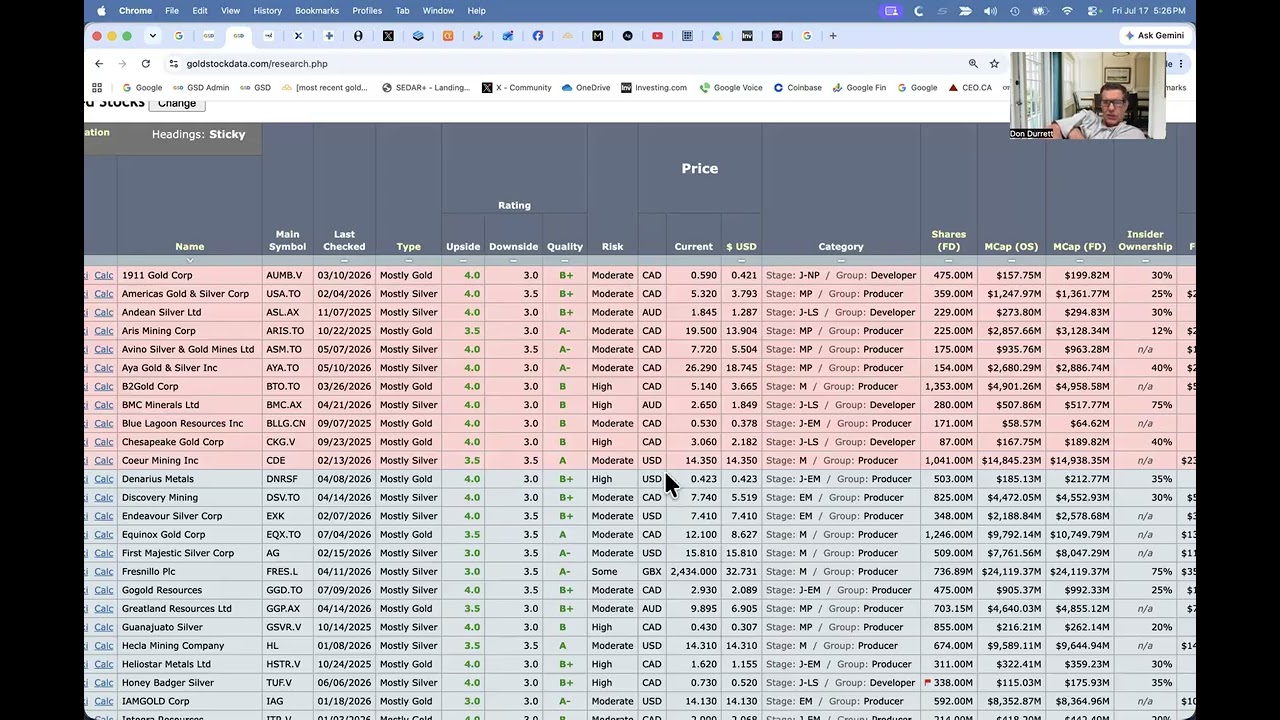
50 buy-the-dip stocks (July 17, 2026)
Key Highlights
detailed- About half of B2Gold's project sits in Mali, a country he expects many investors to ignore, which he says means the Mali asset is effectively being given away.
- As a roughly one-million-ounce producer, he argues even valuing it at a 500,000-ounce producer implies about $5B, which supports the risk/reward.
- He expects the company to grow production, notes it likes a high dividend, and rates management as strong.
He reviews 50 gold and silver mining stocks he owns, sizing the upside against $7,000 gold and $200 silver. Most of the list screens as an eight-bagger or better, and he favors undervalued producers growing output. Development names need patience: permits plus roughly two-year builds push many payoffs to 2028 and beyond. He cautions that gold and silver mining stocks are speculative, so keep allocations small and only risk what you can lose.

Pitch Rick Ep #1 - Versamet Royalties
Key Highlights
detailed- Versamet's largest shareholder at just under 30%, and the CEO says its board representative Mike McDonald is stepping up into B2Gold's CFO role.
- Sold Versamet a portfolio of just under 10 royalties headlined by Kiaka in a $90 million all-share deal, equity the CEO now values at over $300 million.
- The CEO describes B2Gold as a supportive holder on a five-year horizon, only 1.5 years in, making tremendous cash flow at current gold prices with no perceived need for liquidity.
- On the Rosh Pinah due diligence trip, B2Gold sent someone from its own Namibia mine who had previously worked at Rosh Pinah, an advantage the CEO says few small royalty companies have.
- The Kiaka royalty B2Gold sold came into production mid-last year and is ramping into a very significant cash flow contributor, per the CEO.
The CEO argues the value of Versamet's producing royalties alone exceeds its roughly $1.2 billion market cap, before counting development assets. Royalties (cuts of production, not mines) give Versamet 90% operating margins with eight staff; it trades near 10 times cash flow, well below larger peers. Gold-equivalent production has doubled annually from 5,000 ounces in 2024 and should reach a 35,000-ounce run rate once the Eskay Creek stream starts in 2027. The $360 million Eskay Creek stream was priced tightly, but Skeena's planned mine-plan upgrade could materially lift the stream's net present value. With about $370 million of debt repayable from under three years of cash flow, officers and directors own over 10% of shares.

David Lotan Shows You How to Make Junior Mining Millions: Aurion & Fox River Buyouts Explained
Key Highlights
detailed- Lotan says B2Gold was Aurion's joint-venture partner on the ground bordering Rupert's Ikkari discovery, making any takeover a tricky three-piece transaction.
- He expected B2Gold, preoccupied with Sabina and with Mali heading in dangerous directions, to divest its position; instead he believes B2Gold and Rupert worked together to squeeze Aurion out.
- Lotan also saw a pathway where B2Gold might have sold its JV stake to Aurion as the standoff dragged on, one of several outcomes that never materialized before Agnico stepped in.
Guest David Lotan built most of his Aurion and Fox River stakes buying public shares, arguing open-market bargains beat private deal access. Aurion Resources sold to Agnico Eagle Mines for C$481 million ($2.60 per share cash); Fox River Resources followed at C$94 million ($1.10 per share). Lotan ties the decade-long wait to consolidation among major gold producers; rising mid-tier buying power finally revived takeovers of juniors. The multiyear Aurion-Rupert standoff shows embarrassed, hostile bidders can drag out timelines and destroy value on both sides of a takeover fight. Management teams that refuse warrants (rights to buy future shares cheaply) and protect capital structures earn the investor trust that pays off at exit.
Adrian Day: Sentiment 'Unbelievably Lopsided' for Gold, Still 'Very Undervalued', Silver and Oil
Key Highlights
brief- The guest holds up B2Gold as a company that has been very successful running mines in wildly disparate jurisdictions, despite the overruns at Goose he mentions.
Gold's bull-bear sentiment index has collapsed below 10% bullish, a lopsided extreme the guest treats as a classic contrarian buy signal. Bullion pays no income, so the guest values gold only relatively — inflation-adjusted, against global debt and money supply — and finds it cheap. The guest times cycle tops with exponential price moves, media saturation, ETF inflows, physical premiums, and novices handing out gold tips. In mining stocks, people and balance sheets beat geology: back honest, experienced teams with access to money and committed major shareholders. Major gold producers trade at historic-low multiples, and the guest sees value in unloved oil and Asian-facing thermal coal.
Silver Stocks Will Lead the Next Bull Run | Rick Rule
Key Highlights
brief- Rule names B2 Gold as another name that screens undervalued against its peers on price versus net asset value, and notes it is not among this year's conference exhibitors.
After a 35-40% drawdown, Rule says quality mining companies now trade at discounts that make them compelling again. Mining's long underinvestment in exploration and development means companies must buy growth, setting up an M&A wave. Rule screens stocks on price versus net present value, then waits for arbitrageurs or an acquirer to close the gap. He prioritizes deposit size and grade over jurisdiction, arguing world-class ore bodies finance their own infrastructure. Silver equities offer more leverage than the metal, and he expects leadership to rotate from gold as generalist capital returns.

Live Q&A with Rick Rule and Albert Lu
Key Highlights
detailed- Rick calls B2Gold anomalously valued — cheap enough as of July 2026 — with free cash flow he describes as spectacular.
- He says the construction problems that kept the stock in the penalty box are over, with the mine ramping from economic completion toward nameplate capacity, and likens the setup to Equinox before its share price doubled.
- Rick argues B2Gold is the lowest political-risk player in Mali: while others had drama with the government, Clive Johnson quietly flew to Bamako, negotiated, and cleaned the problem up.
- Founder Clive Johnson has retired, leaving a management transition Rick says will prove either good or bad; some holders, including Rick, owned the stock partly because of him.
- He leans slightly toward B2Gold over OceanaGold because of its tier-one Fekola deposit, though he is attracted to both at current prices.
Falling share prices against rising values signal a bargain season; Rule urges investors to pre-build tiered shopping lists before forced selling creates bargains. Mining costs are inflating: consumables rise near 10% compounded versus stated CPI, so AISC (All-In Sustaining Cost — full production cost per ounce) climbs industry-wide. Rule favors uranium's remaining upside after the hated-to-not-hated move, sees a multi-year US natural gas upcycle, and still expects five-to-ten-year metals bull markets. Rule backs B2Gold and OceanaGold at low cashflow multiples, seeing resolved construction problems and quiet Mali diplomacy as mispriced strengths supporting further gold-sector M&A. Ivanhoe Mines offers compelling value for DRC-risk takers as Kamoa-Kakula repairs, a new smelter, and two more tier-one deposits reshape 2027 cashflow.

Toogood Gold ($TGC | $TGGCF): Advancing a District-Scale Gold Project in Nevada
Key Highlights
brief- The CEO says that after Prospector Metals optioned Mike Lake from Troilus Gold, B2Gold came in as a strategic holder of just under 10%, and along with Troilus's 19.9% stake these Yukon-focused shareholders left the Toogood project non-core.
CEO Colin Smith says the never-drilled Table Mountain project in Nevada is a district-scale epithermal (hot-spring style) gold system with multigram gold in surface veins. Band-on-band vein textures record boiling — the process that drops gold out of solution — pointing to shallow drill targets in an intact system. Origin Royalties and Altius Minerals found the project with airborne spectral alteration mapping, mirroring the 16-million-ounce Silicon-Merlin district nearby. In Newfoundland, the Toogood project hit visible gold in 15 of 19 maiden holes, and thin glacial cover makes soil anomalies reliable drill guides. About C$3 million in treasury and 85 million shares out fund the work, with a maiden Nevada drill planned for Q3 or Q4.

Live Q&A with Rick Rule, hosted by Steve Barton 📱
Key Highlights
detailed- Rick argues B2Gold trades at an extraordinarily low price relative to the sum-of-the-parts value of its high-quality assets, making even a company this size vulnerable.
- He sees two clouds over the stock: relations in Mali over its best mine, and a Canadian asset that is over budget and behind schedule.
- With Clive Johnson retiring, Rick says current management has maybe a year to fix the problems; if it does not, 'the symbol changes.'
- He stresses he is not predicting a takeover of B2Gold, only pointing out the vulnerability.
Rick Rule argues resource equities remain reasonably priced after two years of gains, but a 2008-style liquidity crisis could force overexposed investors to sell. Consolidation keeps rewarding shareholders: mergers cut duplicated overhead, and larger miners gain index inclusion, passive buying, and a lower cost of capital. Oil's move from $65 to $105 is anticipatory pricing for rationing, so an unresolved conflict points to higher energy prices ahead. Copper holding firm despite oil-driven slowdown and speculator selling defies Rule's expectations, an anomaly he flags without claiming an answer. In the Q&A, Rule calls Cameco's flood a buying opportunity, favors debt-free Uranium Energy, and explains net present value's blind spots on tier-one deposits.

Live Q&A with Rick Rule, hosted by Steve Barton
Key Highlights
detailed- Rule says Clive Johnson's retirement announcement gives B2Gold's management maybe a year to fix the company's problems, and if they don't, 'the symbol changes.'
- He flags two clouds over the company: its relations in Mali around its best mine, and a Canadian asset running over budget and behind time.
- He argues B2Gold's share price is extraordinarily low relative to the sum-of-the-parts value of its high-quality assets, which makes even a company this size vulnerable to acquisition.
- He says he is not predicting a B2Gold takeover, only pointing out how the math looks to acquirers.
Rule argues resource equities are not excessive despite two years of gains, but liquidity-crisis risk means checking your own exposure. Mining consolidation looks set to continue; Rule favors owning likely takeover beneficiaries because mergers cut overhead and lower capital costs. Rule calls Cameco's flood-driven sell-off a buying opportunity, since a three-month outage barely dents reserves measured in decades. Build NPV (net present value — discounted future cash flow) from measured and indicated resources only, then add back optionality for growth and tail. Development-stage mining assets deserve a basket approach across several names, Rule says, never a single speculative position.
Articles
No articles available
Published articles for this company will appear here
Want the full picture on more companies?
Be one of the first.
A room for resource investors taking shape now — independent, spam-free, no hype.