Bill Powers
Host & Founder | Mining Stock Education | Junior Mining Interviewer
"Conducting detailed interviews with junior mining executives and resource investors through Mining Stock Education"
Biography
Bill Powers runs Mining Stock Education (MSE), a platform dedicated to interviews with mining executives, geologists, and resource investors. For anyone following junior mining stocks, his channel serves as a consistent source of company-level discussions and macro commentary on precious metals markets.
Powers focuses his coverage on gold and silver explorers, developers, and producers — with a particular emphasis on junior miners, the small-cap companies that offer outsized upside but carry significant risk. His interviews typically walk through a company's asset, its stage of development, and the thesis for why the stock could appreciate. Guests have included fund managers such as Larry Lepard of Equity Management Associates, along with mining CEOs and technical specialists.
His approach is straightforward: let the guest explain their case while asking clarifying questions about grade, tonnage, jurisdiction, and capital structure — the basics that resource investors need to evaluate any junior mining opportunity. Powers does not position himself as an analyst; his value comes from curating guests and guiding conversations toward the details that matter for stock selection.
Investors can use MSE as a screening tool — a way to discover companies and hear management articulate their story directly. Powers has built a library of hundreds of interviews, making the channel a practical resource for anyone who wants to hear from mining company leadership before doing their own due diligence.
Videos (58)

Snail-Mail Stock Promos, Short Sellers & Visible Gold: Junior Mining Insights with Powers & Leni
- Top takeaway Relays that generalist funds showed up in force at Beaver Creek this year — meetings booked well in advance, with some executives reportedly taking around 100 meetings over three and a half days — and reads it as a real pickup in institutional interest in juniors.
- Sees the return of 12-to-16-page glossy snail-mail stock promos as a sign of a bigger, more heavily marketed bull phase, aimed at Gen X, later millennials and boomers who hold the cash.
- Describes selling his entire position in a NYSE-listed junior into a one-day, roughly 60% Reddit/Telegram-hype spike (after about a 100% gain in 30 days) because the real catalyst was months away; the stock later fell about 70% from that high and he bought back lower.
- Presses for accountability on both sides: anonymous offshore short reports are hard to litigate, while companies that sit on material news — he cites a setback that reached a local newspaper a week before the company's release — let others sell or short first.
Subdued retail attendance at fall forums contrasts with rising institutional interest; fund inflows look likely to favor isolated stories, not the sector broadly. Twelve-page glossy mailers promoting nickel and tungsten juniors signal heavier promotion; weighing cash, runway, and project substance beats believing the narrative. Specialization pays: pick one commodity or deposit type, learn its signals deeply, and branch out one step at a time instead of staying high-level. Visible gold claims before assays are marketing, not evidence. One company retracted its visible-gold release, so wait for verified results before acting. Site visits and concentration define the co-host's process: see infrastructure firsthand, hold 10 to 15 names, and plan the exit in advance.

Hot Tips Fade, Process Endures: How Sultan Ameerali Multiplied His Money via Junior Miners
- Top takeaway The host frames the interview around process over tips, urging listeners — especially newcomers — to be inspired by the guest's hard work and repeatable process rather than by the stock picks.
- He raises the 'Dead Internet Theory', arguing that AI mining stock channels from roughly the past six months are full of inaccurate information, including false M&A references.
- He recounts confronting an executive whose hired marketing firm flooded the internet with AI videos about the company, telling him it created a negative first impression; the executive terminated the contract.
- He contrasts PDAC with Beaver Creek: PDAC's roughly 30,000 attendees give access to service providers and countries, while a table at Beaver Creek offers more exclusive issuer access.
Asking conference organizers which companies have no meetings exposes the hated commodities, a contrarian corner the guest has turned into profitable trades. Junior mining stays persistently inefficient because information travels through niche podcasts and site visits, rewarding original groundwork over passive screen analysis. The guest runs AI as a first-year analyst: he annotates primary documents first, then lets AI summarize only what he feeds it. Automated AI bots monitor his portfolio and flag special situations (mergers, spinouts, recapitalizations), trading immediacy for breadth; he accepts never being first. Process outlasts hot tips: repeatable due diligence, risk-aware position sizing, and constructivist shareholder behavior compound an edge across a full cycle.

Farming, Not Forecasting: Malcolm Shaw on Investing in Juniors without Predicting Commodity Prices
- Top takeaway The host frames the guest's 'we don't predict, we position' tagline and contrasts it with bigger newsletter outfits that sell certainty about the future.
- He discloses that the interview wasn't sponsored and that he personally invited Malcolm on, and notes he started in 2015 with SilverStocks.
Malcolm Shaw's 'farming, not forecasting' approach focuses on junior companies that perform regardless of commodity prices, supported by a 300-name watchlist. He holds 50-60 positions but concentrates 90% of capital in his top 15, easing into and out of positions to avoid single-point timing risk. Tenaz Energy (formerly Altura Energy) is his biggest winner, scaling from a low-dollar basis on management-led deal-making; Alpha Minerals was a mining standout. Tag Oil in Egypt, where costs spiraled and results fell short, is his current loser; the lesson is that management pedigree alone never guarantees outcomes. Shaw stays inside his circle of competence, avoiding niche metals he cannot fully evaluate, while leaning on sell-side, buy-side, and peer networks for due diligence.
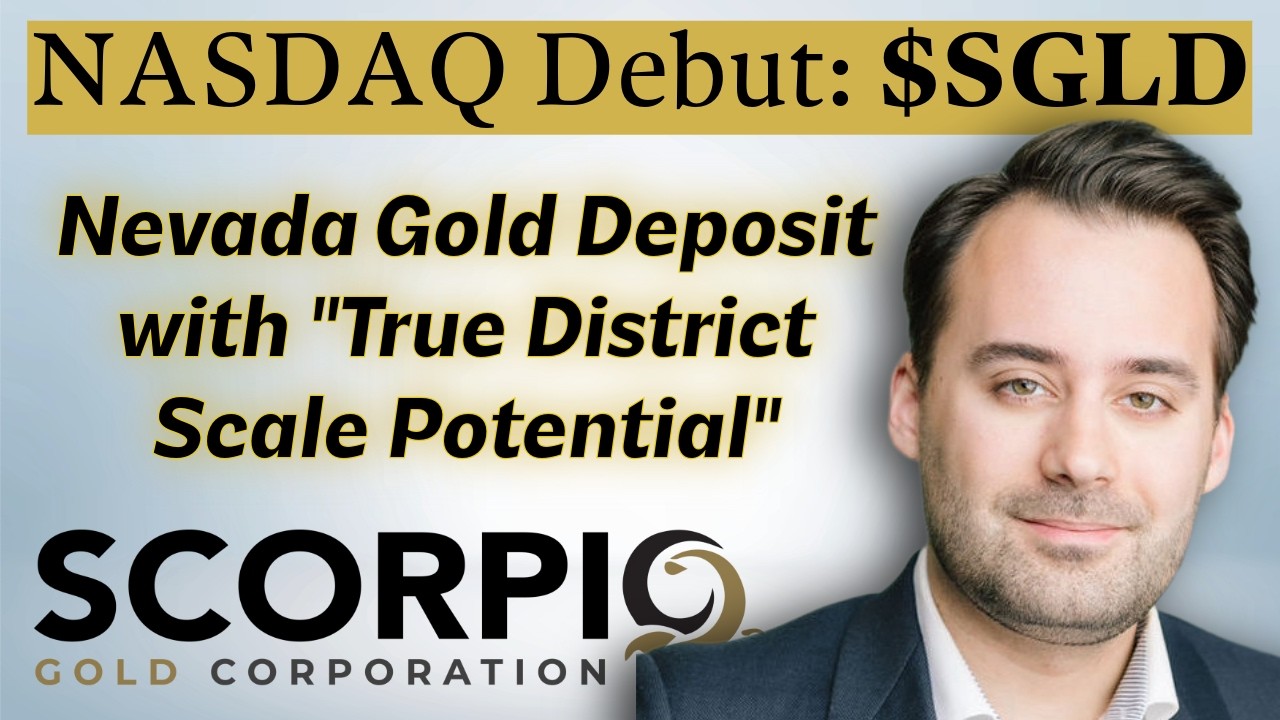
Scorpio Gold’s Nasdaq Debut ($SGLD), Manhattan District Scale Potential, and Reprocessing Upside
- Top takeaway As host of Mining Stock Education, Bill Powers frames the episode around three investor hooks: Scorpio's new NASDAQ listing under SGLD, the under-appreciated district-scale potential of the Manhattan project, and the reprocessing upside from historic Echo Bay mine material.
The guest argues the market is missing district-scale potential at Manhattan: only 2 km of an 8.5 km mineralized trend has been drilled. Scorpio Gold is targeting a 2-million-ounce resource update by end of 2026, up from 740,000 ounces, with two drills still turning in Nevada. A ~$600,000, 32-hole sonic drilling program will grade historic leach pads and waste dumps for potential toll-milling cash flow. The Nasdaq ADR (American Depositary Receipt) listing moved a larger share pool to the US, and a recent C$10.8M raise leaves Scorpio Gold with ~C$8M.
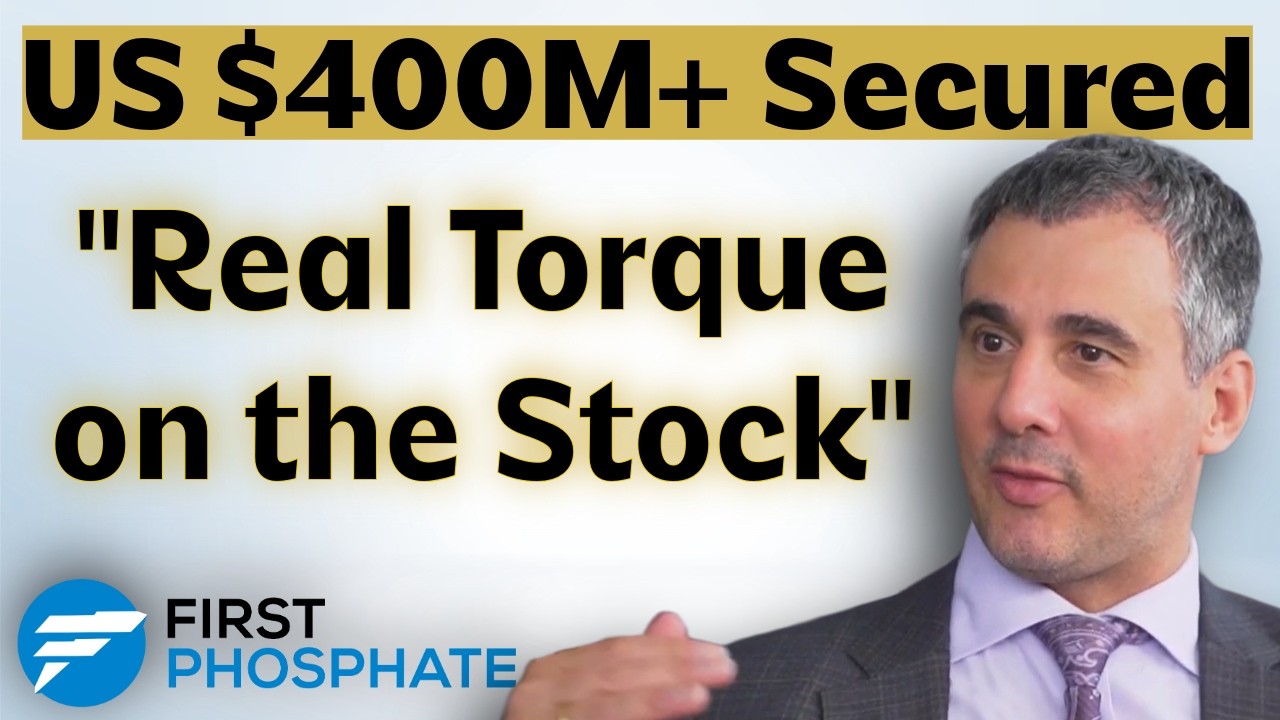
First Phosphate's Torque Moment: How Export Credit Could Kill Dilution - CEO John Passalacqua
- Top takeaway The host draws attention to First Phosphate's self-sponsored NASDAQ uplisting — done without investment banks — and suggests other Canadian juniors are envious of how well it has gone out of the gate.
- He structures the interview around how the company is assembling its capital stack to finance the mine build ahead of a feasibility study and final investment decision.
First Phosphate's CEO says Swiss (SERV) and Danish (EIFO) export credit commitments cover roughly 85% of the mine's capex (build cost), limiting dilution. Export credit agencies fund equipment purchases as debt, a non-dilutive alternative to equity that the guest calls patient, success-aligned capital. Timeline per the CEO: feasibility study in Q1 2027, permitting in 2027, final investment decision late 2027, production near the end of 2029. The company self-sponsored its NASDAQ ADR (American Depositary Receipt — a US-traded share equivalent) without an investment bank or new equity raise. Canada contributed about $21 million in non-refundable feasibility funding, and Québec is fast-tracking environmental permitting, the guest says.

Barrick–Newmont Nevada JV, Permitting Risk, Royalties, and Mine Financing | Analyst Joe Mazumdar
- Top takeaway The host argues investors should measure management on a per-share basis — adding to asset value without adding much to the share count — and says the strongest pitch is a track record of consecutive raises at successively higher prices, citing a flow-through executive's four-raise record.
- The host warns that silver juniors typically keep ATM facilities ready to sell into strength when silver runs, and cautions listeners that even deep due diligence does not guarantee outcomes — 'don't confuse a bull market with brains.'
Barrick is selling Fourmile at a steep discount, but access to permitted autoclave (pressure oxidation) capacity via Goldrush justifies it. Seabridge's KSM court setback shows Indigenous consultation now extends beyond a project's footprint, raising permitting risk across British Columbia. Major gold producers returned roughly 30% of first-half 2026 revenue to shareholders, with buybacks outpacing dividends and the top five dominating. Judge management on per-share value: grow assets without growing the share count, and favor teams that raise capital at rising prices. Coffee's upfront capital quadrupled in a decade, reinforcing the case for hunting fatal flaws early — cutoff grades, jurisdictions, and site visits.

"Contango Offers the Most Leverage to Gold on a Per-Share Basis" explains CEO Rick Van Nieuwenhuyse
- Top takeaway Bill presses Rick to separate real DSO candidates from junior miners marketing one-off bulk samples during the gold bull market, drawing out the grade-and-permitting criteria the model requires.
- Bill frames Contango's value case around next year's forecasted free cashflow versus its 33-million-share count, then asks Rick to respond to pushback that a P/E ratio is the wrong valuation lens for the company.
Contango CEO frames the company as an execution story, targeting growth from ~60K to ~200K gold-equivalent ounces plus 5M ounces of silver annually within five years. The Manh Choh JV with Kinross is the cash engine; 2025 is guided as the low-production year (~45K oz, ~$2,700 H1 AISC) with 2026 set to recover to ~75K oz at lower cost. A direct-ship-ore strategy — mining high-grade rock and trucking it to permitted third-party mills — sidesteps tailings-permitting risk across Lucky Shot, Johnson Tract, and Kitsault Valley. Balance sheet sits at roughly $47M of debt and an expected ~$50M cash position; at $4,000 gold the CEO forecasts $170M+ of free cash flow next year and plans to be debt-free by year-end. With only ~33M shares outstanding, Contango offers outsized per-share leverage to gold and silver versus typical junior producers that carry hundreds of millions of diluted shares.

Why Gold Producers Are Still Undervalued: Greg Orrell on This Cycle’s Missing Retail Money
- Top takeaway Powers frames the discussion around missing retail participation this cycle and the contrast-cyclical relationship between gold and a NASDAQ roll-over
- He notes Canadian permitting has lengthened to US-like timelines, making the time value of money difficult for investors riding through 20-year permit cycles
Gold decoupled from real yields after 2022 Russia sanctions triggered central bank reserve diversification — a structural shift Orrell expects to persist. Producers still trade below historical NAV multiples because investors haven't priced in $4,500-$5,500 gold; Orrell expects multiples to expand as skepticism fades. OCM Gold Fund holds ~20-23% senior producers, 10-13% exploration/development, ~5% royalties, 5-7% silver — trims losers and lets winners compound. Agnico Eagle leads capital allocation discipline; B2Gold holds junior stakes like Snowline Gold but hasn't executed buyouts, a stark contrast to past reckless exploration. With cash below 1% while retail liquidates, Orrell sees further upside — counter-cyclical positioning in a cycle still missing wider participation.

"Occasional Failures Are the Price of Outstanding Wins" - Rick Rule on Portfolio Discipline & More
- Top takeaway Powers observes many attendees at Rule's symposium hold too many positions, including one with 100 companies and a full-time job.
- He describes a recent pitch call where the CEO failed to appear on Zoom and the IR rep turned out to be a '90s email-scraper,' leading him to refuse the stock.
Bull-market arrogance peaks with newcomers — Rick argues the least experienced participants are usually the most confident (mistaking luck for skill). Limit your portfolio to stocks you actually study — his 'Amalgamated Aardvark' anecdote shows why understanding each holding matters more than its count. Sentiment extremes mark turning points — he bought silver when social media dismissed it as 'Buggy Whips' and sold once the love returned. Junior mining mergers stall when management self-interest blocks deals — a clean process like G2/G Mining can align incentives and get them done. Skip speculative categories without precedent — deep sea mining fails his 'probabilistic NPV' (net present value) test, so he still prefers established Rio, Glencore, and BHP.

$10,000 Gold & $300 Silver Forecast Now “Conservative” says David Erfle Junior Miner Junky
- Top takeaway Powers flags a CEO serving as lead executive of multiple juniors — especially when those companies transact with one another — as a red flag for investors, regardless of how the drill results look.
- Powers raises the buy-timing problem around small-cap financings: with cash below $3 million, he prefers waiting until the financing is announced and the company is recapitalized before buying.
David Erfle sees $10,000 gold and $300 silver by 2029 as conservative given sovereign debt dynamics and central bank demand. Despite a 32% rally in gold miners in August, juniors lagged at 13% as institutional money stays sidelined through Labor Day. A CEO leading multiple juniors at once is a red flag, but mid-tier builders adding a producing mine can be a game-changer. Strategic financings from majors like Agnico Eagle lift stock prices, while retail-brokered raises typically hit shares. Sell discipline matters: trim a third after a stock triples, then hold until a buyout or peer-driven overvaluation.
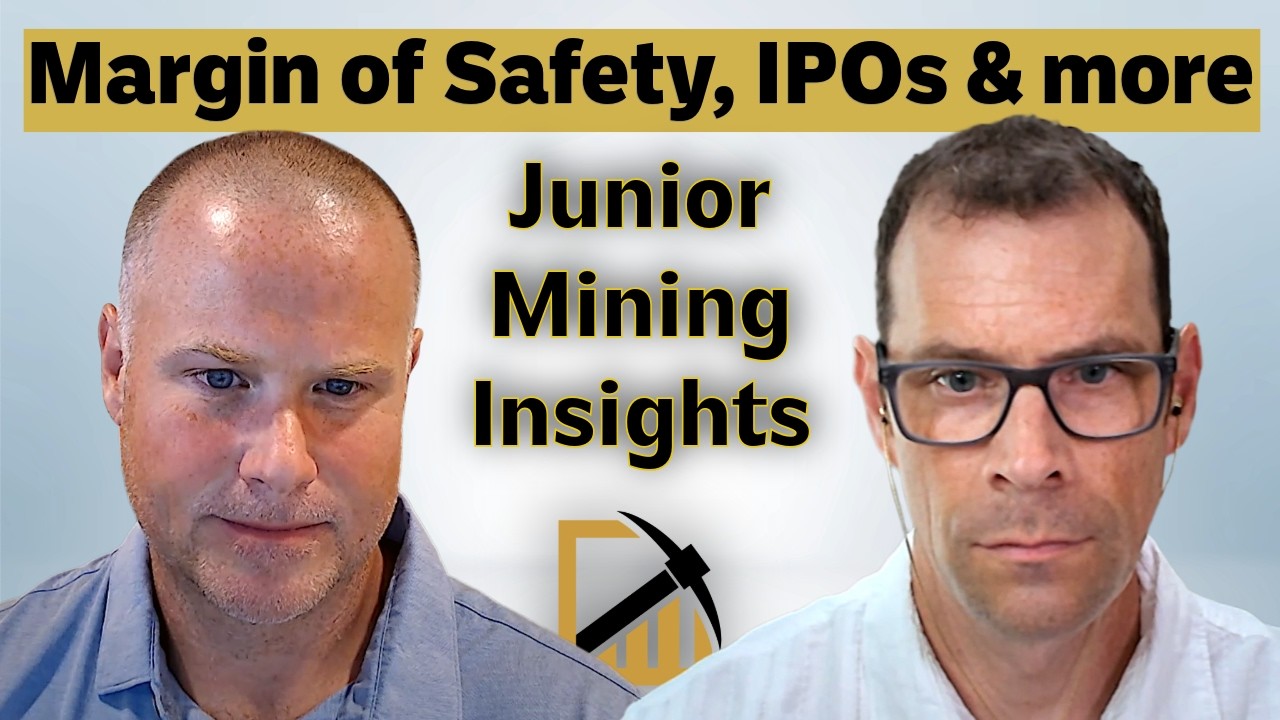
Margin of Safety, Mass Psychology, IPOs & Jurisdictional Risks: Junior Mining Insights-Powers & Leni
- Top takeaway Bill's core musing is that the margin of safety in early-stage juniors resides in the management team, not the project — because a good project in weak hands can be left to languish while the investor gets diluted, and he has repeatedly watched good teams finance below the price at which they said they wouldn't
- Bill makes the case that price-to-value analysis is separate from macro commodity fundamentals, and that macro enters his framework through timing (the resource cycle versus the company cycle), not through the price-to-value spread
- On jurisdictional risk he argues it is ubiquitous but feels like a bait-and-switch when a permit is pulled after the fact, pointing to his own Trilogy experience and the Seabridge KSM news as examples he is uncomfortable with as an investor
- Bill argues that consuming lower-view-count, more substantive content is the differentiator for long-term investors, and that red-day psychology and green-day euphoria both distort learning — pointing to his Neil Atchied interview as a high-quality 'timeless' piece the algorithm under-rewarded
Powers argues margin of safety in early-stage juniors lives in the management team — a project can stall, change hands, and dilute holders before advancing. Both warn Canadian IPO seed and pre-IPO holders often dump at listing — favor fair pricing and avoid groups known for promotional IPO spend. Both argue, citing Neil Atchied, that a well-marketed lesser project beats an undermarketed great one — investors buy a public business, not a rock. Both frame the Seabridge KSM First Nations pullback as a business negotiation rather than a fatal blow — permits do not lock in a project. Leni urges retail to study critical-metals metallurgy — graphite and rare-earth projects live or die on whether end users can actually use the output.

Copper “Fingerprint” at Midnight Sun’s Dumbwa Deposit Unlocks New Expansion Targets - Adrian O’Brien
A ground magnetic survey at Midnight Sun's Dumbwa copper deposit in Zambia 'fingerprinted' the higher-grade block, exposing analogous targets east of the drilled corridor. Phase 1 drilling — a $20M, 80-100k meter fence program — is on track to finish the 11.5 km zone by September. Phase 2 will be more selective and is fully funded by the $15-20M cash balance, focusing on the southern high-grade pockets. Management's plan is to take Dumbwa to a sale-ready discovery; an initial mineral resource estimate is targeted for late 2026 or early 2027. All-in drill costs of $160-165 per meter in Zambia extend the program runway for the cash on hand.

Trump Sends Market Signal with Massive Miner Funding | Critical Metals Expert Tomasz Nadrowski
- Top takeaway The host frames the discussion around President Trump's recent moves in critical minerals funding, presenting them as a market signal that needs scrutiny from an investor angle.
- He expresses open skepticism about scandium, calling it 'scamium' and pressing the guest to justify the $400 million Department of War investment in Sunrise Energy Metals.
- He highlights Westwater Resources' $25 million Export-Import Bank financing, emphasizing that canceled offtake agreements had driven the prior share price collapse and urging investors to evaluate offtake legitimacy.
- He questions the quality of government due diligence in mining, quoting Rick Rule that 'government money is the dumbest money of all'.
- He argues that a publicly traded midstream processing sector needs to emerge, modeled on the oil and gas hub-and-spoke concept, to support critical minerals investment.
White House announced over $2 billion in mining project funding and roughly $150 million for mining schools — a serious market signal but a roughly ten-year workforce fix. The US is 100% import-reliant on 16 of 60 critical minerals; the bottleneck is talent, with a 32% decline in the US mining engineering pipeline. Sunrise Energy Metals got $400 million from the Department of War for what would be the world's first primary scandium mine, tied to aerospace demand. Westwater Resources' $25 million Export-Import Bank loan for Alabama graphite followed cancelled offtake agreements — most defense graphite actually uses synthetic, not natural flake. Nadrowski's fund skips Greenland hype, avoids direct lithium extraction, and avoids pre-resource wildcats; metallurgy, not geology, decides if a critical minerals project survives.
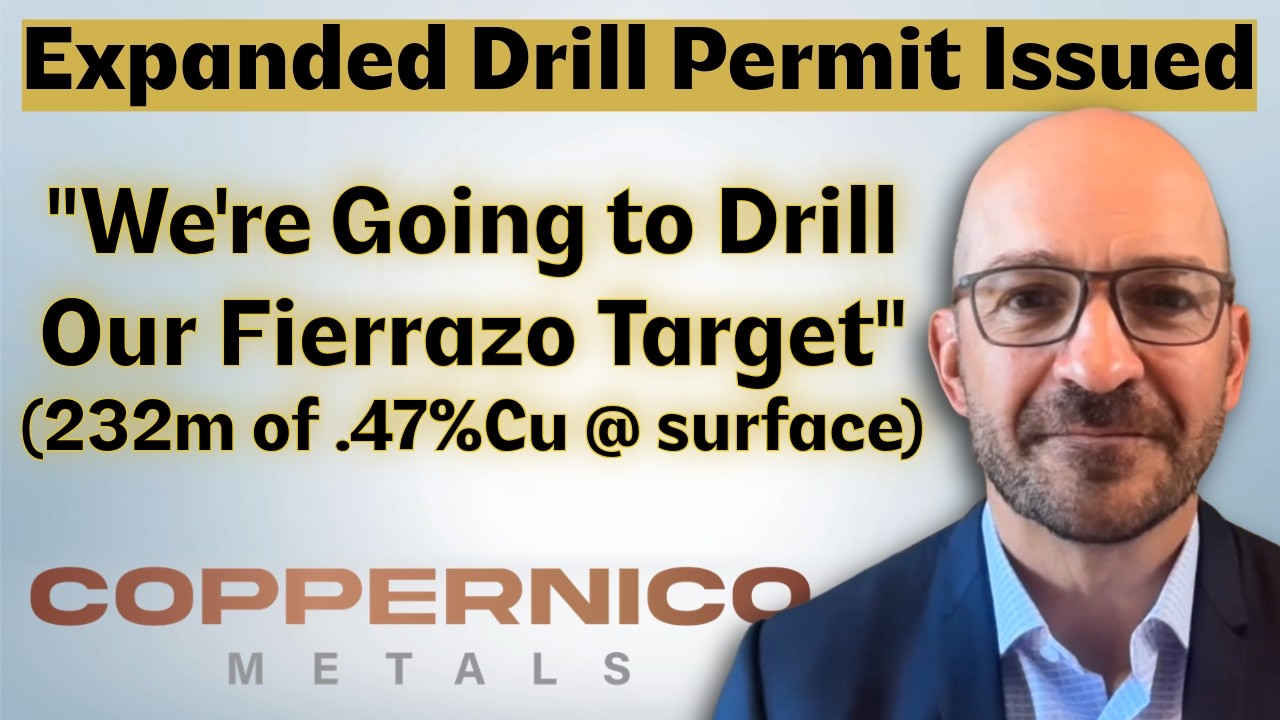
Sombrero Expanded Permit Issued. Drilling Soon. U.S. Acquisition Plans - Coppernico CEO Ivan Bebek
- Top takeaway TOP POINT FIRST: Host Bill Powers pressed Bebek directly on the $5.5M financing being smaller than the previously flagged strategic round, drawing out the explanation that the Peruvian election runoff and Iran war caused most of the ~$20M of demand to wait for permits in hand.
- Powers positions Mining Stock Education as the recurring platform for Coppernico updates, framing this episode around the start-of-activities authorization as the next major catalyst.
Sombrero received an expanded EIA-Sd permit in 7-8 months vs. typical 12-18, enabling up to 300 holes from 181 drill pads in Peru. Drilling is targeted for September/October at the Fierrazo target, where surface samples returned 232m at roughly 0.47% copper. Coppernico closed a smaller $5.5M financing after market uncertainty pushed strategic investors to wait for permits in hand. Teck maintains roughly 9.9% ownership despite the Anglo merger, with Newmont also participating recently as a third-party validator. The CEO is screening U.S. acquisitions after reviewing 240 projects, seeking a 10Moz-plus gold-copper asset for diversification.
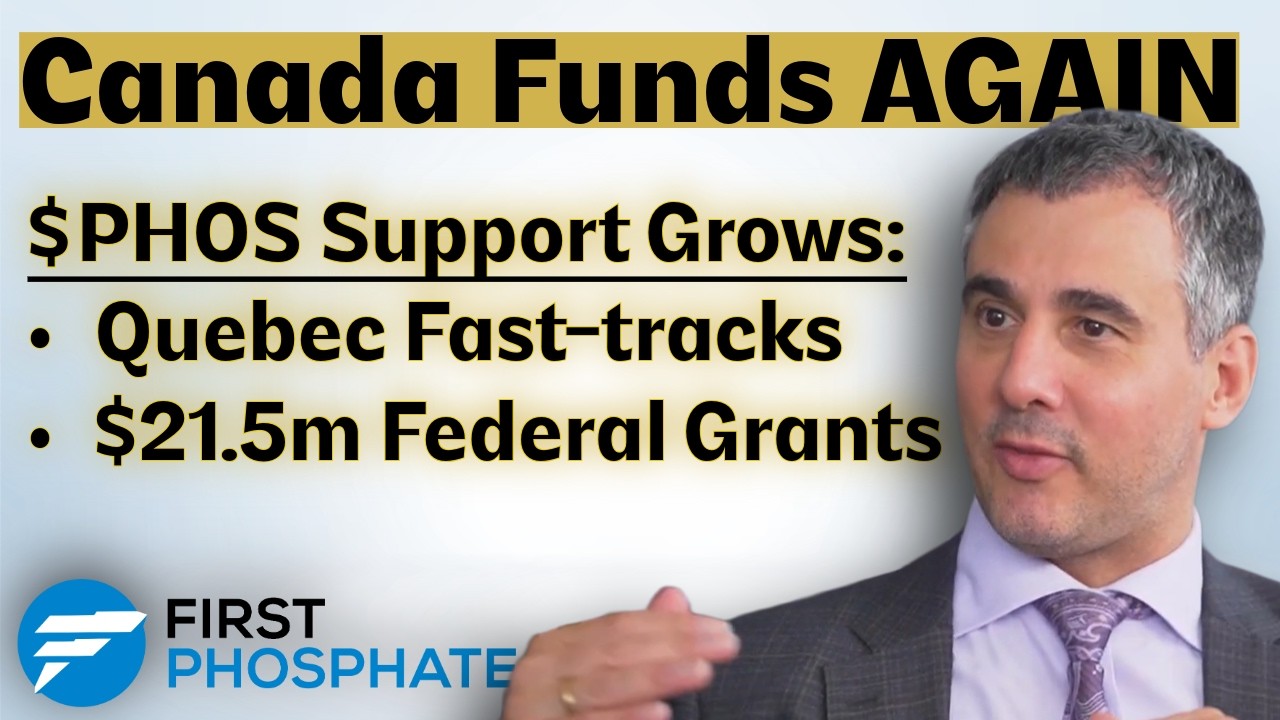
First Phosphate Momentum Grows: Canada Funds AGAIN & Quebec Fast-tracks - CEO John Passalacqua
- Top takeaway Host Bill Powers frames the segment as a sponsor update and stresses that Canadian federal funding for First Phosphate for the second time in 2026 is unusually strong governmental backing for a junior miner.
- Powers steers the conversation toward catalysts, pressing Passalacqua on the feasibility study timing, Quebec fast-track inclusion, and any unreleased milestones beyond the feasibility study.
First Phosphate secured CAD $4.84M in new non-repayable federal funding to build the road and power line connecting its Quebec mine to the concentrator. Quebec's 'Filon' fast-track program named First Phosphate among just three companies, centralizing multi-ministry permits to compress permitting timelines. Combined federal and provincial backing now tops CAD $21.5M on top of a CAD $30M cash position, materially de-risking the company's 2029 production target. Bankable off-take agreements with international partners are already in place, and Denmark's EIFO has signaled EUR 170M in financing for the concentrator build-out. US shareholder count has climbed tenfold to roughly 5,000 over 12-18 months, with tight OTCQX spreads supporting deep liquidity on both US and Canadian exchanges.

“I Sold My Oil Stocks to Buy These Three Gold Stocks” - Pro Investor David Erfle
The guest rotated from oil into three gold-stock buys — Alamos Gold, New Pacific Metals, and Perpetua Resources — after a 30–55% correction. Erfle reads junior miners leading the move: GDX and GDXJ hit their 18-week moving average resistance near $85 and $110 this week. Newmont returned $1.9B of its $2.2B Q2 free cash flow to shareholders — Erfle calls it a 'gun shy' M&A stance after last cycle's deals. Erfle says retail has not arrived: the TSX Venture has stalled near $1,000–$1,100 for 13 years, so the 200% rally has not drawn new buyers.

LITHIUM Demand 'Growing Every Year' and It's Still Early Days
Lithium demand is growing every year and the guest argues a new bull market is accelerating but still in its early stages. Battery storage for AI data centers and solar-plus-storage grids is becoming a major new lithium demand driver alongside EVs. Nine of the world's ten lowest-cost spodumene producers sit in Africa, the guest argues that's where the next supply wave comes from. Lithium Africa assembled 4,000+ sq km across six African jurisdictions counter-cyclically; Ganfeng holds 13.2% and matches exploration dollar for dollar. Springbok in South Africa combines a 30,000-ton existing stockpile, an already-permitted small mine, and an active 3,500-meter drill campaign.
Rick Rule Symposium Reflections: Conversations, Critiques & Portfolio Construction - Powers & Leni
- Top takeaway Bill Powers reports that many newer investors he met at Rick Rule's symposium hold 70-100+ stocks, and he argues they would be better off in sector ETFs like GDXJ or SILJ, since tiny juniors can trade as little as $2,000 a day and take a week to exit.
- On the US-Iran conflict, he says any company needing to finance within six months is in trouble because the financing window can shut abruptly, as canceled March 2020 deals showed, while companies cashed up for multiple years have little to worry about.
- He notes many smart investors took profits into large cash positions after January 2026 and are still waiting on the sidelines in case of a further selloff.
- He urges checking executives' past companies, pay, and legal disputes before buying, saying glitzy marketing at the symposium was leading investors to skip that due diligence.
- He finds AI tools like Claude useful for speeding up research when fed official filings and good prompts, but argues they can never supply firsthand knowledge of the people behind the sector's companies.
Concentration beats diversification: two seasoned investors argue a focused portfolio of roughly 10 well-understood juniors outperforms owning 70 to 100 names. Rick Rule's one-hour-per-company-per-month rule shows why 100-stock portfolios are unmanageable; investors without that time should buy sector ETFs instead. Geopolitical shocks hit junior portfolios through financing windows — check which of your companies must raise capital within six months before holding on. Balance sheets expose 'mining the market': compare marketing and travel spend against drilling dollars to separate value builders from salary collectors. AI accelerates research when fed official filings, but the hosts argue network, experience, and firsthand sector knowledge remain the real differentiator.
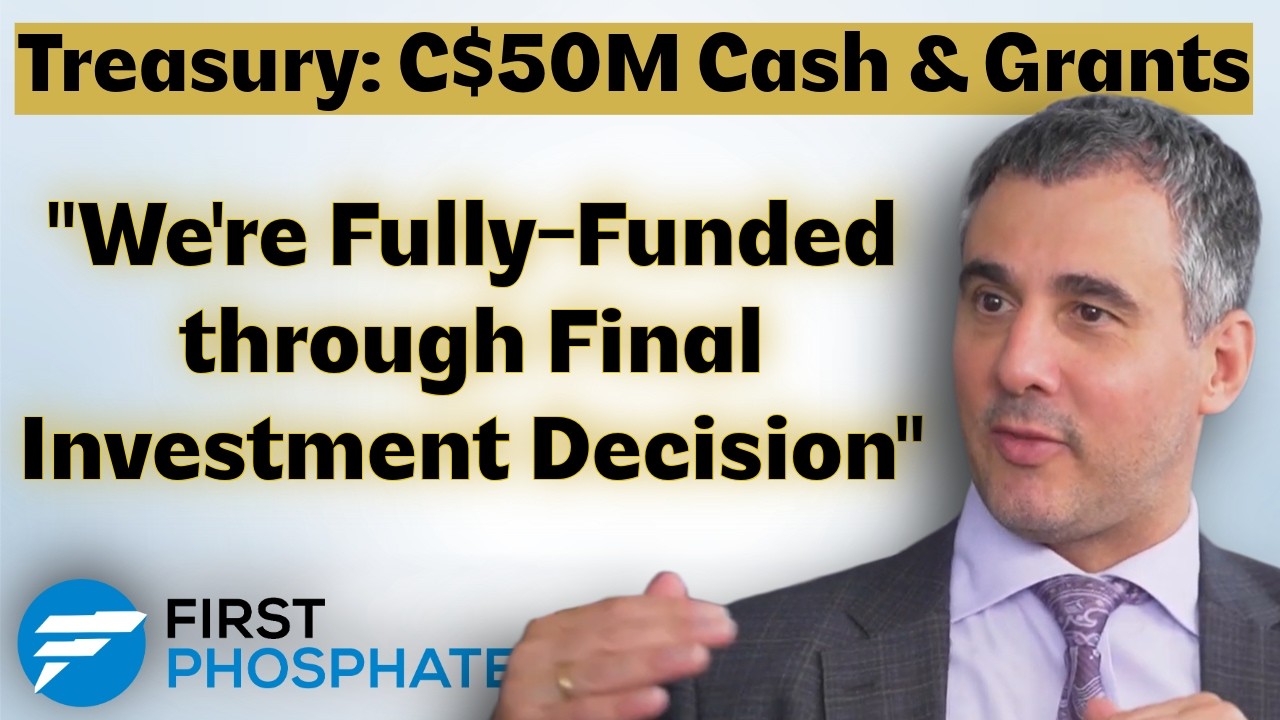
“Fully Funded to FID with $50M Treasury of Cash & Grants” says First Phosphate CEO John Passalacqua
- Top takeaway As host, he frames the sponsor update around the questions on investors' minds — the share pullback to about $1.30-1.40 after a ~500% run, ADR progress, First Nations risk, the Port Saguenay plant and the feasibility timeline.
- He discloses that First Phosphate is a sponsor of the show and directs listeners to his earlier interviews with the company for background.
First Phosphate holds almost $50 million of available capital — treasury cash, a federal contribution, and a fresh raise — giving a 24 to 36-month runway. The CEO argues a systemic selloff — investors selling winners to offset losers — is a catharsis that flushes weak hands and favors cashed-up companies. A collaboration agreement gives the Maastéayash Nation about one percent of First Phosphate, turning First Nations relations into aid for permitting and funding. The company's new ADR (an American security) opens First Phosphate to US institutions barred from OTC quotes; volumes are building as 10-to-1 conversions proceed. Feasibility at the Béjean La Marche mine lands by end of 2026 or Q1 2027, keeping the aggressive 2029 Quebec mine-production target alive.

Luke Gromen: 'GOLD Has to Soar' as War Ramps Up and Debt 'Doom Loop' Accelerates
Gromen argues a US-China economic divorce forces gold to new highs, as Chinese trade surpluses get recycled into gold through offshore hubs. He expects a Nike-shaped equity drawdown of roughly 10% to 20%, then a recovery once dollar liquidity is injected again. Renewed conflict pushes oil and Treasury yields higher from already-elevated levels, with depleted commodity inventories amplifying the shock. Silver looks mispriced as an industrial metal, and electrification supply chains cannot be built with paper metal, only mined ounces. He calls financial repression plus defense-spending stimulus a bad bet, and holds 20% to 22% of liquid net worth in cash and T-bills.
Key Works
Interview platform and newsletter featuring discussions with mining company executives, geologists, and resource investors on junior mining opportunities
Disclaimer: Bill Powers has NOT endorsed this platform and is not affiliated with Pixys in any way.