Don Durrett
LEGENDGold & Silver Mining Stock Analyst | Author | Founder of GoldStockData.com
"Valuing miners by where prices are going, not where they are."
Biography
Don Durrett became a gold bug in 1989 after reading a book that convinced him America's debt-fueled economic growth was unsustainable. His first stock purchase in 1991? A gold mutual fund. He hasn't looked back since.
Today, Durrett runs GoldStockData.com—a comprehensive database covering over 800 gold and silver mining stocks. His methodology combines rigorous data analysis with forward-looking valuation models, helping investors identify which companies offer the best risk-reward profiles at current prices.
What sets Durrett apart is his willingness to share his framework publicly. Through his Seeking Alpha articles, X posts (with over 70,000 followers), and frequent podcast appearances, he's become one of the most accessible voices in gold stock analysis.
Most analysts value mining companies based on current gold prices. Durrett doesn't. He projects valuations using $4,000 gold and $100-150 silver—prices he believes are coming based on structural economic factors. This forward-looking approach reveals which companies are truly undervalued versus which are fairly priced today. His analysis earned endorsement from billionaire Eric Sprott.
Videos (77)
Masterclass: Investing in Gold/Silver Mining Stocks (Part 4)
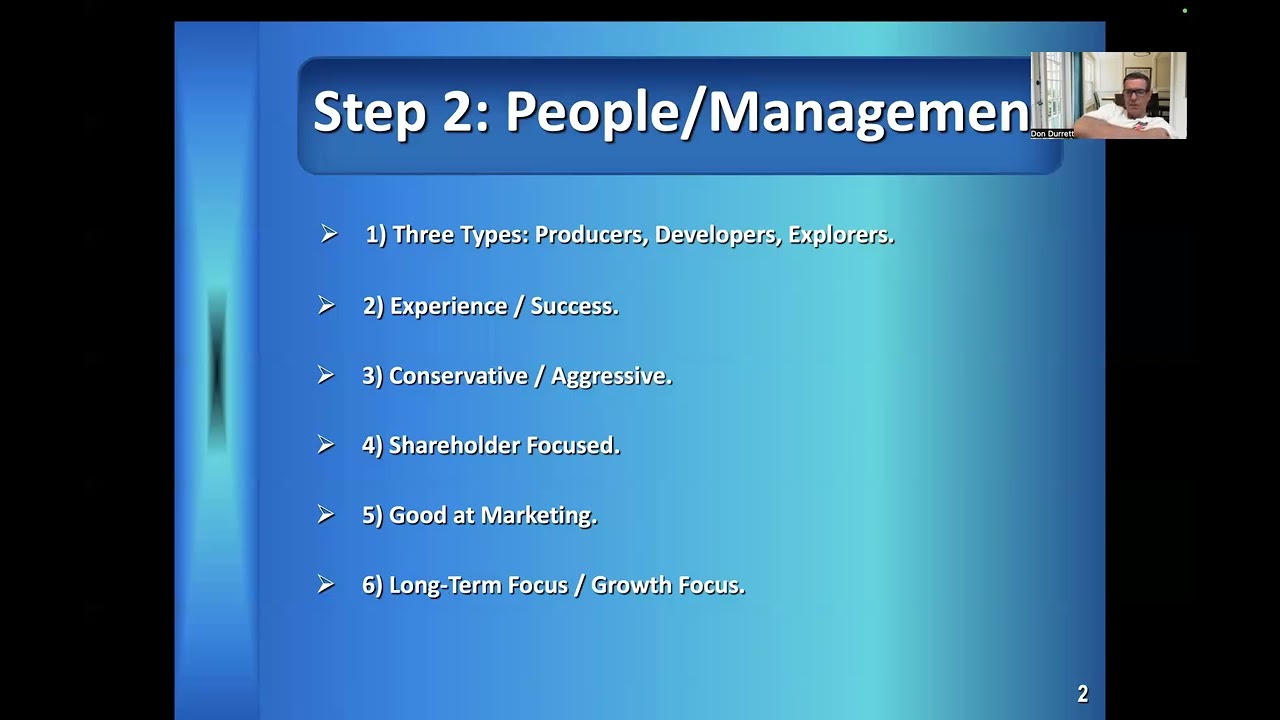
- Top takeaway In this final masterclass video the speaker walks through his 10-step method for analyzing gold/silver mining stocks: properties, people/management, share structure, location, projected growth, investor enthusiasm/chart, cost structure & financing, balance sheet, low valuation, and a final rating.
- The speaker argues investors should favor aggressive, shareholder-focused management teams with a long-term growth orientation, and that strong marketing — including an updated company presentation and an active X presence — is a real edge.
- On financing and share structure, the speaker prefers tight share structures, half-warrants over full-warrants, and conventional debt over convertible debt, and warns that reverse splits at non-producers are typically very harmful to shareholders.
- On valuation, the speaker prefers a market-cap growth-rate framework (future market cap vs. current market cap) and is looking for ~5x+ upside on producers, ~10x+ on developers, and explorers trading at roughly 1% of spot per ounce.
- On entry and exit, the speaker recommends buying dips below the 200-day moving average rather than chasing breakouts, and waiting to sell until miner free-cash-flow multiples on elite producers push above 20x.
The author's 10-step checklist turns mining stock analysis into a discipline: size the deposit first, end with a numeric rating. Prefer gold deposits above 1.5 million ounces with grades of at least 1 g/t (open pit) or 5 g/t (underground) and recovery above 80%. AISC (All-In Sustaining Cost — what it really costs to produce an ounce) should run about one-third of gold's spot price, with a 10% annual inflation assumption. Tight share structures (under ~150 million shares), conventional debt, and half-warrant financings protect per-share value; full warrants, heavy dilution, and reverse splits are red flags. Estimate a miner's future market cap using free cash flow times a 5-20x multiple, then divide by today's market cap for a clean growth-rate view.

Goldgroup Mining ($GORO): Building a Multi-Asset Gold and Silver Producer
- Top takeaway TOP: Don calls the Gold Group/Gold Resource merger a 'transformative deal' and values the combined company as a five-bagger once San Francisco is in production, with the merged asset now an aggressive emerging mid-tier producer.
- Likes Denarius Metals as a 7-out-of-10 risk-reward play, citing the high-grade Zancudo mine (~8 g/t, similar to Aris Mining) and the CEO's Colombia copper stake.
- Bullish on 1911 Gold at under US$1, citing True North going into production this year and the Rockland-Ogama deposit upgrade to 700,000 ounces at 8 g/t.
- Saw Vizsla Silver executive Michael Connor describe the stock as 'dirt cheap' on stage at Beaver Creek after its drop to about US$0.95.
Goldgroup's $15M acquisition of Gold Resource Corp added the Don David silver-gold mine, transforming a single-asset producer into a multi-asset Mexican platform. A 26,000-meter drill program at San Francisco targets resource expansion; restart capital is roughly $25M with a target output of about 50,000 ounces a year. Goldgroup is advancing the Back 40 copper-gold project in Michigan but cites an 18-month permitting risk in a Democratic-leaning state. Eric Sprott, Cala, and other insiders control roughly 70% of the float, sharply limiting the risk of a lowball takeover. Forced Russell 2000 selling after a 15-day inclusion window wiped out half the market cap — a mechanical dip that disciplined investors exploited.

Revival Gold ($RVG.V | $RVLGF): Building a Path Toward U.S. Gold Production
- Top takeaway Don is very bullish on gold and silver heading into Q4 2026: he cites Jordan Roy Byrne's call that the bottom is in, sees a likely S&P correction around the midterms that could pull gold back to $4,000, but expects $4,600 in play first and silver capable of reaching $70.
- He applies a six-checkbox framework (project, location, management, insiders, upside potential, path to production) and rates Revival Gold as checking all six boxes with scores of 8-plus across the board and a 9 on both location and upside.
- On valuation, he models Merkur alone producing roughly $400 million of free cash flow per year at $7,000 gold and $3,000 cost around 2030, applies a 10x multiple for a $4 billion standalone value, adds about $2 billion for BearTrack, and frames gold-in-ground optionality at $300 per ounce as a minimum $2.4 billion floor.
- He notes gold developer stocks have rebounded sharply — GDX and GDXJ up 6 to 7% on two days the prior week — after being battered since March 1, but argues the broader developer space remains under-invested, citing 1911 Gold (going into production this year) and NexGold (near construction) as examples that are also "getting no value."
- Don warns that development projects "always break my heart" because they take years to reach production, but argues the current entry is a rare combination of low market cap, multi-million-ounce resource, strong insiders, and a clearly mapped path to a 2028 construction decision.
Hugh Agro pitches Revival Gold as a US-focused developer with two multi-million-ounce brownfield gold assets — Mercur (Utah) and Beartrack-Arnett (Idaho). Mercur's PEA targets 90-100k ounces a year over a decade at about $208M capex, supported by existing roads, water, and a 30-minute drive to labor. Beartrack-Arnett's underground Joss zone recently returned a roughly 500 gram-meter intercept, with miles of untested strike still ahead. Junior developers are re-rating as gold holds $4,000+; Mercur's Q1 PFS and 2028 construction decision are the next triggers. Trading near US$200M with ~$28M-Canadian cash, Revival is about $25 per ounce in the ground — well below the ~$100/oz junior average.
Masterclass: Investing in Gold/Silver Mining Stocks (Part 3)
- Top takeaway The host's central thesis is that buying gold and silver miners is partly a bet on the metals themselves, so the only edge an investor can control is the price paid and the quality of the underlying asset
- He sorts names into a three-stage framework — producers, developers, and explorers — and applies a separate checklist to each, arguing explorers are a bear-market-only trade because their inelastic valuations cannot keep up with elastic producers and developers in a bull market
- On producers he requires long-life assets of at least eight years, a flagship mine of two million ounces or more, a clean balance sheet with no net debt preferred, management execution plus shareholder quality, and at least a five-bagger upside calculated against his $7,000 gold assumption
- On developers he insists all six boxes be checked — NPV at roughly two times CapEx or better, an IRR of at least 25% at spot, a minimum ten-bagger upside to absorb expected dilution, a mining-friendly jurisdiction, a strong management team preferably staffed by former producer operators like Tony McCouch, a credible path to production, and meaningful insider ownership
- On explorers he applies only two rules — buy ounces in the ground at less than 1% of spot, ideally 0.5%, and buy early in the Lassonde curve immediately after an 'excellent' discovery hole of at least 200 gram-meters for gold or 2,000 for silver, ideally north of 5,000
Don Durrett walks through his producer, developer, and explorer checklists for getting an edge in gold/silver mining stocks. Producers must score 7-9 on his 10-point rubric: long-life flagship mines, clean balance sheets, and at least a 5x bagger at his $7,000 gold. Developers must check all six boxes: NPV at 2x CapEx or better, 25%+ IRR at spot, and at least a 10x bagger to absorb dilution. Explorers shine in bear markets because they are inelastic; buy gold in the ground below 1% of spot and enter early in the Lassonde curve. Specific calls: Alamos Gold and Kenros screen as 6x baggers in the current correction, while Vizsla Silver's NPV runs at 5x its CapEx.

Metalsource Mining's ($MSM | $MSMMF) Silver Hill Project: Drill Results & What's Next
- Top takeaway Don outlines his macro thesis that the US bond market will run into trouble, driving gold to $7,000-$10,000, and says he invests for big alpha rather than near-term chart moves.
- Don frames Metalsource Mining as an early drill story with a solid discovery, the kind of project he says is ahead of the curve among exploration juniors.
- He says he bought the dip in Sidney Resources, describing it as a story too good to be true but worth owning in case any part of it proves out.
- Don highlights that institutional investors are drawn to the polymetallic nature of Metalsource's deposit, where base metals pay for the mine and precious metals are credits.
- On Power Metallic, Don says the company has been doing infield drilling rather than step-outs, which he would prefer to see expanded.
Metalsource Mining's Silver Hill project has produced a standout drill hole grading 48 g/t gold over 12.6 meters within its first 21,000 feet of drilling. Lead-zinc base metals at Silver Hill act as the project's economic backbone while gold and silver are by-product credits — a mix the CEO says institutional investors prefer. Property-wide IP survey suggests Silver Hill's mineralized trend may extend along roughly 2.4 kilometers of strike beyond the original mine footprint. Both Silver Hill and Bird Pilot sit on private land in mining-friendly North Carolina, removing the permitting risk that has stalled other junior explorers. Cullen says Metalsource has $4 million in cash, Eric Sprott as its largest shareholder, and no need to raise before seasonal strength in Q1.

Masterclass: Investing In Gold/Silver Mining Stocks (Part 2)
- Top takeaway Don Durrett argues that a portfolio should use a pyramid structure, with larger allocations to lower-risk bullion, funds and quality producers to help withstand volatility.
- He sees mid-tier producers as offering the best risk/reward because strong balance sheets and free cash flow can support quicker growth through acquisitions.
- He advises limiting allocations to higher-risk developers, small producers and explorers, noting that many will fail to meet their potential.
- He argues investors should buy dips rather than chase rallies, using the 200-day moving average and disciplined entry prices as guides.
- He says selling should wait for market froth and company-specific exit criteria, rather than taking profits too early.
Portfolio risk is managed through a pyramid that gives larger allocations to bullion, ETFs, majors, and mid-tier producers. Don Durrett favors mid-tier producers for their balance sheets, free cash flow, and capacity to grow through acquisitions. Allocation should decline as company risk rises, with developers and explorers receiving smaller positions than established producers. Long-term investors should avoid over-trading, buy corrections rather than rallies, and sell when a company’s underlying story changes. Exit decisions should combine valuation, operating performance, targets, and market froth instead of harvesting winners too early.

Masterclass: Investing In Gold/Silver Mining Stocks (Part 1)
- Top takeaway Durrett argues that gold and silver miners are a high-conviction wager on a debt-driven economic crisis rather than a conventional investment.
- He says economic uncertainty is the main driver of gold prices, more important than real rates or the US dollar alone.
- He expects a recession, government budget pressure and bond-market problems could support gold over the next 12 to 36 months.
- He frames miners as offering asymmetric upside if gold rises, while acknowledging opportunity cost if the thesis does not play out.
- He describes his approach as long-term speculation, with the timing of a debt-bubble break uncertain.
Don Durrett frames gold and silver miners as a high-conviction response to what he sees as an unsustainable debt-driven economy. He argues economic uncertainty matters more for gold than negative real rates or dollar weakness, citing periods when those signals diverged. The masterclass distinguishes long-term compounding, trading, and speculation, with Durrett favoring concentrated, long-duration bets built around conviction. He presents miners as an asymmetric wager: limited downside near his assumed gold-price floor versus substantial upside if recession and fiscal stress emerge.

Gold & Silver Miners, Macro Risks, and Investing Strategy | Don Durrett and John Feneck
- Top takeaway Don's core thesis: gold will be significantly higher — potentially double — within 36 months; he ignores the next 12 months and looks 36-60 months out.
- He models all picks at $7,000 gold and $200 silver (which he calls conservative) and plans to sell miners between $7,000 and $8,000 depending on multiples.
- His top-five buy-the-dip picks are Silverco, Denarius, Talisker, 1911 Gold, and Jaguar Mining — all framed as 'undervalued producers'.
- He argues gold miners don't fit a buy-and-hold capital-appreciation model, which is why Wall Street avoids them — citing Agnico Eagle's drop from $250 to ~$135 in 2026.
- His de-risking strategy: low allocations per stock, a base of ETFs/mutual funds, physical metal, major miners, plus high-conviction mid-tier producers for upside.
Don Durrett calls junior gold and silver miners a once-in-a-generation asymmetric trade — entry prices vanish once gold crosses $5,500–$6,000. He values juniors on a 36-month forward gold/silver price ($7,000 and $200 today) instead of spot, capturing leverage before the metal moves. Build a portfolio pyramid — ETFs and majors form the foundation, junior miners sit on top with capped position sizes near 1% of capital. When the original thesis survives a 40% drawdown, add to the position — averaging down improves blended cost basis and removes emotion. The macro case rests on Fed intervention history from Greenspan through today and ongoing de-dollarization — both push investors into gold.
Silver47 Exploration ($AGA | $AAGAF) on Red Mountain's Critical Mineral Potential & Path to 2027 PEA
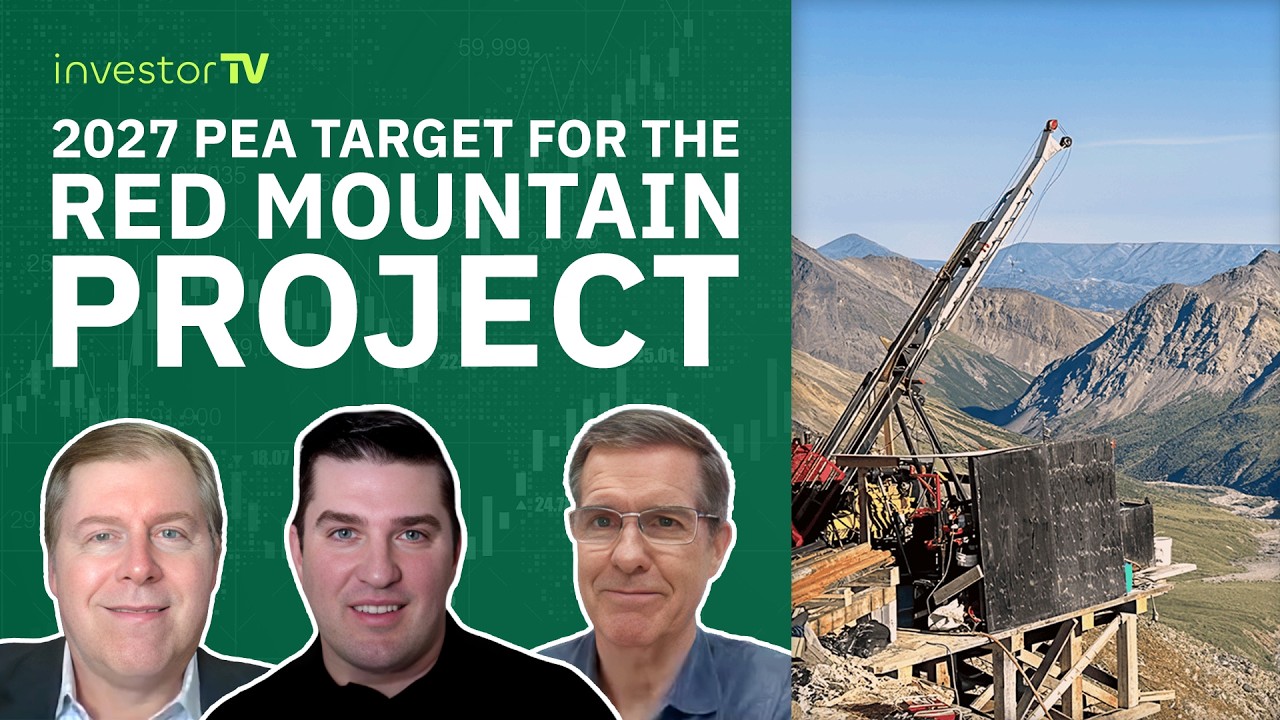
- Top takeaway Don argues Red Mountain alone could be a $1.5B optionality play at $200 silver if Silver 47 reaches 400-500M ounces, with potential 5-10x upside if the company pivots from exploration to development
- Don values silver producers using a 10x multiple on $50 margins, equating every 1 million ounces to a $500M market cap
- Don predicts silver's 'second leg up' will raise the price floor above $100, framing the current correction as comparable in depth and duration to 2008
- Don argues the market is missing that 42M of Hughes's 44M ounces sit on private land, a key valuation point also used by Blackrock
- Don says he bought Silver 47 at listing for its Red Mountain exploration potential, calling the project very valuable on its own
A 22-cent EV per ounce on Silver47 Exploration's 246M silver-equivalent ounces screens 2-10x below peers like Blackrock Silver, framing a clear valuation gap. The CEO argues most ounces are inferred, but three high-grade US projects (Red Mountain, Hughes, Mogollon) underpin a 1B-oz aspiration and a 2027 PEA. With $45M Canadian in working capital and four rigs running, Silver47 plans roughly 20,000 meters of 2026 drilling across Alaska, Nevada, and New Mexico. Co-hosts Don Duret and John Fenwick frame a deep correction in US silver developers as a contrarian bottom-fishing setup before a potential second leg up. Near-term producers like 1911 Gold, Denarius, and LaHontan anchor a broader US silver thesis alongside Silver47, all riding a bipartisan critical-mineral policy tailwind.

GoGold Resources ($GGD | $GLGDF): CEO Bradley Langille on Building the Los Ricos Property in Mexico
- Top takeaway Don argues the setup for gold and silver stocks is constructive into Q4 absent a renewed AI-led rally, and frames GoGold as a top development-stage name whose project, team, location, path, insiders and upside all clear his checklist.
Los Ricos South targets first pour in 2028, fully funded with $284M cash against $227M capex and no major equity raise. At roughly $12/oz AISC — what it really costs to produce an ounce — Los Ricos South sits in the top decile of global silver developers. CEO Bradley Langille plans parallel tracks: Los Ricos South into production by 2028, Los Ricos North from PEA to permit by Q1 next year. Langille expects Mexico's open-pit permitting to accelerate under President Scheinbaum, who is methodically clearing the inherited backlog of about 100 operational permits. The Parral operating mine plus copper and zinc byproduct sales generate roughly $60M/yr free cashflow to internally fund Los Ricos development.

Delta Gold Technologies ($DGQ | $DGQTF) CEO on Gold's Role in Quantum Computing
- Top takeaway Calls the story fascinating but ultimately a 'roll your dice' situation — the open question is whether this technology actually turns into a working quantum computer.
- Argues the company has offloaded the hard work: the universities run the R&D and the patents are filed, so it is now 'sitting back waiting to see how it unfolds.'
- Expects quantum computing to eventually reduce the compute cost of AI 'by a factor of 100, maybe more,' and likes that the approach uses gold.
- In the intro, pushes back on Rick Rule's 2-in-10 win rate: thinking long term, he expects about 7 of 10 picks to work out but always budgets for roughly three disappointments.
- Pressed the CEO on whether the patents amount to more than an idea on paper, drawing out that about 40 people do daily lab work across the two universities.
Delta Gold's CEO argues gold's electron spins could enable a new qubit design, with patents filed by University of Toronto and Penn State. The company holds exclusive licenses to university patents, funds one million dollars per university yearly, and targets 2028 for partnership talks. Qubit error rates remain the bottleneck: today's best run one error per 6.5 million operations, a billion times less stable than a laptop. Hosts urge junior-mining investors to expect losing half on any stock, diversify broadly, and judge holdings over years, not single quarters. Don Durrett calls the venture a roll-your-dice bet: the R&D and patents are done, but whether it becomes a computer is unproven.

Mineros ($MSA | $MNSAF) CEO on Growth Story, Investments & 2030 Gold Production Goals
- Top takeaway Values everything off a $7,000 long-term gold price: the major producers print as four-baggers there, quality mid-tiers are his sweet spot, and he sizes Mineros as a 10-bagger even after its run.
- Argues gold's fundamentals have never been better and calls $7,000 conservative — the average investor holds about 75% of net wealth in equities and no gold, a future buying wave he believes he is far ahead of.
- Walks through his checklist for producers: long-life, high-quality assets; acceptable jurisdiction risk (a new conservative president in Colombia, no problems observed in Nicaragua); an already-experienced management team; roughly 50% insider ownership; and valuation checked last.
- Sees undervalued mid-tiers everywhere: Wesdome, Artemis and Hemlo in Canada; Westgold, Regis, Ramelius, Greatland and Capricorn in Australia; plus Jaguar Mining, SSR Mining and Mineros.
- Prescribes a four-step re-rating playbook for producers — clean up the balance sheet, pay out 35-50% of free cash flow with dividends of at least 4%, keep free cash flow high, and tell the market — saying the multiple keeps rising after three quarters of it.
Mineros S.A. trades at 0.47 times net asset value (what its mines and cash are worth) despite a tenfold share-price re-rating under Sun Valley control. Sun Valley Investments deployed about $200 million to take control, then doubled silver recovery and lifted gold output 22% through operational fixes. Guidance rose to 240,000 ounces with costs tracking below plan, and the CEO targets 500,000 ounces by 2030 via the Porvenir project and acquisitions. An upsized $175 million buyback and $30 million dividend program return cash, while a strategic gold reserve keeps bullion in company vaults. Analyst Don Durrett argues quality mid-tier gold producers are the sweet spot, and Mineros still offers tenfold upside on his $7,000 gold assumption.
50 buy-the-dip stocks (July 17, 2026)
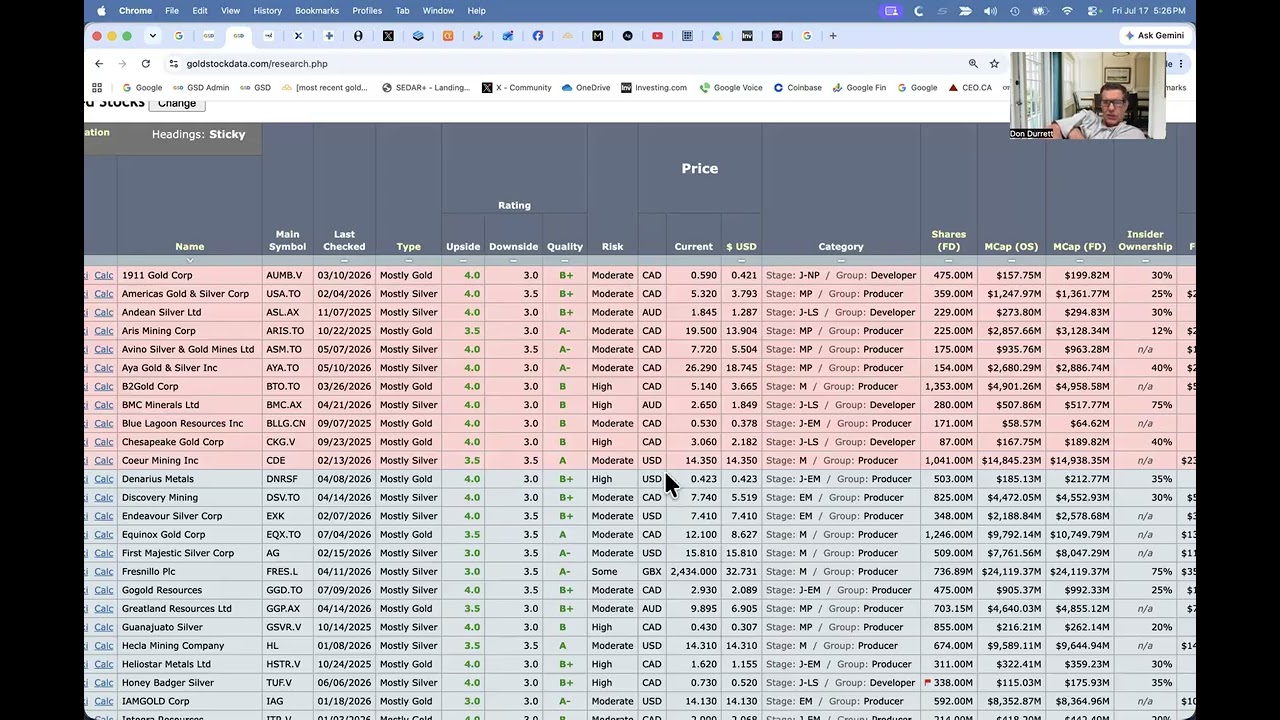
- Top takeaway Don Durrett's core thesis for the list is a $7,000 gold and $200 silver assumption, with those levels expected within 36 months and holding.
- He says every name on the 50-stock list prints as an eight-bagger or better except IAMGOLD, with most in the ten-bagger range or higher, valued on free cash flow and growth.
- He frames the holdings as roughly one-third of a 169-position portfolio and says he will add to any name that falls below about 0.5% of the portfolio.
- He warns that gold and silver mining stocks are closer to speculating than investing, advising small allocations and only investing what can be lost, given how volatile the names are.
He reviews 50 gold and silver mining stocks he owns, sizing the upside against $7,000 gold and $200 silver. Most of the list screens as an eight-bagger or better, and he favors undervalued producers growing output. Development names need patience: permits plus roughly two-year builds push many payoffs to 2028 and beyond. He cautions that gold and silver mining stocks are speculative, so keep allocations small and only risk what you can lose.
THESE Gold & Silver Stocks a Screaming BUY - 'More Bullish Than Ever': John Feneck and Don Durrett
- Top takeaway Durrett argues this is fundamentally a gold story in which silver is the little sister that will not lead on its own — a rally to $4,400-$5,000 in gold would only take silver to around $70, and any near-term bounce would be a dead cat bounce.
- He says the gold bull market is nowhere near over: the chart only really breaks below $3,000, probably $2,800, and he expects a possible lower low into the US midterms from the $3,950-$4,000 area.
- He calls the June dip and the current one buying opportunities he has already bought, and puts HUI at 615, down 38% from 989, as close to the low he expects — the low 500s possible, but no 400s.
- His macro case for owning miners is that you should own gold and silver miners because you do not believe in the US economy, citing a $2 trillion budget deficit with no solution, inflation stuck above 2%, housing unaffordability, banks holding underwater bonds and roughly 10,000 jobs a month being lost to AI.
- His picks are Hecla and Core Mining then Pan American and First Majestic as quality silver producers for 12 months, Honey Badger, Andean Silver, BMC Minerals and Silver Storm as 36-to-48-month silver developers, and Equinox, Westgold Resources and SSR Mining as gold producers with 1911 Gold and NexGold among developers.
Durrett frames the metals selloff as a correction, not the end of the gold bull market, which he says only breaks below $3,000. Both guests attribute the drop since March 1st to the Iran war rather than mine fundamentals, and warn of another seasonal dip this fall. Feneck's development picks include Silverco, Blackrock Silver and Silver 47, each trading far below its spring highs on unchanged plans. Durrett's stock lists split by horizon: quality North American producers for a year, developers for three-to-five-year multi-bagger attempts. Feneck is bullish on tungsten equities despite an 8-9x spot price surge, because China supplies about 80% and no ETF or futures market exists.

Deep Sea Minerals ($SEAS | $DSEAF) CEO on the Opportunity in Seabed Critical Minerals
- Top takeaway He expects the lows are not yet in for gold and silver, predicting a further leg down sometime in 2026 as he sees the S&P 500, near 7,500 and an all-time high, breaking down below 7,000 when the AI trade fails and the economy tips into recession.
- He sees gold support between $3,500 and $3,850, putting roughly 85% odds on not breaking below $3,800, and silver support at $50-55, framing the current dip as a buying opportunity.
- His core argument: with majors printing as four-baggers after the 37% HUI correction, mid-tiers should average over five-baggers and quality developers around ten-baggers, so investors should buy quality dips rather than chase drill stories.
- On Deep Sea Minerals he stays cautious, calling it high risk until the harvesting technology is proven, but argues that if either billion-dollar peer succeeds, the company could do extremely well by riding their coattails with its licenses already in place.
- He reports that US government officials he has spoken with recently, including three on Zoom calls last month, get the memo on critical minerals and are looking for ways to compete with China on metals supply.
Deep Sea Minerals plans to harvest polymetallic nodules, seafloor rocks bearing nickel, copper, cobalt and manganese, in the CCZ and Cook Islands. A 1980 US law, revived by a 2025 executive order, gives NOAA a commercial licensing path in international waters outside the ISA. At about a $56 million market cap, the CEO positions the company far below multi-billion-dollar seabed peers TMC and the Odyssey Marine merger. Hosts see gold support at $3,500-$3,850 and silver at $50-$55, with the HUI (gold miners index) down 37% creating buying setups. Near-term catalysts include a NASDAQ uplisting, a Cook Islands license submission, NOAA full compliance, a $50 million shelf, and the Impossible Metals partnership.

Western Star Resources ($WSR | $WSRIF): Building a U.S. Tungsten Platform
- Top takeaway Assesses Western Star as very cheap at its roughly C$15 million market cap — cheap even if the resource only doubles, provided tungsten prices do not collapse — with a million tons implying about 10 years of mining.
- Sizes the ore value at about $2,500 per ton at a 0.5% grade (roughly 100 lbs at about $25/lb) and about $6,000 per ton at the company's 0.5-1.5% grades — revenue-wise, basically a high-grade gold mine — while noting recovery rates were never discussed.
- Argues China's tungsten cutoffs to Japan this year preview worse treatment of the US, and that Western Star's three US projects offer three ways to win in a great jurisdiction.
- Lays out his gold-book positions: he owns Alkane, Western Exploration, and 1911 Gold, favoring 1911's True North ramp toward 70,000-90,000 oz with free cash flow at $7,000 gold a thing of beauty.
- Details his recent buys: Cerro de Pasco on its tailings and water-remediation permit thesis, and Hemlo to round out Canadian mid-tier coverage.
Tungsten prices have multiplied this year while China controls roughly 80% of supply, drawing US government funding toward domestic producers. Western Star consolidated twelve past-producing tungsten mines into three brownfield (previously mined) packages across Nevada and New Mexico. The Rowland property historically graded 3.38% tungsten, over ten times the national average, with surface sampling running 1-5%. Eagle Point carries a non-compliant (pre-modern standard) USGS resource of 200,000 tons at 0.6% tungsten, exposed at surface and never drilled. With about 46 million shares and a C$15 million market cap, the CEO argues the stock is deeply undervalued against ore value.

Silver: Could We Soon Run Out? What You Need To Know | Don Durrett
- Top takeaway Durrett argues the gold bull market is intact despite the roughly 29% correction from January's $5,600 peak, and expects one more dip below $4,000 before a second leg up begins around November 1, 2026.
- He expects gold near $8,000 within 36 months, calling that conservative, and sees silver following to a $150 to $175 target area as the gold-silver ratio compresses into the 30s.
- He predicts real silver shortages ahead: five straight years of deficits averaging over 100 million ounces, driven by investor demand rising from about 20% to 30% of supply, with an eventual corporate announcement that a plant must shut for lack of silver.
- He argues the US is already at a doom loop, with $2 trillion annual deficits and $1 trillion in interest payments, and expects a recession to begin in 2026 that the Fed cannot fix, like Japan's lost decade.
- He turned bearish oil after the Iran war showed ample supply, expecting a $50 or even $40 price within 12 months, and sees AI as a near-term net negative that kills jobs and drains liquidity rather than saving the economy.
Silver deficits averaging over 100 million ounces for five years stem from investor demand, and the guest expects genuine physical shortages ahead. Gold's 29% correction from 5,600 mirrors past bull-market pullbacks; he expects one more dip below 4,000 before a year-end rally. The guest's key signal is the gold-to-S&P 500 ratio: above 0.77 would mark rotation into metals and the next miner leg. He argues US deficits near $2 trillion yearly create a doom loop, making Fed monetization, recession, and a gold fear trade likely. Silver follows gold as a monetary metal: he targets roughly $150-175 silver and 8,000-plus gold over the next three years.

RPX Gold ($RPX | $RDEXF): A Staged Strategy Toward Gold Production in Ontario
- Top takeaway Calls the support break a normal bull-market correction, not the end: citing past 40-60% drawdowns and gold near $4,000 with silver down about 57% from its peak at the late-June 2026 taping, he sees $48-55 silver and $3,500-3,800 gold as the downside zone into end-2026 and expects $3,800 to hold as gold's low for the year.
- His macro thesis - unpayable US debt pushing the bond market toward fragility and some kind of reset - underpins targets of $200 silver and $7,000-8,000 gold, and he says 2026 is for accumulating shares, not selling.
- Over the next 12 months he expects a new gold all-time high around $5,600 and heavy M&A led by Canada's roughly 15 quality development projects, with mid-tiers as the buyers.
- On RPX Gold: if permits come, construction in 2028-29 would make it a growing ~50,000-ounce-per-year Canadian producer at a ~$40 million market cap versus $75 million of claimed starter-pit free cash flow - 'it looks pretty juicy to me,' though he does not own it and likes the board, including Rachel Goldman.
- Tactics: keep dry powder and buy dips in stages (silver at 58, 55, then 50; a 10-stock dip list for early July including Blackrock Silver), stay a diversifier rather than press bets; the miners' index he tracks is down about 35% from 975 to the low 600s and his adding is done once it reaches 1,000.
RPX Gold's staged plan mines small starter pits and hauls ore to area toll mills (third-party processing plants), funding growth without heavy shareholder dilution. Startup capex sits under $50 million, with roughly $75 million in targeted annual free cash flow to fund drilling and the eventual underground decision. The consolidated property holds a 1.7-million-ounce resource drilled only to about 300 meters along a seven-kilometer gold structure. No on-site mill or tailings means no Environmental Assessment (EA) is required, with management hoping for permits in place by summer 2027. Both analysts frame the June metals break as a normal bull-market correction in which silver falls harder than gold, creating buying windows in juniors.

Sitka Gold ($SIG | $SITKF): Advancing a 5+ Million-Ounce Gold Project in Yukon
- Top takeaway Argues the gold and silver correction, with gold down about 28% and silver down about 52% as of the June 24, 2026 taping, is a normal, roughly five-month-old pullback within the third great bull market, and he still expects higher highs rather than the end of the bull.
- Attributes the drop to a perfect storm of war-driven sovereign gold selling, rising interest rates, a stronger dollar, and AI optimism that has calmed recession and inflation fears, while insisting the business cycle has not been repealed.
- Frames the macro backdrop as deteriorating: a $2 trillion US deficit with about $1 trillion of interest cost, most sectors weakening apart from a one-and-done AI data-center build-out, and AI acting as a job killer for high-paying roles.
- In his closing summary he calls Sitka Gold a pure exploration optionality play worth a minimum of $1.2 billion (about $150 per ounce on 8 million ounces) versus roughly $375 million today, sees upside to 10-15 million ounces, and expects a rerate once gold is back above $5,000, though the big payoff is a 3-5 year wait.
- Says gold is currently tracking interest rates and the dollar only because economic anxiety is low, so a slightly hawkish Fed chair is enough to knock gold down for now.
Don Durrett argues the gold and silver correction is cyclical, not the end of the bull market, and expects higher highs eventually. Sitka Gold's RC Gold project in the Yukon hosts over 5 million ounces across granite-hosted intrusion-related deposits being expanded by drilling. A 2.25-million-ounce inferred resource at the Rosgobel discovery also carries tungsten and silver byproducts, opening potential non-dilutive financing options. Sitka is fully funded with $40 million in the bank for its 60,000-metre drill program, releasing results every couple of weeks. Don Durrett frames Sitka as an optionality play, valued around $50 an ounce in the ground against a $1.2 billion takeover estimate.

Triumph Gold's Drilling Plan Takes Shape in the Yukon
- Top takeaway Co-interviews Triumph Gold's John Anderson in this segment, alongside John Feneck, as Anderson explains the conditions behind the company's return to drilling.
Triumph Gold CEO John Anderson honored a four-year-old public pledge: no action until gold topped $2,200 and copper reached $5. Both thresholds are met: the Yukon camp is growing to 45 people and three drill rigs (machines that bore core samples) start full-time from April. A new Yukon government was the third condition, tying the start of fieldwork to territorial politics as much as metal prices. Anderson also plans to drill a high-grade silver project in Utah, adding a second commodity to the gold-focused portfolio.
Key Quotes
"Is the stock market telling the truth at an all-time high, or is it gold that's telling the truth? Well, it's pretty obvious that gold is the one telling the truth."
"You're projecting what that price will be. And so you're saying when the market collapses or when the bond market implodes, then you're going to see what type of functional prices are you using now."
"Gold equities are being mispriced unbelievably in today's market given the prospective rise in the metal's price."
Key Works
Available on Amazon
Specializations
Disclaimer: Don Durrett has NOT endorsed this platform and is not affiliated with Pixys in any way.