John Passalacqua
CEO & Director | First Phosphate Corp | Phosphate Mine Developer in Quebec
"Leading First Phosphate's 378% resource expansion at Bégin-Lamarche in Quebec"
Biography
John Passalacqua is the CEO and Director of First Phosphate Corp (CSE: PHOS, OTCQX: FRSPF), a company developing high-purity phosphate deposits in Quebec, Canada. Resource investors following the battery minerals and fertilizer supply chains should know him as the executive leading one of the more advanced phosphate exploration projects in North America.
Under Passalacqua's leadership, First Phosphate delivered a 378% increase in indicated mineral resources at its Bégin-Lamarche project in Quebec, according to an updated mineral resource estimate (MRE — a formal estimate of tonnage and grade based on drilling data, prepared to industry standards). The indicated resource now stands at 6.2 million tonnes grading 7.70% P₂O₅ (phosphorus pentoxide, the standard measure of phosphate content), containing approximately 478,000 tonnes of phosphate. This followed extensive drilling and metallurgical work (the science of extracting valuable minerals from ore) on the property.
Passalacqua's focus is on sedimentary phosphate — a critical mineral for both fertilizer production and lithium iron phosphate (LFP) batteries used in electric vehicles. The Bégin-Lamarche project targets high-purity phosphate suitable for both markets, positioning the company at the intersection of food security and energy transition demand. Quebec's mining-friendly jurisdiction and existing infrastructure give the project logistical advantages that Passalacqua has emphasized in public commentary.
Prior to First Phosphate, Passalacqua served as President of EXPOWORLD. His current role is hands-on: he oversees exploration strategy, resource expansion, and the company's path toward feasibility and production decisions. Investors tracking critical minerals outside the better-known lithium and uranium sectors may find phosphate — and Passalacqua's project specifically — worth monitoring given the resource growth achieved to date.
Videos (20)

Canada Is Finally Fast-Tracking New Mines | John Passalacqua - First Phosphate
- Top takeaway Argues Canada's investment climate has improved under Prime Minister Carney versus the Trudeau era, and frames the federal investment summit as 'the beginning' of further initiatives rather than an end point.
- Calls the productivity mega deduction 'interesting' because letting capital costs be expensed sooner would lift IRRs and NPVs, but says the details are not yet out and he wants equal treatment for local and foreign investment.
- Frames export credit agencies as ideal capital partners because they back their own exports and employment rather than trying to take control of the project.
- Describes running resource estimate, PEA, feasibility, permitting and funding in parallel (rather than sequentially) as a 'novel' strategy that G7 and Canadian governments are responding to.
- Justifies the $475M USD capex for the Bay and LaMarche project as 'very reasonable' and 'very low,' noting most phosphate projects run over $1B and some into the $2-3B range.
Sovereign-backed financing from Switzerland and Denmark now covers roughly $400M of the US$475M capex needed for First Phosphate's Bégin-Lamarche project. G7 Critical Minerals Alliance designation shortens the path to export-credit-agency support, letting the company secure sovereign guarantees before its feasibility study is complete. Quebec's Filon fast-track permitting program compresses multi-ministry reviews into a single coordinated decision; the company targets permits in Q2-Q3 2027. A feasibility study is due in early Q1 2027, with a final investment decision gated by financing, engineering, and permitting milestones. Canada's new productivity mega deduction could lift project IRRs and NPVs by letting miners expense capital costs sooner, though eligibility details are still emerging.
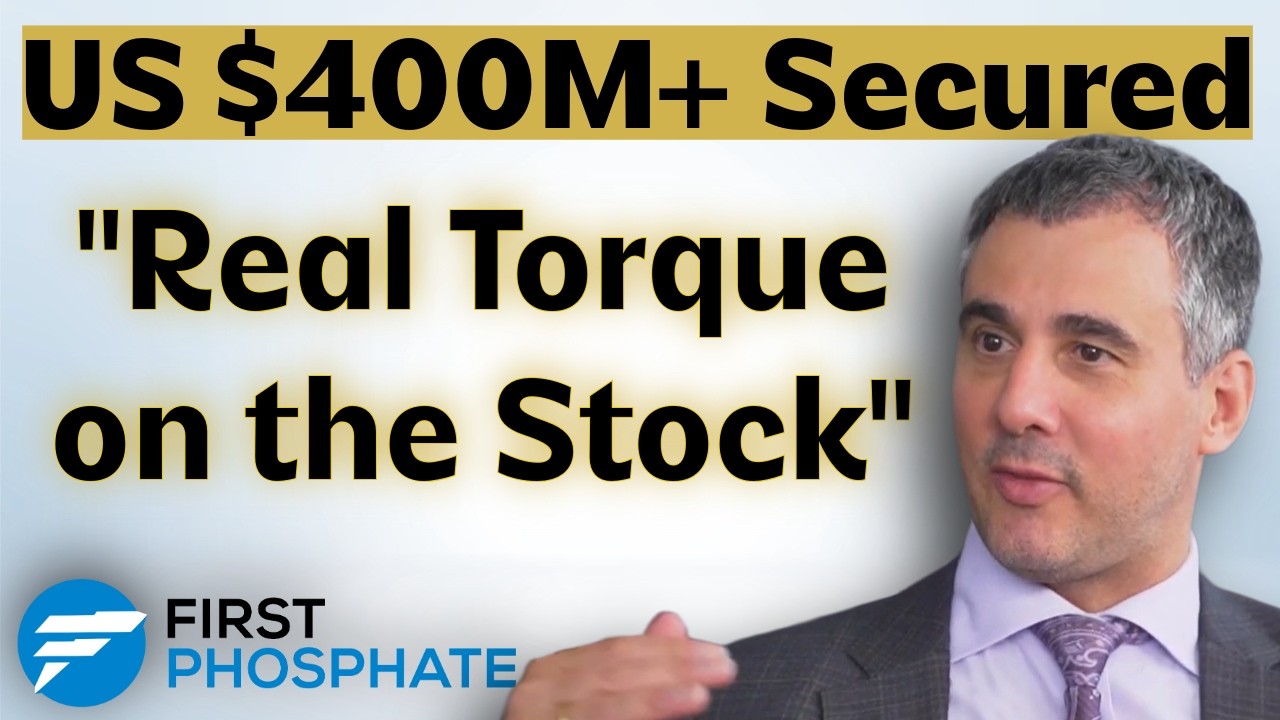
First Phosphate's Torque Moment: How Export Credit Could Kill Dilution - CEO John Passalacqua
- Top takeaway The CEO argues that with export-credit commitments covering almost 85% of the ~$475 million capex, the Quebec mine can be built with mostly friendly, non-dilutive sovereign capital, significantly reducing dilution for shareholders.
- He portrays sovereign and export-credit lenders as patient, non-toxic financing at the best interest rates because their goal is jobs and a settled supply chain rather than a quick return.
- He lays out the path to production: feasibility study in Q1 2027, permitting during 2027, final investment decision at the end of 2027, and production near the tail end of 2029.
- He calls the self-sponsored NASDAQ listing a lifetime achievement and says the company traded more stock in its first month on NASDAQ than in its entire prior history, with no sponsor bank, no capital raise at listing, and no share consolidation.
- He claims First Phosphate was the first OTC-listed ADR to reach NASDAQ and only the second Canadian ADR ever to trade there, in a listing process that took about nine months.
First Phosphate's CEO says Swiss (SERV) and Danish (EIFO) export credit commitments cover roughly 85% of the mine's capex (build cost), limiting dilution. Export credit agencies fund equipment purchases as debt, a non-dilutive alternative to equity that the guest calls patient, success-aligned capital. Timeline per the CEO: feasibility study in Q1 2027, permitting in 2027, final investment decision late 2027, production near the end of 2029. The company self-sponsored its NASDAQ ADR (American Depositary Receipt — a US-traded share equivalent) without an investment bank or new equity raise. Canada contributed about $21 million in non-refundable feasibility funding, and Québec is fast-tracking environmental permitting, the guest says.
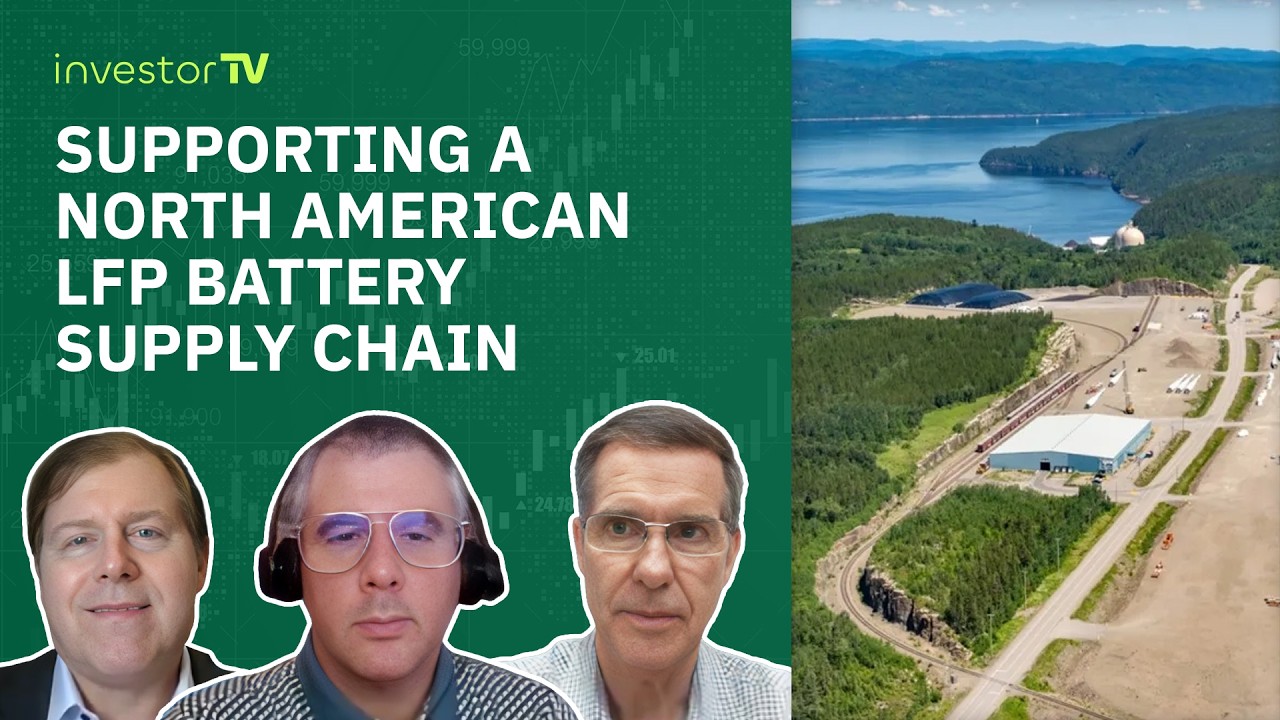
First Phosphate ($PHOS | $FRSPF) CEO on Advancing Its Quebec Phosphate Project
- Top takeaway Passalacqua argues phosphate is the real LFP choke point: the cathode is 60% phosphate versus only 4% lithium, and Western purified phosphoric acid supply (drawn from sedimentary rock usable mainly for fertilizer) is already forecast by CRU Group to fall short of traditional demand by 2035 — let alone LFP demand CRU says will nearly double, while Benchmark Minerals cites 8-10x growth.
- He positions First Phosphate's igneous anorthosite in Saguenay-Lac-Saint-Jean, Quebec as one of only four igneous phosphate zones worldwide (the others being Northern Europe, Russia, Southern Africa, Brazil) and one of only three North American igneous developers — and the only one 100% dedicated to LFP batteries and closest to deep-water port.
- He emphasizes the supply-chain argument: roughly 98-99% of LFP battery production sits in China, China has restricted LFP technology exports since the October 2025 Xi-Trump spat (even though LFP was invented in North America around 2001), and the company has demonstrated a 150-cell, 2,000-cycle North-American LFP build with Prayon, Hoganus, Century Lithium, Nouveau Monde Graphite and Altium.
- He highlights governance and capital structure: debt-free, $80M self-raised, NASDAQ ADR listing this month, board and management paid in shares, ~20% insider / ~40% high-net-worth ownership, and Indigenous collaboration plus Canadian and Quebec government support including fast-track status.
- He argues the project is a 'picks and shovels' play on the electron economy — with EVs only ~14% of LFP demand — driven by solar/storage and AI data center power-conditioning needs, and cites a forthcoming Q1 2027 feasibility study, mid-2027 permitting, and end-2027 investment decision with 40-50% of capex already spoken for by sovereigns.
First Phosphate could supply up to 350 GWh of LFP battery feedstock from a single Quebec igneous phosphate deposit, management says. Updated indicated resources grew 378% in this week's mineral resource estimate, supporting a project NPV of $2.1B and IRR of 37%. The guest argues phosphate, not lithium, is the overlooked choke point for North American LFP cathode supply. The project is one of just three North American igneous phosphate deposits; Agnico Eagle recently acquired a second via Martison. Management ties near-total Chinese LFP dominance to broader US bond and currency fragility, framing critical minerals as a hedging play.
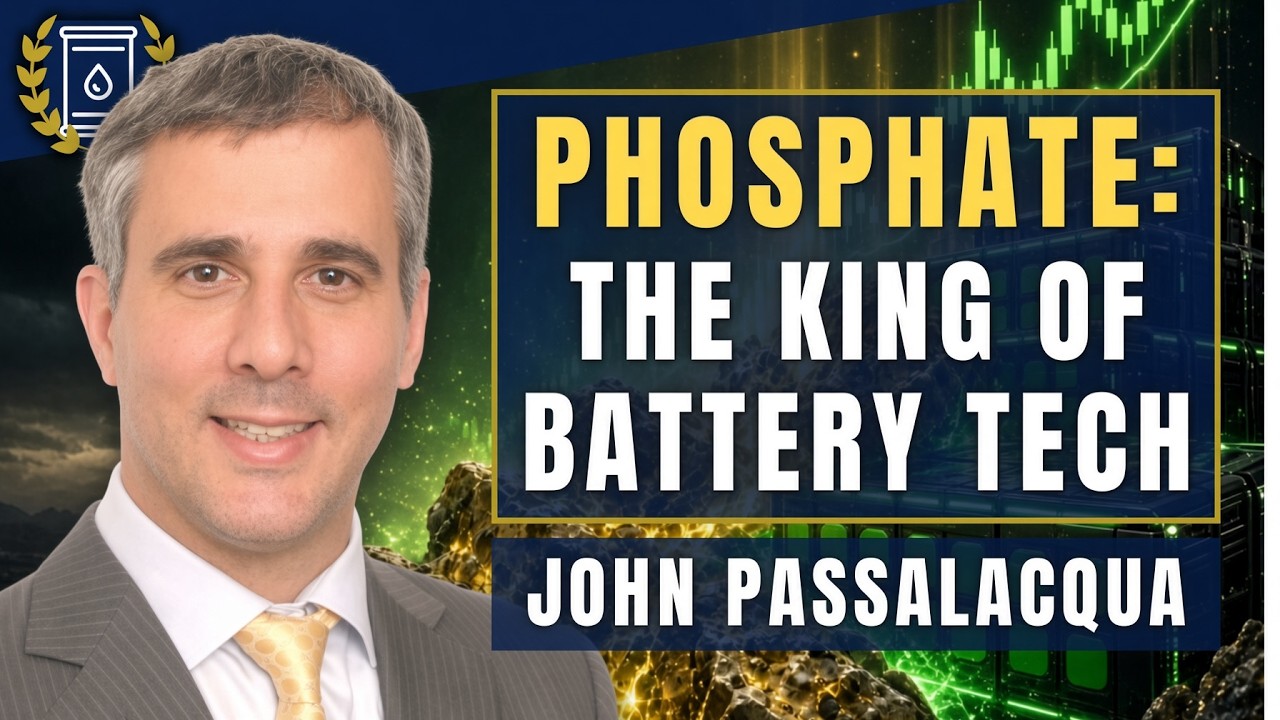
'The Growth is Incredible' - Why Phosphate and LFP Batteries Are Dominating
- Top takeaway Passalacqua argues that igneous phosphate is structurally superior for LFP batteries, citing a 91.1% conversion ratio into purified phosphoric acid versus only 10-30% for sedimentary phosphate, which he notes is contaminated with cadmium, uranium, and thorium.
- He contends LFP will continue to dominate battery chemistry, citing 81% of Chinese EV battery installations in April 2026 and 95% of new utility-scale battery contracts, and frames sodium-ion and silver battery alternatives as unproven versus the LFP track record.
- He argues North America must onshore LFP production because roughly 99.9% of LFP batteries are currently made in China, and positions First Phosphate's mine-to-market strategy as the Western supply chain alternative.
- Passalacqua notes phosphate is 61% of an LFP cathode (versus ~4% lithium and ~35% iron), so phosphate demand growth tracks almost 1:1 with LFP cathode active material demand, with Chinese LFP demand reportedly growing 25-60% quarter over quarter.
- He claims First Phosphate is the only public company he is aware of that is 100% dedicated to high-purity igneous phosphate for the LFP battery industry.
Igneous phosphate's 91% conversion to battery-grade acid gives it a structural edge over sedimentary sources for LFP. Phosphate makes up 61% of an LFP cathode versus just 4% lithium — LFP growth pulls phosphate demand along almost 1:1. China makes roughly 99% of LFP batteries; G7 wants no supply chain over 60% concentrated in one country by 2030. Quebec fast-track permitting plus Danish and Italian offtake letters at the G7 mark a coordinated Western push to onshore LFP. Phosphate exposure is far more concentrated than lithium — 150+ lithium names but First Phosphate claims to be the only pure-play igneous LFP supplier.

Why Governments Are Backing This Critical Minerals Project | John Passalacqua - First Phosphate
- Top takeaway Passalacqua argues First Phosphate is garnering unprecedented multi-tier government backing — from Quebec's fast-track permitting, to NRCan funding, to G7 international recognition
- He frames the March 2026 NRCan grant as covering the "beginning and the end" of the earlier funding round — both the concentrator process and the site's road and electricity infrastructure
- He emphasizes that the funding is non-repayable and non-dilutive, leaving the existing shareholder structure untouched
- He positions the company inside the G7 Resilience and Critical Minerals Alliance, framing the asset as strategically important to Western critical-mineral supply chains
NRCan provided First Phosphate $16.7 million in non-dilutive funding covering the concentrator, site electricity, and access roads in and out of the property. Quebec's provincial government launched a fast-track permitting process to advance First Phosphate's igneous phosphate project toward production. First Phosphate was acknowledged at the G7 summit and supported within the G7 Resilience and Critical Minerals Alliance. Provincial, federal, and international governments are aligned on bringing First Phosphate's igneous phosphate mine into production quickly.
Government Funding Is Fast-Tracking This Mine | John Passalacqua - First Phosphate
- Top takeaway The guest argues that federal funding under Canada's 'first and last mile fund' is fast-tracking infrastructure studies for the mine.
- He emphasizes the project's proximity to a provincial highway and hydro, framing the infrastructure gap as small but non-trivial.
- He flags that engineering work to determine exact power requirements must be completed before mine construction.
First Phosphate qualifies for Canada's first and last mile fund to engineer the mine's access road and power line. Site proximity to a main provincial highway and nearby hydro keeps the infrastructure build short and contained. Remaining engineering work focuses on routing the short access road and sizing the power line before construction.
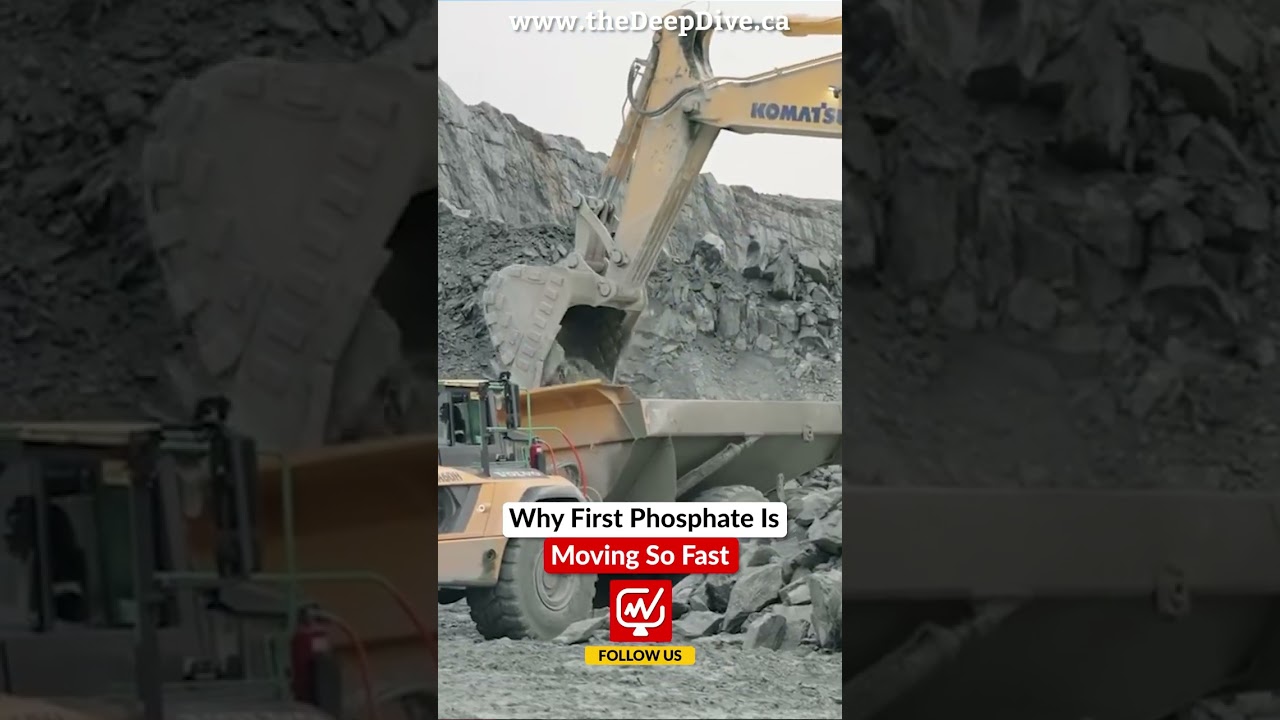
Why First Phosphate Is Moving So Fast | John Passalacqua - First Phosphate
- Top takeaway Passalacqua's lead argument is that First Phosphate must move quickly because phosphate is in urgent need, particularly for LFP batteries on top of fertilizer demand.
- He pushes an aggressive timeline, contending that the resource becomes more valuable the faster it reaches production.
- He asserts that as of August 2026 the company has full funding to get to a final investment decision (FID) on its mine.
- He frames the post-FID phase as building the mine, with the stated goal of moving into mostly non-dilutive capital.
First Phosphate is racing to production to capture phosphate demand from both fertilizer and LFP battery markets. Management argues a mineral resource's value rises the faster it reaches production, justifying an aggressive development timeline. Full funding is secured through the final investment decision (FID — the formal go-ahead to build), with non-dilutive capital targeted for construction. Non-dilutive capital — debt, royalty, or streaming deals that avoid issuing new equity — keeps existing shareholders from being diluted through the build.
First Phosphate's Race to Production | John Passalacqua - First Phosphate
- Top takeaway Argues First Phosphate's central focus is getting its igneous open-pit phosphate mine into production by 2029 — only 3-4 years out from the as-of date.
- Cites the just-finished infill drill program — which upgraded resources from Inferred to Indicated and Indicated to Measured — as a key recent de-risking step.
- Frames completing the feasibility study by end of 2026 / early 2027 as the critical unlock for permits, capital raises, and closing out remaining offtake agreements.
- Lays out a sequencing thesis: feasibility first, then permits, capital, and offtakes, to assemble a capital stack that brings the mine into operations.
First Phosphate is targeting open-pit igneous phosphate production by 2029 — only three to four years away. The recent infill drill program upgraded resources, moving them from Inferred to Indicated and Measured. Management expects the feasibility study to wrap by late 2026 or early 2027, enabling permits and offtake talks.
First Phosphate Momentum Grows: Canada Funds AGAIN & Quebec Fast-tracks - CEO John Passalacqua
- Top takeaway Passalacqua argues that layered government support — local municipalities, Quebec's provincial fast-track, Canadian federal grants, and G7 critical-minerals recognition — proves Ottawa wants the project in production as fast as possible.
- He explains Quebec's fast-track program (one of three companies selected) as a central coordinating point that dispatches the company across permitting, energy, and natural-resource ministries to compress bureaucratic timelines.
- He emphasizes a stacked capital plan: roughly $30M Canadian in cash, ~$20M in grants, and about $170M euros from the Export-Import Bank of Denmark for the concentrator, which he says enables concurrent rather than sequential work toward a 2029 production target.
- He says there are no logistical bottlenecks at the deep sea port ~70km from the mine site, with the federal port's $50M wharf expansion described as an added bonus; definitive prepaid off-takes with international partners are ready to be served.
- He attributes recent share-price strength and tight ~1-cent spreads on the CSE (PHOS) and U.S. OTCQX (FPHOY) to a retail investor base that has grown from about 500 to over 5,000 in the past 12-18 months.
First Phosphate secured CAD $4.84M in new non-repayable federal funding to build the road and power line connecting its Quebec mine to the concentrator. Quebec's 'Filon' fast-track program named First Phosphate among just three companies, centralizing multi-ministry permits to compress permitting timelines. Combined federal and provincial backing now tops CAD $21.5M on top of a CAD $30M cash position, materially de-risking the company's 2029 production target. Bankable off-take agreements with international partners are already in place, and Denmark's EIFO has signaled EUR 170M in financing for the concentrator build-out. US shareholder count has climbed tenfold to roughly 5,000 over 12-18 months, with tight OTCQX spreads supporting deep liquidity on both US and Canadian exchanges.
Canada Is Pouring Millions Into This Battery Mineral | John Passalacqua - First Phosphate
- Top takeaway Argues that infrastructure is what de-risks the project: the Begin-Lamarche site sits only 1-2 km from the main provincial highway, is very close to Hydro-Quebec power lines, and is roughly 70 km from the deep-sea Port of Saguenay, with nearby forestry villages supplying a workforce that does not require a remote camp.
- Frames the cumulative $21.5M in non-dilutive Canadian federal funding (March 2026 plus the new $5M), combined with Quebec fast-track permitting status and G7 Critical Minerals Alliance letters of intent from Denmark, Italy, and the EU, as multi-level government validation of the project.
- Outlines a schedule targeting feasibility completion by year-end 2026 / early 2027, followed by permitting and a final investment decision, with first open-pit production aimed at 2029.
- Characterizes the current news flow as de-risking every day, noting that he and the board are paid in shares and that the leadership team has contributed to multiple insider financing rounds.
- Positions phosphate as a battery mineral for the LFP (lithium iron phosphate) supply chain, with First Phosphate pursuing a vertical mine-to-market model in North America.
A $5M non-dilutive Canadian grant adds to First Phosphate's $16.7M federal haul, funding road and power work at its Quebec project. Bégin-Lamarche sits 1–2 km from a highway and 70 km from the Port of Saguenay, sharply trimming infrastructure capex. Quebec's fast-track permit plus G7 letters of intent from Denmark, Italy, and the EU stack international support behind First Phosphate. An aggressive 2029 open-pit mine target hinges on completing feasibility by late 2026 or early 2027. The guest argues investors should evaluate mining projects on logistics — roads, power, workforce — before deposit geology.
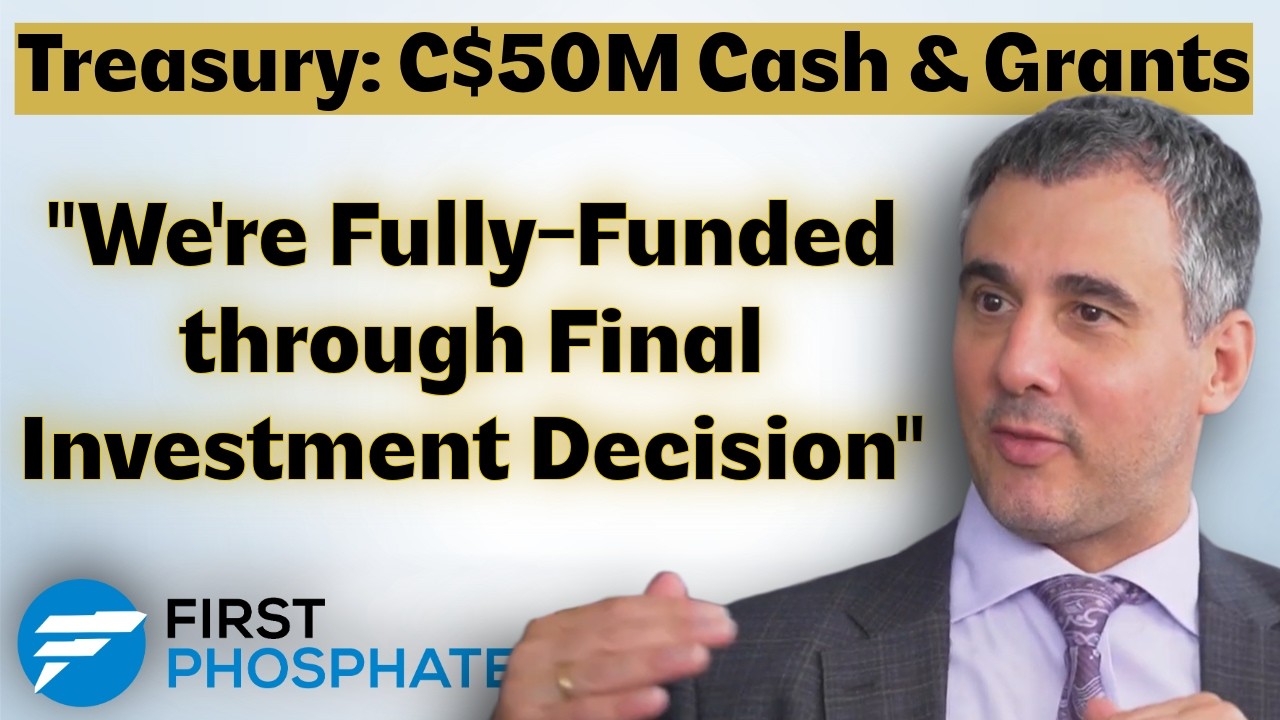
“Fully Funded to FID with $50M Treasury of Cash & Grants” says First Phosphate CEO John Passalacqua
- Top takeaway Argues First Phosphate's cashed-up balance sheet — a 24-36 month runway from nearly $50M in cash and grants — means the 2026 small-cap selloff does not change its fundamentals or its path to a final investment decision.
- Characterizes the selloff as 'systemic' profit-taking in which investors sell winners to offset losers, and frames the washout as a 'catharsis' that flushes weak hands and positions companies like his to attract sidelined cash.
- Contends First Nations are a source of aid rather than obstruction, citing the collaboration agreement with the Maastéayash Nation and its active support in winning the $16.7M Canadian government contribution.
- Remains deliberately cautious on timing, calling the 2029 mine-start target 'very, very aggressive' and declining to date the Port Saguenay phosphoric acid plant until that project is further de-risked.
- Drawing on his floor-trader and market-maker background, he expects more choppiness ahead, telling listeners to 'put your crash helmets on' and wait for September.
First Phosphate holds almost $50 million of available capital — treasury cash, a federal contribution, and a fresh raise — giving a 24 to 36-month runway. The CEO argues a systemic selloff — investors selling winners to offset losers — is a catharsis that flushes weak hands and favors cashed-up companies. A collaboration agreement gives the Maastéayash Nation about one percent of First Phosphate, turning First Nations relations into aid for permitting and funding. The company's new ADR (an American security) opens First Phosphate to US institutions barred from OTC quotes; volumes are building as 10-to-1 conversions proceed. Feasibility at the Béjean La Marche mine lands by end of 2026 or Q1 2027, keeping the aggressive 2029 Quebec mine-production target alive.

The Battery Boom Has a China Problem | John Passalacqua - First Phosphate
- Top takeaway His central argument is that the small and mid cap sell-off is a capital-availability story rather than a company story: a restarting Iran-US conflict pushes oil and inflation up, keeps interest rates high, shrinks available capital, and small caps are sold first - so investors should sort holdings by who already holds cash, and he expects funded names like his to be where sidelined cash returns.
- He argues igneous phosphate is structurally better suited to batteries than to fertilizer, since LFP-grade material needs one more purification step into purified phosphoric acid and igneous rock converts almost entirely into that acid without entering the fertilizer stream, which he describes as sheltering the company from sulfur and sulfuric acid cost pressure.
- He cites the composition of an LFP cathode - roughly 60% high-purity phosphate against about 4% lithium - and states that LFP is around 75% of all batteries produced worldwide, using that to argue phosphate demand is tightening on both the agricultural and battery storage sides.
- He is pushing an aggressive timeline out of necessity: feasibility study by early 2027 and production by 2029, funded through to the final investment decision, with the aim of moving into mostly non-dilutive capital for mine construction; he adds that the investor base grew roughly tenfold from about 5,000 holders on the latest Broadridge list, with more small funds and family offices entering even as retail was retained.
- He states that almost the entire board and all senior management are shareholders, that the board and his own CEO compensation is 100% in stock or RSUs, that he owns about 10% of the shares, and that management takes 50% of pay in equity, with minimizing dilution as the stated objective.
LFP (lithium iron phosphate) batteries need a purer phosphate than fertilizer, and igneous rock sidesteps the fertilizer chain Hormuz disruptions are squeezing. Phosphate makes up roughly 60% of an LFP cathode by weight against just 4% lithium, and LFP is about 75% of batteries produced. The small-cap selloff tracks macro — oil, inflation, rates — so the guest urges investors to check each company's cash and re-raise needs. First Phosphate closed a $17.7 million raise, holds about $35 million, and adds a non-dilutive $16.7 million federal contribution. Feasibility study targeted for late 2026 or early 2027, production by 2029, and G7 partners lining up behind both Quebec projects.

First Phosphate Just Got Backed By The G7 | John Passalacqua - First Phosphate
- Top takeaway The CEO calls the G7 naming of two First Phosphate projects the week's big news, arguing it puts the company inside the G7's critical-minerals effort.
- He frames the G7 goal as cutting supply-chain concentration: by 2030 no single country should own more than 60% of a supply chain G7 members are part of, eventually down to 50%.
- He argues the LFP battery supply chain was in focus in the G7's selections and that First Phosphate's projects were mentioned at the summit.
- He points to two deals tied to the announcement: the Béjane La Marche mine and a phosphoric acid plant at the Port of Sagné.
First Phosphate says its Béjane La Marche mine and Port of Sagné phosphoric acid plant were named in G7 deals. The G7's Critical Minerals Resilience and Production Alliance targets no single country holding over 60% of a member supply chain by 2030. Prime Minister Carney announced 13 projects with eight countries; the LFP (lithium iron phosphate) battery supply chain was in focus.
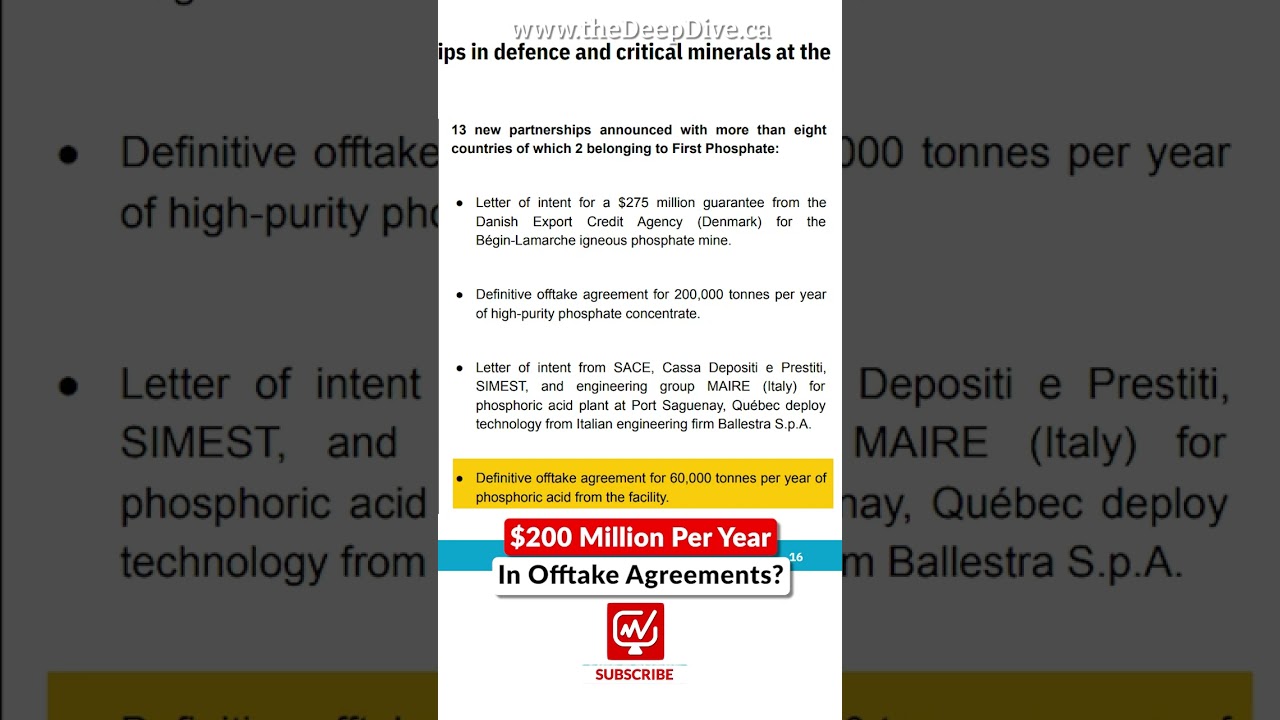
$200 Million Per Year In Offtake Agreements | John Passalacqua - First Phosphate
- Top takeaway Argues that as of June 2026 First Phosphate's offtake deals — 200,000 tonnes of phosphate concentrate and 60,000 tonnes of phosphoric acid — add up to roughly $200 million USD of value per year.
- Points to the $275 million Danish Export Credit Agency guarantee for the Béjean La Marche mine as institutional backing for the project.
- Claims the G7 views the LFP battery supply chain as a strategic prerogative and says a G7 statement came out in favor of First Phosphate and the supporting nation states.
- Cites letters of interest from Italian state entities SACE, CDP and CIMEST, plus interest from Maier Group, for the Porto Sagné phosphoric acid plant.
First Phosphate reports about $200 million per year in combined offtake value spanning phosphate concentrate and phosphoric acid. A $275 million guarantee from Denmark's export credit agency and a 200,000-tonne concentrate offtake back the Béjean La Marche mine. Italian state entities sent letters of interest and Milan-listed Maier Group showed interest in the Porto Sagné phosphoric acid plant. The guest says G7 support for the LFP (lithium iron phosphate) battery supply chain creates an opening for First Phosphate.
This LFP Supply Chain Story Just Got G7 Backing | John Passalacqua - First Phosphate
- Top takeaway Top point: he argues the G7's concentration goal — no single country or region owning more than 60% of a supply chain G7 members are part of, eventually 50% — is why phosphate and the LFP battery chain were in scope, and that G7 support makes the company's projects a G7 prerogative rather than a company-level lobbying win.
- He says a G7 commitment is strong because the nation states behind it all want the projects to happen and the G7 reports on them each year, and he does not foresee problems getting the letters of interest to definitive terms over the coming months or year.
- He states the offtake agreements are already definitive and bankable, with some prepaying done, leaving the feasibility study and converting the remaining letters of interest into commercial agreements as the outstanding work.
- He argues the upgraded resource now merits advancing to development, pointing to a PEA-stage comparison in which the project already held enough phosphate for half of North America's new-vehicle LFP fleet for 23 years, a figure he says has only grown since.
- He frames the G7 announcement as letting the company stack work layers instead of stopping between steps, which he says is why they are already moving on the capital stack while feasibility is still outstanding; his 12-month goal is to be into permits or close to them with most or all of the capital stack built and engineering and long-lead orders starting.
First Phosphate won a $275 million state guarantee, 200,000 tonnes of phosphate offtake, and Italian letters of interest after G7 recognition. The G7 wants no single country above 60% of a critical supply chain, and phosphate projects were named for the first time. An infill drilling campaign moved resources from inferred to measured, lifting indicated tonnage almost 400% and leaving the deposit open at depth. The guest frames 18 million tonnes of contained phosphate as 900,000 tonnes a year of concentrate shipping through the Port of Sagnuay. Feasibility is targeted for Q1 2027, with permitting and a capital stack next, and an open pit mine running by 2029.
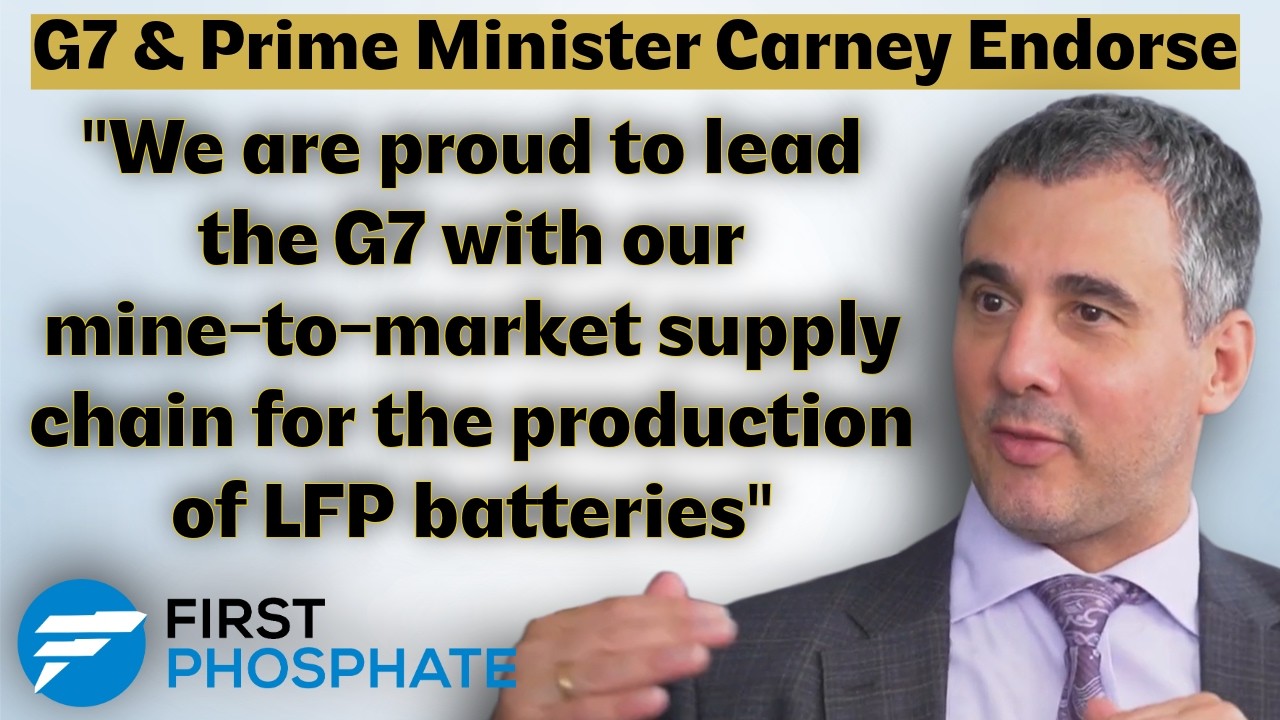
First Phosphate Endorsed by G7 Summit & Prime Minister Carney: New Partners & Definitive Offtake
- Top takeaway The CEO argues First Phosphate is now the leading company for onshoring the LFP battery supply chain in the Western world after being endorsed at the G7 level, and says the responsibility is to execute.
- He lays out a timeline targeting a feasibility study by end of 2026 or early 2027, a final investment decision by end of 2027, construction in 2028, and mine production by 2029, calling it aggressive but necessary.
- He estimates the LFP battery market at $100 to $200 billion within 4 to 5 years, notes LFP currently has roughly 100% dependency on China versus the G7's stated goal of 50% dependency by 2030, and positions the company to capture that onshoring.
- He explains the G7 Critical Minerals Resilience and Production Alliance accelerated deals that might have taken a year or more into a few months, starting from a $16.7 million Canadian federal contribution received at PDAC in March.
- He says three existing shareholders wanting to commit about $5 million prompted the $15 million financing, which grew oversubscribed within 24 hours and closed even after the market pullback tied to Iran-related issues.
G7-level endorsement and sovereign letters of interest cover roughly half of First Phosphate's roughly $500 million mine capex, de-risking the capital stack before feasibility. Definitive offtake agreements lock in 200,000 tonnes per annum of phosphate concentrate and 60,000 tonnes of phosphoric acid at prices that float with the market. CEO John Passalacqua targets a feasibility study by end-2026, a final investment decision by end-2027, and mine production by 2029. A triple-oversubscribed C$15 million financing plus a C$16.7 million federal grant lifts access to capital above C$50 million. The company positions itself as the Western leader in onshoring the LFP (lithium iron phosphate) battery supply chain, which today is concentrated in China.

First Phosphate: “378% Increase in Indicated Mineral Resources” - CEO John Passalacqua
First Phosphate's Bégin-Lamarche project in Québec shows a 378% increase in Indicated Mineral Resources, giving the company confidence to advance toward a feasibility study. The CEO highlights a clean capital structure and shareholder support for warrant exercises as key financial strengths for funding the project's next phase. Agnico Eagle's recent deal in the phosphate sector is presented as a strong industry signal validating the strategic importance of this critical mineral.
Canada May Finally Be Backing Its Battery Supply Chain | John Passalacqua - First Phosphate
First Phosphate is building a mine-to-market LFP battery supply chain in Quebec, with plans for a mine, phosphoric acid plant, and downstream facilities. Denmark's export credit agency has indicated interest in supporting up to €170 million of supplies, significantly de-risking the project's capital stack. Canada adding phosphate to its top critical minerals list and the proposed Canada Strong Fund could provide major catalysts for domestic phosphate development.
First Phosphate Secures EUR 170M Commitment & Targets 2029 Production with CEO John Passalacqua
- Top takeaway Passalacqua argues the EXIM and Danish LOIs cover roughly 50-60% of the ~$475 million US build cost, giving the project pricing competitiveness and confidence for other lenders and suppliers to join the capital stack.
- He frames geopolitical disruption — the Iran conflict and Strait of Hormuz closure sending sulfuric acid and fertilizer prices sharply higher — as validation of First Phosphate's core thesis of building a local North American/Western LFP phosphate supply chain.
- He claims the deposit, tested only to about 400 meters depth, already supports a minimum 23-year mine life of high-purity phosphate that he says could power half of North America's new-vehicle fleet for 25 years, with room to grow wider and deeper.
- He stresses the infrastructure and pit will be deliberately designed to avoid cornering the company, so deeper or wider resource can be exploited later if economics permit.
- He cites a June 2025 US Department of Defense white paper endorsing the phosphate type as rare and feasible, suggesting DPA Title III funding could make it important for North American electrification and defense.
Export credit agency LOIs from Denmark (EUR 170 million) and the US EXIM Bank ($170 million) cover roughly 60% of First Phosphate's $475 million concentrator capex. CEO John Passalacqua says converting LOIs to definitive financing requires a feasibility study (end-2026), permitting (early 2027), equipment contracts, and detailed engineering. A definitive bankable offtake agreement that already carries some prepayment de-risks the Quebec project and supports an aggressive 2029 production target. About 40,000 meters of infill drilling at 50-meter centers confirmed resource continuity and found two new zones that could expand the pit, resource, and mine life. Strait of Hormuz disruption to sulfuric acid supply reinforces the company's push for a local Western LFP phosphate supply chain.
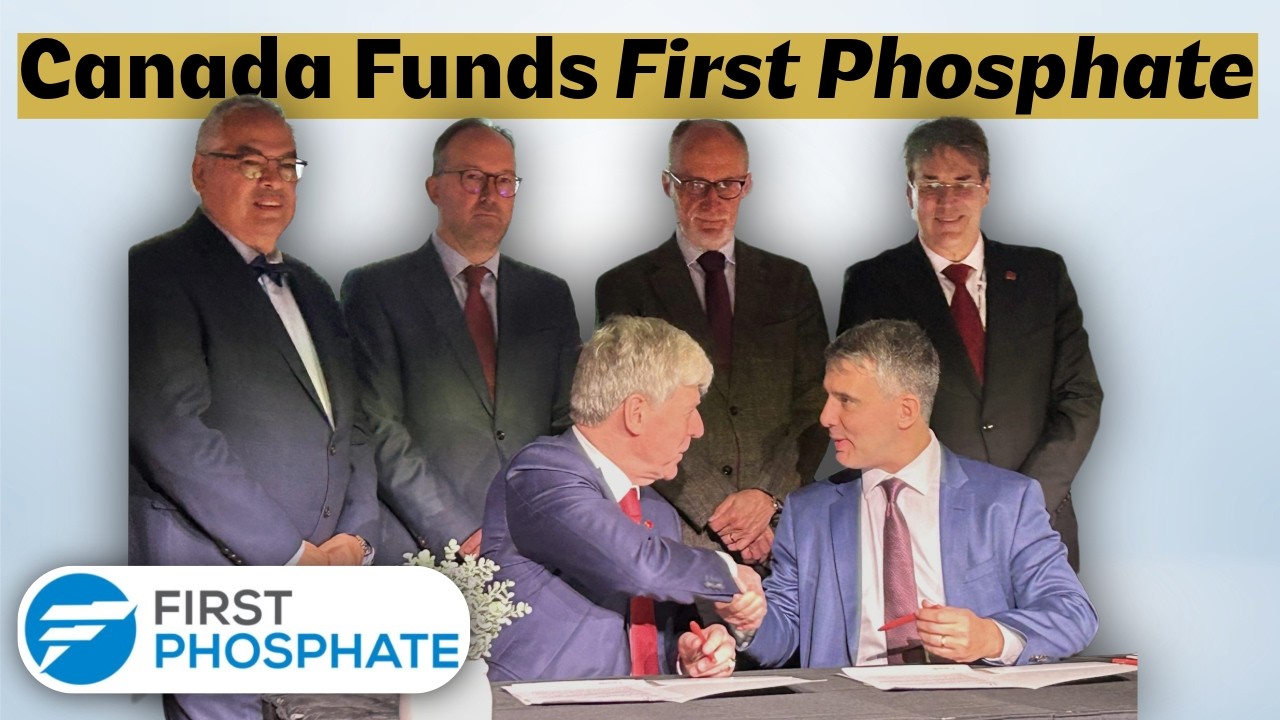
Canada Funds First Phosphate & Incentivizes Domestic Phosphate Production with CEO John Passalacqua
- Top takeaway His central argument is that the shares are undervalued at roughly 5% of the preliminary economic assessment NPV, and that clear Canadian government support raises the odds the mine is built, leaving substantial upside.
- His thesis on demand: only about 4% of an LFP battery is lithium while roughly 60% of the cathode is high-purity phosphate that fertilizer-grade rock cannot supply, and around 75% of batteries produced worldwide are lithium iron phosphate.
- He argues that location decides which critical mineral projects ever get built, and that the company's Quebec resource, about 70 km from a deep-sea port and 2 km from a highway with hydro and a nearby workforce, avoids the infrastructure capex trap facing remote lithium and other finds.
- He says he wants to build a phosphate-based critical mineral supply for North America and Europe, that his leading offtakers are European with Belgian authorities appearing at the funding announcement, and that the company is also working with the United States while tariff rulings are pending.
- On capital structure he presents the 10-to-1 ADR as a trailblazer that brings US institutions in, and says he and the board buy stock because management is paid in shares and shareholders should see that alignment.
A C$16.7M non-repayable federal grant de-risks the company through feasibility, permitting and a final investment decision. LFP (lithium iron phosphate) batteries are 60% phosphate by mass, and battery-grade supply comes from scarce igneous rock. Siting 70 km from the Sagné deep-sea port with power, road and a commuting workforce cuts infrastructure capex most critical-mineral projects must fund. Phosphate joined Canada's clean-tech A-list, unlocking a 30% refundable tax credit that reduces capex for downstream processing. A 10,000 tonne-per-year cathode plant concept is paused until Canada-US tariff rulings settle, with Europe leading offtake interest.
Key Quotes
"The indicated mineral resource now stands at 6.2 million tonnes grading 7.70% P₂O₅, containing approximately 478,000 tonnes of phosphate."
— Updated Mineral Resource Estimate announcement for Bégin-Lamarche project
"Where others see a rock in the ground in Quebec, I see the fundamental building block for the next decade of energy storage."
— The Deep Dive interview on First Phosphate's vision
"Phosphate is rapidly emerging as a strategic pillar of North America's battery supply chain."
— LinkedIn commentary on critical minerals recognition
"Lithium iron phosphate batteries now power the majority of global battery production, but supply chains remain heavily concentrated in Asia."
— YouTube interview on LFP supply chain dynamics
"Securing $21.5 million in non-repayable Canadian government funding signals that phosphate belongs on the critical-minerals agenda and de-risks our path to a Bankable Feasibility Study."
— RedChip Companies interview on First Phosphate (Nasdaq: PHOS)
Key Works
Announced a 378% increase in indicated mineral resources to 6.2 million tonnes at 7.70% P₂O₅ at the Bégin-Lamarche project in Quebec following extensive drilling and metallurgical work.
In-depth profile of First Phosphate's mine-to-market strategy for LFP battery-grade phosphate in Quebec
Interview covering purified phosphoric acid, China's market role, insider ownership, and energy transition positioning
Analysis of First Phosphate's stock rerate, milestones toward feasibility, and positioning in the critical minerals supply chain
Canadian Mining Journal coverage of First Phosphate's Nasdaq debut under ticker PHOS.
Extended interview covering strategy, mine-to-cathode integration and critical-minerals policy.
Video interview tying the Nasdaq listing to the Quebec phosphate-to-LFP thesis.
Specializations
Disclaimer: John Passalacqua has NOT endorsed this platform and is not affiliated with Pixys in any way.