Michael Lebowitz
Portfolio Manager | Thoughtful Money | Market Analyst
"Market analysis and portfolio strategy commentary on Thoughtful Money"
Biography
Michael Lebowitz is a portfolio manager and market analyst who appears as a guest on the Thoughtful Money platform, where he provides commentary on equity markets, macroeconomic conditions, and portfolio strategy. His discussions frequently address market volatility, timing decisions, and how investors should navigate periods of geopolitical uncertainty and rapid price movements.
Lebowitz has been featured in multiple Thoughtful Money videos discussing whether market pullbacks represent buying opportunities or reasons for caution. His analysis tends to focus on broader equity market trends rather than specific commodity or natural resource sectors. He has addressed topics such as market bottoms, the speed of market recoveries, and how geopolitical events like the Iran conflict have impacted investor sentiment and asset prices.
While Lebowitz offers perspectives on markets that may tangentially affect mining and commodity investors—such as inflationary pressures from energy prices during geopolitical conflicts—his primary focus appears to be general equity market analysis and portfolio management rather than dedicated commodity or mining sector coverage. Investors seeking specialized natural resource insights may find his macro commentary useful as context, but should not expect deep sector-specific mining analysis.
Videos (11)
Market Starting To Crack Under High Bond Yields? | Michael Lebowitz
- Top takeaway His top point is that calm index levels are misleading: a very small group of AI tech stocks is masking significant churn underneath, with the equal-weighted S&P down 4 percent while rate-sensitive sectors are worse (financials -5, short small cap -6.5, real estate -7, utilities -9), and his dispersion index sitting at the extreme readings that previously preceded index declines.
- He calls an intentional hyperscaler capex pullback the biggest market risk over the next year or two, on the idea that they decide they are spending too much and build five data centers instead of seven, which he says could easily send the market into a 25 percent correction.
- On rate transmission he stresses delay rather than absence of impact: bonds issued in 2021 come due now at rates repriced from about 2.5 percent to 6 percent, forcing cost cuts, and by his breakeven math real yields near 2.7 percent are very restrictive. He adds that the pain is concentrated in the belly of the curve, with two-year yields up nearly half a percent over the last month while the 30-year rose only 6 basis points, so it lands first on floating-rate and shorter-duration borrowers.
- He criticizes the Fed's latest projections as internally odd, saying the 2027 year-end funds rate median was raised about half a point from 3.6 to 4.1 percent with no change to the growth, inflation or unemployment forecasts, which implies higher rates do no harm.
- On positioning he says the firm sold some longer bonds to buy the five-year at about 5 percent, trimmed the large-cap tech position, added value and a little utilities, and he argues expected ten-year equity returns at today's valuations look negligible next to a return locked in at roughly 5 percent.
Michael Lebowitz argues a calm S&P 500 hides real strain, with rate-sensitive sectors and the equal-weight index already well behind. Companies that issued bonds in 2021 at low rates now refinance near 6%, forcing layoffs, store closures and cut capital budgets. Lebowitz calls an AI capital spending slowdown the biggest market risk, since data centers supply about 4 points of GDP growth. Measuring real yields against breakeven inflation rates (what investors expect prices to rise) shows policy is more restrictive than the headline yield suggests. Lebowitz's team trimmed tech for value and moved from the 30-year into the 5-year, though oil near $120 could undo the rotation.

Bonds To Reverse Soon As Yields Approach 'Line In The Sand'? | Michael Lebowitz
- Top takeaway The guest argues 10-year bond yields at 5% are a 'line in the sand' and likely the maximum near-term upside, with secular lower yields expected over the next couple of years as yields trend toward the real growth rate
- Distinguishes bond fundamentals from narratives, noting that Core CPI at 2.5%, trimmed mean PCE at 2.3%, and break-even inflation expectations at 2.5% remain near pre-war levels and do not justify current yields, while narratives around the Iran war, tariffs, deficits, and AI-driven debt issuance are driving the disconnect
- Argues institutional buyers such as insurance companies, pension funds, and endowments will step in to buy at the 5% level before the Fed intervenes, calling the 'market put' more powerful than any 'central planner put'
- Frames buying 5% intermediate-maturity bonds today as a 'free option' — worst case, hold to maturity for steady 5% income; best case, sell at a profit if yields fall and reinvest in stocks or other assets
- Says RIA is waiting for technical signs of a trend reversal and additional inflation prints before adding duration to portfolios, preferring to buy with more confidence at lower yields than to catch a falling knife
Lebowitz sees 5% on the 10-year Treasury as a 'line in the sand' that will force the Treasury, Fed, and institutional buyers to intervene. Narratives around Iran, tariffs, deficits, and AI debt are pushing yields higher, but trimmed mean PCE at 2.3% shows fundamentals do not justify the move. Fed chair Warsh's hawkish Jackson Hole pivot may be 'jawboning' to establish credibility before potential cuts into 2027. RIA is watching for technical reversal signals before extending bond duration, with three-to-five-year maturities the likely sweet spot. Trailing 10-year bond returns bottomed and CAPE near 41 argues for locking in higher yields, especially for retirees.
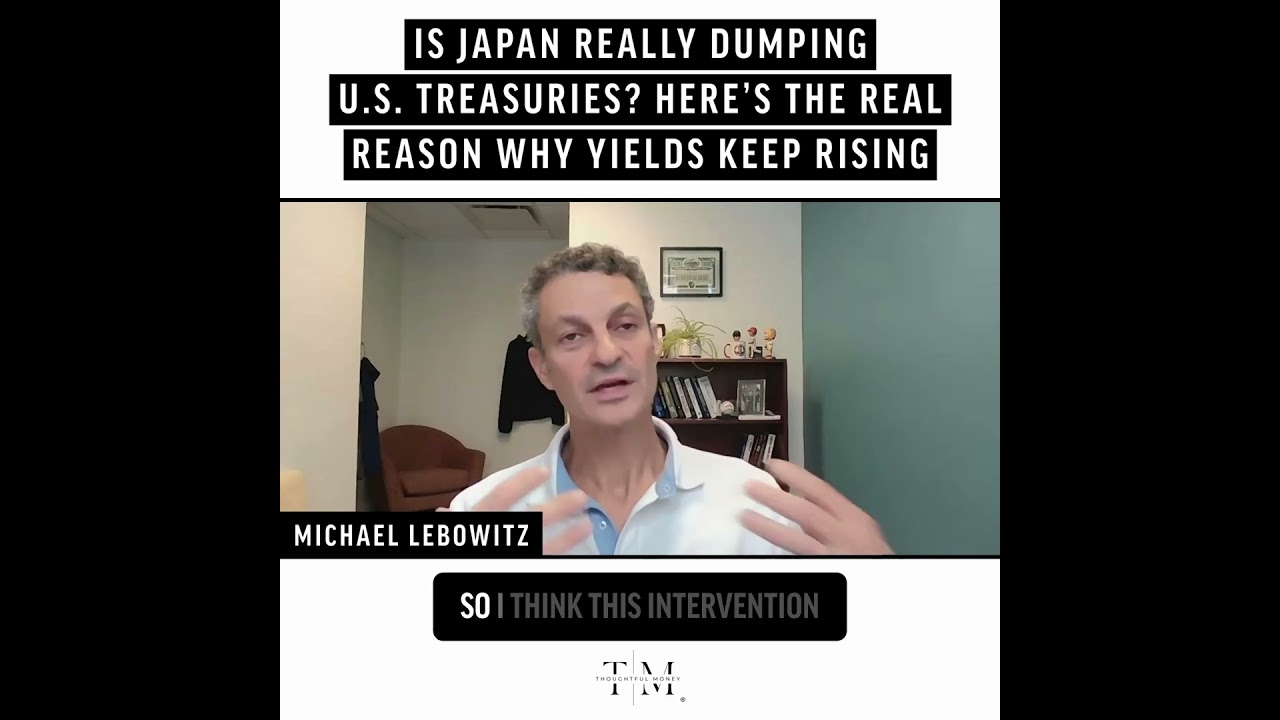
Is Japan Really Dumping U.S. Treasuries? Here’s The REAL Reason Why Yields Keep Rising
- Top takeaway Lebowitz argues Japan isn't actually selling U.S. Treasuries outright — they're likely using repos and Fed facilities to get dollars while defending the yen, a lesson learned from the August 2024 yen carry trade unwind that hurt U.S. markets
- He sees a bond supply-demand imbalance as the main yield driver, citing both government debt rollovers and a 'massive wave of borrowing from the hyperscalers' for the AI build-out boom
- Real yields look very attractive in his view — investors can lock in 3% on a 30-year TIPS on top of inflation, versus 10-year equity expected returns he reads as flat to negative on a CAPE basis
- He doesn't believe inflation expectations are the culprit — 5/10/30-year inflation expectations sit roughly where they were before Iran, with the recent rise only in 1-year expectations
- He expects yields to mean-revert to the inflation expectations anchor once oil market volatility calms down, since deficit and supply concerns have stretched yields well beyond that fundamental anchor
Japan can defend the yen by pledging Treasuries as repo collateral to obtain dollars, avoiding direct Treasury selling pressure. Rising yields likely reflect a bond supply-demand imbalance from heavy government debt issuance plus hyperscaler AI-driven corporate borrowing. Long-term yields are pushed by both inflation expectations and a term premium; current levels look stretched versus the inflation anchor. Real yields near 3% on 30-year TIPS offer an attractive return alternative when CAPE-implied equity returns sit flat to negative. Once oil volatility settles, yields may revert toward their fundamental inflation-expectations anchor rather than stay elevated.

False Breakout? Or Is A Wave Of New Market Highs Ahead? | Michael Lebowitz
- Top takeaway Calls the labor market 'meh' for the better part of a year and warns the unemployment-rate drop to 4.1% is a participation-rate artifact, flagging wage growth of just 0.1% as a real problem given that 70% of GDP is personal consumption.
- Argues bond yields have become stretched on deficit and supply fears (term premium) rather than on inflation expectations — pointing out 30-year TIPS are offering roughly 3% real yield versus flat-to-negative CAPE-based equity real returns — and expects calmer heads to eventually prevail.
- Sees the S&P 500 breakout as a healthier market because chip-momentum excess and the leveraged Situational Awareness Fund have been washed out, but warns the move above the Bollinger Bands could be a false breakout like the late-June downside fakeout.
- Frames GDX-vs-GLD (not GDX-vs-S&P) as the right pair-trade lens for miners and says a durable gold/gold-miner trend change hinges on real yields truly reasserting their historical negative correlation with gold, beyond just a one-week reaction to a soft payrolls print.
Real rates are reasserting themselves as the dominant driver of gold prices after a stretch when the historical link weakened, says Lebowitz. He expects the S&P to retest the breakout before either resuming the uptrend or sliding back into the trading range. Lebowitz argues bond yields will drift lower once oil volatility fades, with real yields near 3% anchoring the floor. The collapse of the levered Situational Awareness fund illustrates how quickly a momentum-driven, leveraged book can blow up.
How Oil Is Secretly Controlling The Bond Market
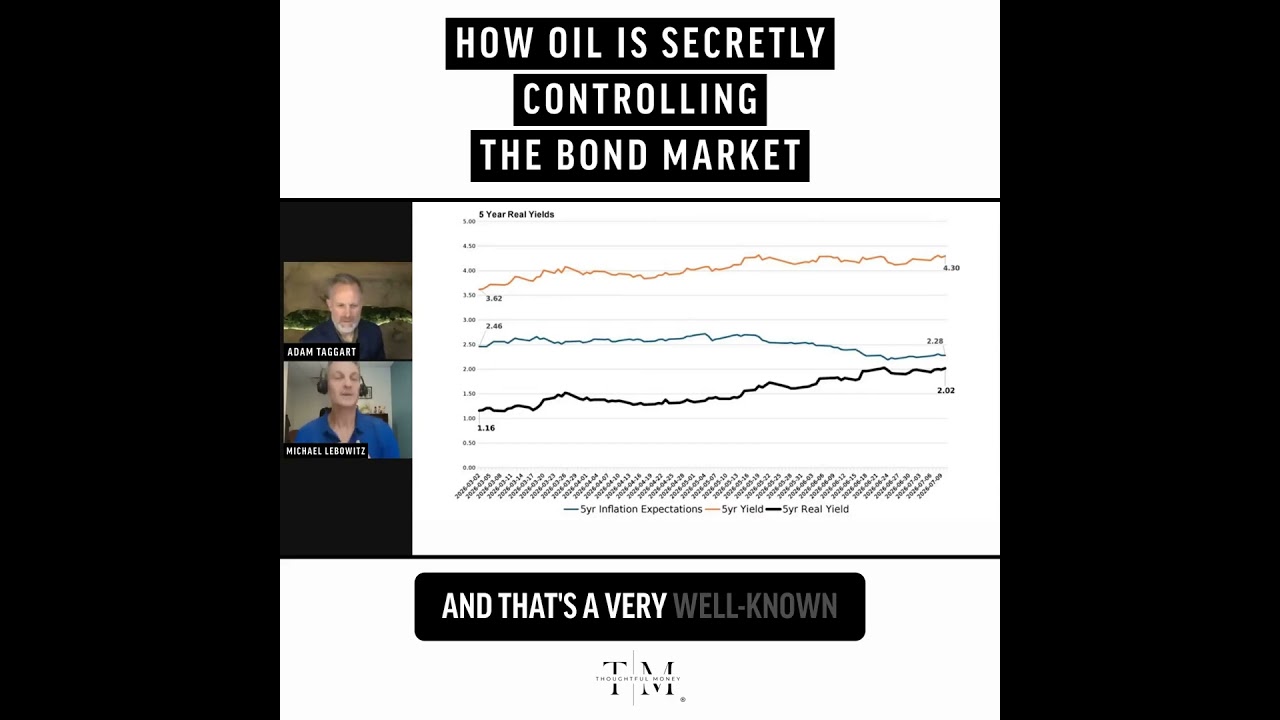
Crude oil has become the bond market's dominant driver, with oil-yield correlation climbing above 50% — its highest reading since March 2020. Since the Iran conflict began, falling inflation expectations clash with rising 5-year yields, pushing real yields up nearly a full percentage point. Michael Lebowitz argues the bond market is pricing a geopolitical risk premium, possibly preparing for a scenario where oil spikes to $150–200 a barrel. Adam Taggart flags fiscal risk as an alternative explanation — an expanded conflict could widen deficits and increase Treasury issuance.

What Bonds, Oil & Gold Are Telling Us | MIchael Lebowitz
- Top takeaway As of the recording, he argues bonds are being driven by oil rather than inflation or the economy: crude's correlation with five-year yields is above 50%, the highest since March 2020 — 'as goes oil, as goes bonds.'
- He flags a paradox: five-year inflation expectations have net declined since the Iran conflict began (from about 2.46% to 2.28%) while yields rose from roughly 3.62% to about 4.30%, a war/deficit premium he expects to prove transitory — and he is taking the under on year-end yields if Iran doesn't spiral.
- He reads credit spreads as a sign of complacency rather than safety: BBB spreads near 97 basis points sit in the bottom 2% of their 20-year range despite a three-month uptick, and he sees no cracks in liquidity today — but says to watch single-B versus BBB divergence and repo/SOFR markets as early warnings.
- On gold, he argues it is a bet on the Fed: with real rates above 2%, policy is extremely restrictive, so this is not the time to own it — he would wait for real rates to turn down, with gold's direction, like bonds', keyed to the oil price.
- He plans by scenario rather than point forecast — prepared for $150 oil, $50 oil, or a drawn-out equilibrium — and says if $110 oil were certain he would add energy exposure, trim other equities and hedge the bond side.
Oil, not inflation, is steering bond markets right now: crude's correlation with five-year yields is the highest since March 2020. The guest expects bond yields lower by year end — current levels carry a war premium that should fade with the Iran conflict. Credit spreads (extra yield corporate bonds pay over Treasuries) sit near 20-year lows, signaling complacency and ample liquidity — watch, don't act. Gold is a bet on the Fed: with real rates (rates minus inflation) above 2%, policy is restrictive and gold faces headwinds. Plan for scenarios, not point targets: think through $150 oil, $50 oil, and stalemate, and pre-decide how the portfolio responds.
The Real Threat To AI Stocks Is AI Itself
- Top takeaway Lebowitz argues the biggest risk to the AI trade is AI itself: innovation that makes computing far more efficient could shrink the need for today's city-sized data centers and turn the current spending boom into wasted money.
- Citing Carlota Perez's book, which he wrote about a few months before this June 2026 video, he argues investors are poor predictors of the future and that early leaders in past revolutions, from railroads to the internet, rarely stayed dominant.
- He does not rule out Nvidia, Microsoft, Amazon, and Google remaining the leaders, but insists the AI era will not unfold the way the market currently prices.
- He reads the wave of large IPOs in mid-2026 as smelling like a late-stage cycle, with industry insiders selling while buyers take whatever comes to market.
- He guesses Apple is waiting in the weeds, as a company that is never first but makes everything much better, to become the leading broker of AI products to consumers and businesses.
Market Headwinds vs Tailwinds Make This A Time For Caution | Michael Lebowitz
- Top takeaway The guest's core message is caution: with record-high valuations, relatively high rates, heavy IPO supply and a speculative environment since 2020, he suggests investors consider taking a few chips off the table over the next six months even if the year ends near current levels.
- He argues the SpaceX IPO is a liquidity headwind via his 'marble in a jar' theory — a ~$75 billion raise into a jar that is already full means other holdings must shrink, unlike 2021's SPAC wave when Fed QE expanded the jar.
- He explains why hyperscalers are choosing equity over debt to fund AI capex — asset/liability mismatch on interest costs and stocks trading above intrinsic value — and calls the resulting supply a big headwind, since money must come from the price of other assets.
- From his quantum computing article, he argues that if quantum computing breaks encryption, Bitcoin's value is at risk, but concludes encryption underpins everything so protections will have to be developed; he expects relevant quantum products from IBM and Google around 2029-2030 and warns pure-play quantum stocks will be very volatile.
- On trades, his firm did nothing this week; in prior weeks they trimmed tech profits, rotated mildly from growth to value (buying Walmart, Costco, Coca-Cola and others), and sat out the SpaceX listing, expecting dealers to keep markets calm into early the following week.
Mega IPOs like SpaceX drain market liquidity just as the Fed is no longer expanding it, forcing investors to sell existing holdings to make room. With valuations near record highs and headwinds and tailwinds pulling in every direction, the speaker's bias is caution, including trimming some risk. Hyperscalers shifting AI funding from profits to debt and equity suggests capex may be outrunning both cash flows and physical buildout capacity. Oil prices, not war headlines, drive inflation and bond yields; a Strait of Hormuz reopening could quickly relieve both and support stocks. Investors should size portfolios to a personal required return and risk tolerance instead of chasing benchmark returns in a speculative market.
Stephanie Pomboy: Just How Screwed Are We?
Rising bond yields threaten to severely impact stocks, bonds, and real estate, potentially bringing the broader economy to its knees. Kevin Warsh is positioned as a hawkish potential Fed Chair whose strict 'price rule' approach may intentionally allow current asset bubbles to deflate. Investors should consider defensive positioning in gold miners and energy, as extreme market concentration in AI stocks signals growing systemic risk.

Is The Market Bottom In? Stocks Up Big So Far This Month | Michael Lebowitz
Stocks experienced a violent bounce following the declared Iran ceasefire, raising questions about whether the market bottom is finally in. Discussion covers latest inflation data, oil price trends, bond yields, and defense stocks, providing a comprehensive macroeconomic overview. Portfolio manager Michael Lebowitz shares his firm's numerous active trades this week, including analysis of AI risks to the banking sector.

Will The Iran War Crash The Markets? | Michael Lebowitz
RIA portfolio manager Michael Lebowitz is actively decreasing equity exposure, citing technical breakdown risks and a weakening five-month stock market trading range. Rising private credit fears and disappointing payroll data signal economic stress, with credit spreads being monitored as a critical leading indicator for broader market trouble. Investors should establish strict rules and triggers for exposure reduction, while watching the strengthening US dollar and key moving averages for market direction.
Specializations
Disclaimer: Michael Lebowitz has NOT endorsed this platform and is not affiliated with Pixys in any way.