Mike Larson
Editor-in-Chief | MoneyShow | Financial Markets Commentator
"Macroeconomic market analysis and investor education as Editor-in-Chief at MoneyShow"
Biography
Mike Larson serves as Senior Vice President and Editor-in-Chief at MoneyShow, one of the longest-running investor education and conference platforms in the financial industry. In this role, he oversees all aspects of the firm's investor education efforts and leads content operations and planning for its extensive lineup of conferences, webinars, and publications. His position places him at the nexus of retail investor education and market analysis, where he helps shape how thousands of investors understand market dynamics.
Before joining MoneyShow, Larson built his reputation as a senior editor and analyst, developing expertise in broad market analysis with a particular focus on interest rates, monetary policy, and their effects on asset prices across equities, fixed income, and commodities. His analytical framework tends to emphasize macroeconomic drivers—Federal Reserve policy, inflation trends, and geopolitical risk—as key determinants of sector rotation and investment opportunity.
Larson has become a regular commentator on financial media, including appearances on programs like the KE Report, where he discusses market resilience, the persistent "buy the dip" mentality, and how geopolitical tensions are reshaping investor sentiment. His commentary often addresses how macro forces ripple through commodity markets, energy prices, and mining equities, making him a relevant voice for resource investors seeking to understand the broader backdrop against which commodity cycles play out.
While Larson is not a specialist commodity or mining analyst, his macro-oriented perspective provides useful context for natural resource investors. His work at MoneyShow also gives him access to a wide network of sector experts and fund managers, and he frequently moderates panels and curates content featuring specialists in gold, energy, and resource investing at MoneyShow events.
Videos (7)

Mike Larson - Fed Rate Hike Recap, the Technical Setup for Gold Miners
- Top takeaway Argues gold and the miners have a promising setup after holding key moving averages, and he would jump back in with both feet if the reversal gains momentum.
- Reads the Fed as sounding more hawkish after the hike, with markets pricing one to two more hikes and possibly two, three, or four into next year.
- Contends rate hikes cannot produce oil or fix geopolitics — the Fed can only slow demand to blunt second-round energy inflation.
- Points to energy leading sectors year to date with defensives lagging as a sign the market stays offensive and hard-asset leaning.
- Sees the AI build-out as mid-inning rather than ninth-inning, with copper, natural gas, and uranium demand supported for now despite bubble risks.
The Fed's hawkish hike targets second-round inflation from stubbornly high oil prices that rate increases cannot directly produce away. Long-end yields are rising across the US, UK, Germany, Japan, and Canada alike, signaling a global bond-market repricing rather than a US-only problem. Energy's 47% year-to-date leadership with lagging utilities signals an offensive, hard-asset-leaning market, not one pricing a recession. Gold and miners held key moving averages after a strong August rally; holding support after retracing half a gain is a powerful buy setup. AI infrastructure spending has further to run despite bubble warnings, keeping copper, natural gas, and uranium demand supported into next year.

Mike Larson & Dan Steffens - Are Gold and Silver Out of Purgatory? Plus High-Upside Energy Stocks
- Top takeaway Mike frames the precious metals pullback as a healthy digestion of the 2025 blow-off rather than the end of the bull market, calling the past several months "purgatory" rather than a bear market
- The guest argues Treasury Secretary Bessent's plan to double purchases of long-term bonds - what he dubs "Bessent versus the bond market" - signals a step toward dollar devaluation and supports owning gold and silver
- Mike sees GDX holding the 70-75 zone as the durable low, with an ideal scenario being a pullback to the mid-$80s on lighter volume before a confirmed second leg up
- The guest says some generalist "hot money" has rotated from precious metals into copper, critical minerals, rare earths, and uranium, but maintains the broader commodity complex still looks solid
- Mike argues XLE hitting new highs while oil hasn't is bull market behavior, and that sector rotation - with energy, financials, and industrials picking up - is healthy even if tech and chips take a breather
Precious metals' rebound looks like a lasting turn after the 2025 blow-off, supported by global bond interventions signaling dollar debasement. The Treasury doubling long-bond purchases and helping Japan intervene in yen reinforce gold and silver as hedges against currency weakness. Government-led critical minerals investment is creating a multi-year tailwind for resource equities, including rare earths, uranium, and copper tied to AI infrastructure. Energy stocks are outperforming crude oil because refinery damage and supply-chain disruptions will take 12-18 months to fully rebalance. Small-cap and mid-cap oil and gas names with clean balance sheets offer compelling valuations, including Baytex, Crescent Energy, Matador, and Devon Energy.
Weekend Show - Mike Larson & Robert Sinn - Q3 Market Outlook, Energy Shifts, and Critical Minerals
- Top takeaway Mike Larson's first-half takeaway: technology led all S&P 500 sectors in H1 2026 (XLK up about 28%) with energy second (XLE just under 20%), and the late-half rotation out of AI and chip names into laggards is a healthy broadening he hopes continues.
- He expects the Fed to hike once, at most twice, before the end of 2026 and thinks that is already priced in — he is not worried about a rampant tightening cycle and wouldn't be surprised if peak Fed fear is behind us.
- On energy, he says the round trip is done: whether you missed the run or took profits, now is the time to add — favoring dividend payers, oilfield services that will restart shut-in production, and midstream yield — because he doesn't believe oil slides to $50.
- He observes generalist interest has rotated from precious metals into critical minerals — REMX and LIT have outshone gold and silver this year — a shift he thinks has legs because it is driven by national security and supply-chain policy, not just politics.
- He is not calling a top: respected investors see the cycle running a couple more innings, well into 2027, though he is somewhat more conservative — and he advises diversifying into laggards like energy, metals, industrials and materials for the second half.
Mike Larson argues the H1 2026 rotation out of megacap tech is healthy, and favors diversifying into energy, industrials, and materials. Generalist money has rotated from precious metals into critical minerals as governments treat mineral supply chains as national security, a shift both expect to last. Robert Sinn sees gold's quick rejection below $4,000 and extreme bearish sentiment as marking a tradable low, with miners priced for far worse. Q2 earnings arrive with near-record producer margins against depressed expectations, which Sinn argues sets up senior miners for an upside re-rating. Post-July 4 seasonality plus cashed-up juniors rushing drill results could fuel a summer rally; Sinn picks platinum as his second-half wildcard.

Mike Larson - Navigating Rising Rates, the Tech Bubble Debate, and Resource Opportunities
Global bond yields hitting multi-decade highs signal a major shift from rate cuts to potential hikes, creating headwinds for equity valuations. Massive impending IPOs from private tech giants like SpaceX and OpenAI risk triggering a significant equity supply shock that could drain market liquidity. Gold and silver miners remain in a dead money consolidation phase, while smart money strategically rotates into hard assets, financials, and materials.
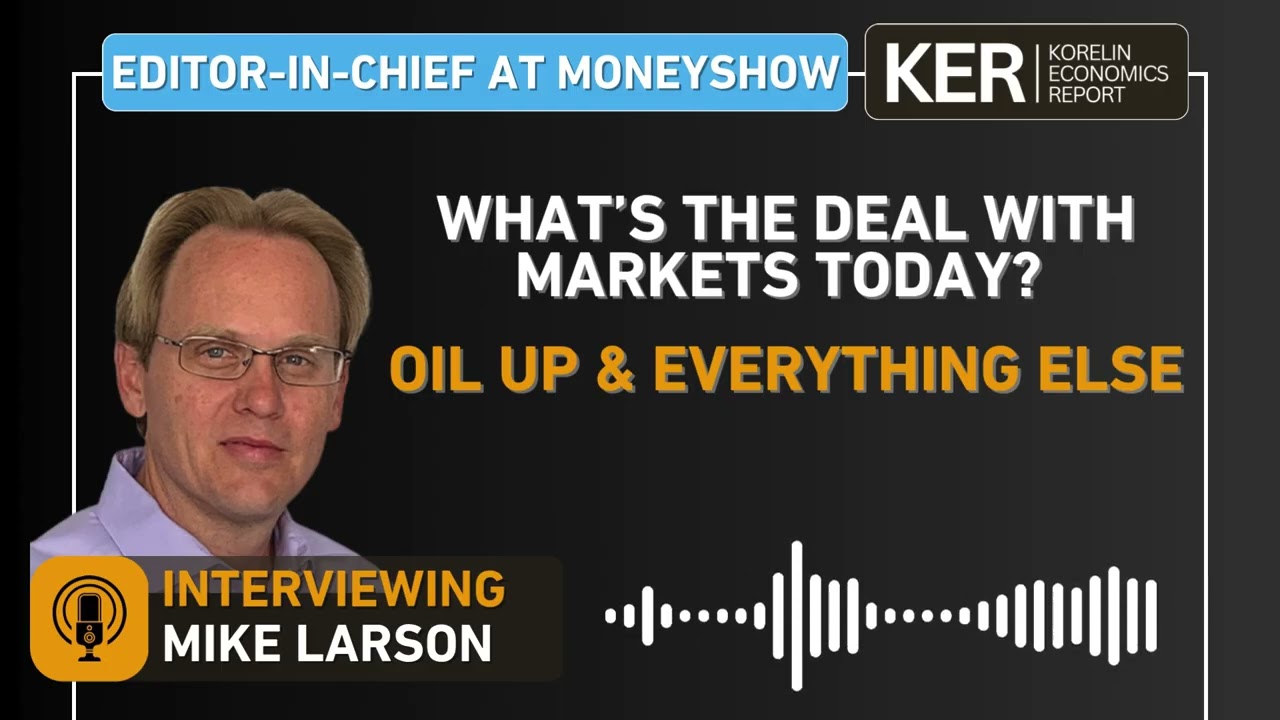
KE Report Mike Larson April 22 2026
Markets are demonstrating resilience, with equities and oil rising simultaneously as investors price in a diplomatic resolution to Middle East tensions. Gold and silver are experiencing a healthy short-term correction, but the long-term bull case remains intact despite the current consolidation phase. Savvy traders are rotating into copper and strategic industrial metals, driven by AI infrastructure demand and escalating global supply chain risks.
Mike Larson & Doc - The SaaS-pocalypse vs. The Silver Supercycle: Navigating the 2026 Market Shift
- Top takeaway The guest argues the dominant 2026 driver is a rotation out of pure AI/tech into economically sensitive sectors (energy, materials, transports, consumer staples), with foreign markets continuing to outperform the US.
- He says big-tech AI capex is now being punished by investors, with cumulative spending overshoots of tens to hundreds of billions versus analyst expectations, raising 'how much is too much' questions.
- He frames the 'SaaS apocalypse' and AI-driven financial-planning disruption as exaggerated near-term, arguing real displacement will take years and is constrained in highly regulated industries.
- He remains a long-term precious-metals bull and thinks silver revisiting $120 is 'in the cards' once the current base-building/consolidation phase plays out, supported by central-bank buying, debasement insurance demand, and continued loose US fiscal policy.
- He expects 2026's first half to be much choppier than recent years — citing midterm, geopolitical, Fed, and AI-valuation overhangs — with a possible stronger run into year-end once those clear.
Mike Larson argues a multi-year rotation from AI tech into precious metals and energy is gaining momentum, supported by central bank buying and supply constraints. Silver's recent spike above $120 and $60 crash resembles past bull-market blow-offs that have historically resolved into sideways bases rather than bear markets. Richard Postma argues major producers with strong balance sheets — including Coeur, Equinox, and Hecla — typically rebound fastest when metals enter a new upleg. Mining stocks tend to recover in stair-step patterns rather than V-shapes, Postma notes, rewarding patient accumulation during consolidations. US and China critical-mineral designations for silver may create a long-term price floor as new legislation moves to support domestic supply.

Mike Larson & Dave Erfle - Volatility Ahead, Metals Roaring, Why Silver Stocks Lag the Spike
- Top takeaway Mike Larson expects 2026 to be more volatile, especially in the first quarter and possibly first half, citing midterm elections, Fed policy uncertainty, and ongoing geopolitical headlines.
- He has been bullish on metals since the second half of 2018 and remains constructive, but is being careful not to add too much exposure at current levels.
- He sees opportunity in beaten-down areas like REITs and high-yield BDCs, where credit worries may be overdone, and continues to favor offensive over defensive positioning.
- His annual Money Show top picks report (68 picks from 39 contributors for 2026, free with sign-up) tracks full-year performance; Avino Silver & Gold Mines (up 567%) and Heliostar Metals were among the 2025 top performers.
- Early 2026 winners already concentrate in defense and drones (RedCat Holdings up roughly 23% in a week off the January 7 report), silver proxies like PSLV, an AI name (Wildan Group), and defensive dividend plays like Philip Morris and Hormel.
Silver's 2026 breakout above a 45-year resistance at $50 is structurally different from the 1980 Hunt Brothers corner and 2011's CME-driven speculative bubble — it is anchored by a sixth straight supply deficit and critical industrial demand. Despite silver tripling in twelve months, silver equities have not delivered their historical 2–2.5× leverage to the metal, with stocks priced in silver at levels last seen during the 2020 pandemic crash. Gold futures hit record highs above $4,600 as central bank buying, sovereign de-dollarization, and concerns about Fed independence create what the guest calls a "Category 5 hurricane" for precious metals. Dave Erfle is rotating gains from advanced developers into drill-stage juniors under $200M market caps, where raising capital and diluting less aggressively is now possible for the first time in years. The TSX Venture's breakout above 1,000 — a twelve-year neckline — carries a measured target near the 2011 high, roughly 150% higher from current levels if monthly closes confirm.
Key Quotes
"The 'Buy the Dip' mentality remains undefeated in 2026, even amidst escalating geopolitical tensions."
— KE Report interview, April 2026
Key Works
Oversees all investor education efforts, content operations, and conference programming at MoneyShow, featuring expert analysis across sectors including commodities and natural resources.
Discussed why the buy-the-dip mentality persists in 2026 and how geopolitical tensions in the Middle East are influencing market behavior and sector rotation.
Specializations
Disclaimer: Mike Larson has NOT endorsed this platform and is not affiliated with Pixys in any way.