Steve Hyland
Host & Founder | The Deep Dive | Mining & Resource Investment Interviewer
"Hosting The Deep Dive — substantive interviews with mining executives and resource investors on commodity markets and mining stock fundamentals"
Biography
Steve Hyland is the host and driving force behind The Deep Dive, a Canadian financial media platform that has become a go-to destination for mining and resource investment analysis. Through both written content and video interviews, Hyland has built a reputation for conducting substantive, data-driven conversations with mining executives, commodity analysts, and resource investors, covering everything from junior explorer strategy to major producer earnings breakdowns.
Hyland's interview style is notably grounded in fundamentals rather than hype. His segments regularly dissect quarterly earnings from major miners like First Majestic Silver and Barrick Gold, walking viewers through revenue, EBITDA, free cash flow, production costs, and valuation metrics. He has hosted some of the most recognized names in the resource investment space, including Rick Rule, the former President and CEO of Sprott US Holdings, engaging him on topics ranging from Federal Reserve policy to the psychological versus financial drivers behind gold price movements.
The Deep Dive's commodity coverage spans the full spectrum of the mining sector, with particular depth in precious metals and copper. Hyland has interviewed executives from companies like Vizsla Copper, Selkirk Copper, Canadian Copper, and Contango Silver & Gold, exploring themes such as copper's structural supply shortage, silver's margin-expanding potential at current prices, and the capital allocation strategies that separate successful junior miners from the rest. His conversation with Craig Parry, Co-Founder of Inventa Capital and Executive Chair, explored bullish cases for copper heading to extraordinary price levels and silver potentially reaching $200.
What sets Hyland apart in the crowded financial media landscape is his willingness to challenge narratives and dig into the details that matter to investors. Whether examining why headline cost inflation doesn't tell the full story at a silver producer, or exploring why retail investors disappeared from winners like Great Bear and Snowline, his interviews provide context that goes beyond surface-level commentary. His discussions with seasoned operators like Brayden Sutton, who shared 20 years of lessons from trading, raising capital, and running junior companies, offer viewers hard-won perspective on market cycles and investor psychology.
For mining stock investors, The Deep Dive has become essential viewing for its consistent pipeline of actionable intelligence on resource companies and commodity markets. Hyland's ability to draw out candid insights from both mining executives and investment legends makes his platform a valuable filter in an industry where quality information is often scarce.
Videos (196)

Restarting America’s Highest-Grade Silver Mine | Heather White - Sunshine Silver
- Top takeaway Says his team only discovered Sunshine while setting up the interview and he was blown away by the project's grade, framing it as a big silver story worth watching while the company proves it can execute.
- Jokes that if the stock becomes massive, The Deep Dive will claim it was the whole reason behind the success.
CEO Heather White says Sunshine's Idaho project is North America's highest-grade silver resource: 264 million ounces at over 1,000 grams per ton. The historic mine produced over 400 million ounces before undercapitalized, debt-laden prior owners went bankrupt; the Electrum Group bought the project in 2010. A March SK-1300 initial assessment, the US-listed equivalent of a 43-101 PEA, outlines an NPV above $2.2 billion at $60 silver. Roughly $600 million of installed infrastructure, including drifts and a 4,000-foot shaft, supports a targeted first production by end-2028. Watch execution: three feasibility studies are due in the first half of 2027 and an updated mineral resource estimate is expected in early 2027.

They Explored ONLY 6% and Found a Gold Mine | Sean Roosen - Osisko Gold Group
- Top takeaway Interviews Roosen at the Beaver Creek Precious Metals Summit, pressing him on the Caribou construction decision, the conversion drilling, and the long-run district vision he had previously only heard about off camera in July.
- Endorses Osisko's market-cap-per-100,000-ounces slide as a quick metric for comparing producers, and closes the interview with a sponsored plug for Tintic Standard Gold Mines.
Osisko Gold Group's Cariboo mine is 22% built and over-financed — $1.7 billion available against C$990 million of remaining capex, first production targeted Q1 2029. Conversion drilling targets 3.6 million ounces already accessed by mine infrastructure, setting up a doubling from 200,000 to 400,000 annual ounces. Only 6% of the 86-kilometre Cariboo trend has been drilled; a $160 million, 30-drill program over two years pushes the resource deeper. Roosen flags two overlooked assets: Sirios' open-pit-scale James Bay discovery and the revenue-producing Tintic project in top-ranked Utah. Roosen expects gold higher on declining US dollar confidence and argues energy suppliers, not tech firms, will win the AI buildout.

Gold Giant Bets $57M on a 4-Million-Ounce Target | Matt Manson - Radisson Mining
Agnico Eagle's C$57 million investment for a 10 percent stake validates the O'Brien gold project's scale after the major's deep technical due diligence. O'Brien's resource has grown from roughly 900,000 ounces in 2023 to 2.3 million ounces, with an eight-rig drill program targeting three to four million ounces. The investment funds a first modern underground ramp — about 300 meters deep — to test mineralization continuity, ground conditions, and mining methodology. Management prioritizes growing the resource before updating its preliminary economic assessment (PEA — an early-stage mine study) built on a smaller resource. Conference floor signals: about 80% of Beaver Creek attendees were investors this year, with high-net-worth money moving from real estate and tech into gold.

The Gold M&A Wave Will Create 10-Baggers | Tim Clark - Fury Gold Mines
- Top takeaway The host presses Clark on whether the M&A wave needs a higher gold price or just cash-flowing equities, and links Clark's answer to the scenario Ari Sussman described to him a year and a half earlier despite Canadian banks turning a blind eye to the junior sector.
Large gold producers are sitting on billions in cash but must replace depleted reserves, which Tim Clark says sets up a coming M&A wave. The guest argues junior gold stocks historically return 10 to 15 times once takeover deals start, because cashed-out investors must redeploy into a small market. Fury Gold Mines pairs the Committee Bay project in the Arctic with Eau Claire in Quebec, sited beside the Éléonore mill. Eau Claire's earlier study used $2,400 gold and showed up to $800 million with toll milling; Clark hopes higher prices lift those figures. Watch for fall drill assays, a November metallurgical update, December resource updates, and a prefeasibility study (a detailed economic study) in the first quarter.

30M Gold Ounces, 700% Stock Gain, Still Unknown | Daniel Henao - Mineros
- Top takeaway He presents Mineros as a producing gold company he had never heard of despite covering mining stocks, making the reason for its low profile the central question of the interview.
- He frames the Tolima purchase as Mineros solving a problem the seller could not, and expects it to create substantial shareholder value.
Mineros S.A., a 52-year-old Latin American gold producer, remains largely unknown to North American investors despite a share price up roughly 700% over five years. The company produced 122,000 gold-equivalent ounces in the first half of 2026 and raised its 2026 guidance to as much as 240,000 ounces. The Tolima acquisition from AngloGold Ashanti adds a historical estimate of roughly 28 million ounces for $10 million upfront plus $60 million contingent on permits. Management argues five decades of community relationships in Colombia can unlock Tolima, using Work for Taxes — funding community projects instead of income tax. First-half revenue reached roughly $559 million with adjusted EBITDA of $260 million, and management targets 300,000 ounces next year and 500,000 by 2030.

Doubling Silver Production Was Only the Beginning | Dan Dickson - Endeavour Silver
- Top takeaway He notes The Deep Dive's YouTube audience has grown substantially and frames the interview for viewers new to the Endeavour Silver story.
- He steers the conversation through the silver-price pullback, growth drivers, the recent Terranera and Guanesevi incidents, and the exploration pipeline.
CEO Dan Dickson calls silver's pullback a healthy pause, expecting gold to move first before silver catches up and overshoots. Endeavour Silver has grown from about 7 million to 15 million silver-equivalent ounces (silver plus byproduct metals), targeting 17-18 million in 2027. Pitarrilla's feasibility study is due shortly; its 600-million-ounce silver resource could add 7 million ounces of annual production around 2030. Setbacks are modest: a cracked mill trunnion (a feed pipe) and a resolved community blockade defer only about 10 days of production. Underground drilling across every mine keeps replacing resources, with new results and estimates expected in the fourth quarter.

Where Gold Investors Will Make the Biggest Money | Kevin Smith - Crescat Capital
- Top takeaway The host highlights Goliath's willingness to act on Crescat's geological feedback, recalling a visit to the Gold Digger property and sitting in as Bill Pearson pressed Goliath geologists on what lies between the high-grade zones.
- He expresses admiration for Tectonic's CEO, noting how hard it is to win believers early and pointing to the company's strong progress over the prior couple of years.
Crescat Capital's fiat-debasement thesis — governments must inflate away unpayable debt — underpins its $20,000 gold target and push into exploration juniors. Early-stage exploration stocks give the most upside leverage to rising gold, which is why the fund rejects about ten opportunities for every investment. Goliath Resources is showing mineable grades between its high-grade veins — the bulk-tonnage (large, lower-grade) evidence a tier-one system needs. Silver Bow controls 80% of Montana's historic Butte district, which the USGS called the biggest undeveloped copper-silver system remaining in the United States. Bulk-tonnage gold with high-recovery metallurgy drives positions in Altamira Gold and Tectonic Metals, with Donlin Creek's development de-risking Alaska infrastructure.

They’re Uncovering an Entire DISTRICT OF GOLD | Michael Bennett - Altamira Gold
- Top takeaway Frames Altamira as an 'elephant hunt' for a large ore body and suggests to Bennett that the company is sitting on a potential tier-one, district-scale asset.
- Closes by asking what watch-list investors should track over the next 12 months and pointing to upcoming assay results from the recent drilling program.
Altamira Gold added over 600,000 ounces with just 12 drill holes, lifting Maria Bonita (its main deposit) from 720,000 to over 1.3 million ounces. The guest argues today's roughly $4,300 gold price makes low-grade deposits economic; his resource was viable at $1,500 gold in 2019. A new porphyry (a large, low-grade intrusion-hosted gold system) called Maria Bonita West was found at depth, and its first drill hole is now collared. Altamira frames Cajueiro as a multi-porphyry district, targeting over three million ounces, with new targets Novosonios and Tavares North in the pipeline. The Deep Dive discloses Altamira is a paying client of its parent, Canacom Group, so treat this coverage as compensated promotion.

A Gold Giant Just Entered Japan | John Proust - Japan Gold
- Top takeaway The host frames the Solidcore announcement as a huge deal for Japan Gold and pushes for the full backstory and deal terms, marvelling at the Bajoe historic mine's 125 g/t grade as being like a concentrate.
- He proposes a longer-form follow-up interview in the next couple of months and agrees that visiting Japan now might be the time, calling the deal the catalyst.
Solidcore Resources has committed $35 million over three years to five Japan Gold projects and took a near-19% stake at a 50% premium to market. John Proust says roughly 11 mining companies pursued Japan Gold after the Barrick alliance ended, leaving a $23 million exploration database. Solidcore solely funds chosen projects to prefeasibility (a mid-stage economic check) for 70% ownership, then to 80% by funding bankable feasibility. A 35-hole, 18,000-metre drill program starts in November at the Bajoe project, testing a basement feature beneath a historic 125-gram-per-ton mine. Proust argues committed multi-year capital beats option deals where partners promise large headline totals but commit only small early dollars.

5th Silver Mine Going Online | Arturo Préstamo - Santacruz Silver
- Top takeaway The host frames the silver backdrop as a record high near $121 in January 2026, followed by a pullback and partial recovery as of the interview.
- The host notes Santacruz Silver's stock is up about 1,000% over five years and hopes it rises another 1,000% over the next five.
Santacruz's CEO argues silver clears $80 within months and moves beyond $100 long term, framing producer economics around a rising metal price. A dedicated 500-tonne-per-day mill removes San Lucas's milling bottleneck, letting the ore-sourcing operation grow output 8-10% annually. Treasury grew from $75 million to roughly $120 million since Q2, and the boliviano devaluation trims dollar costs since about 85% of spending is local. Mines and mills never missed a day through Bolivia's 53-day blockade; rail concentrate exports flowed while trucked tonnes waited out the disruption. Soracaya targets 300 tonnes per day by December, then ramps toward 2.5-3 million silver-equivalent ounces (output expressed in silver terms) during 2028.

Why Agnico Eagle Wants 22% of Vizsla Copper | Peter Mercer
- Top takeaway The host opens by observing that copper has kept showing strength while many other well-known commodities are seeing more volatility, and structures the interview around the Agnico Eagle investment in Vizsla Copper and the company's exploration plans.
Vizsla Copper's Peter Mercer argues copper's strength is just beginning as EV, battery and clean tech demand rises while mines get deeper and lower grade. Agnico Eagle takes about 19.9% of Vizsla Copper in an all-share deal for the Delta and Helm Bay projects, rising to 22% after shareholder approval. The guest says Agnico sought copper exposure and an Alaska-based operator, taking equity alignment rather than cash plus rights to join future financings. Newly staked Miller copper-gold project sits beside the producing Mount Milligan mine, where Mercer sees porphyry systems (large deposit types) continuing onto Vizsla ground. Vizsla's biggest drill program yet spans 40,000 metres across Alaska and British Columbia, with Alaska assays due over the next two to three months.
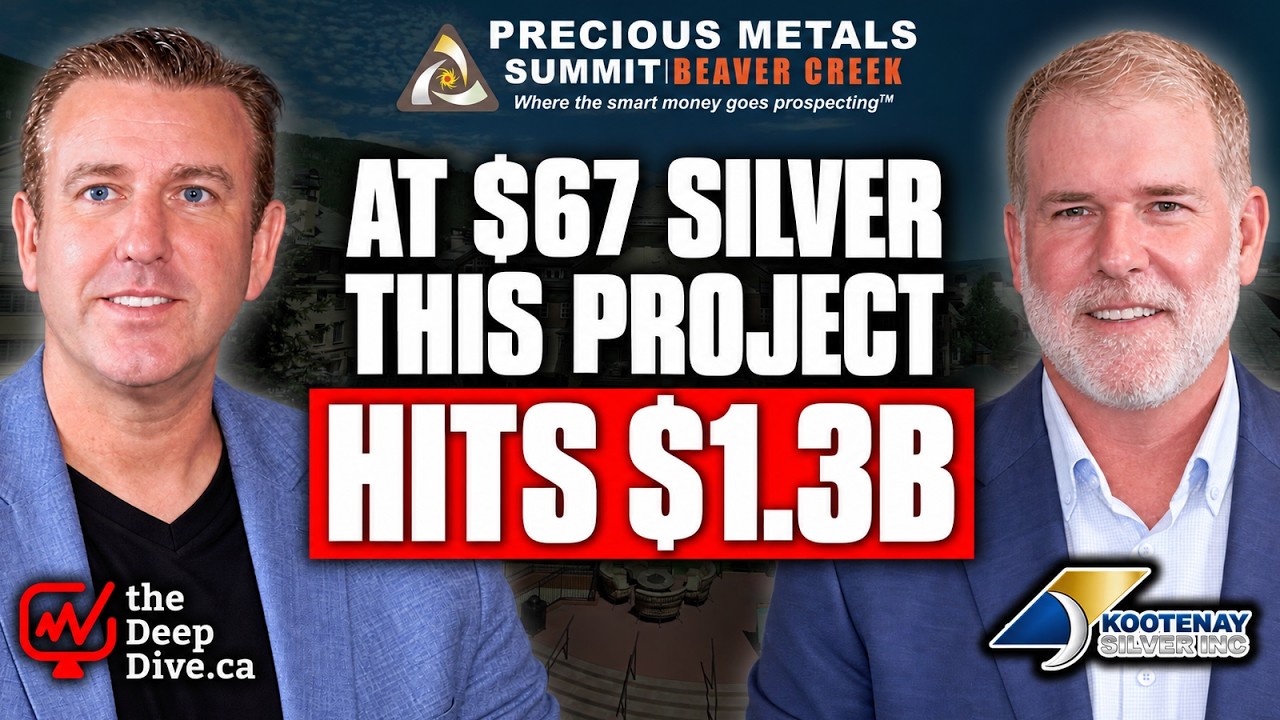
They Found 54 Million Ounces of Silver, Now They Want More | Dale Brittliffe - Kootenay Silver
- Top takeaway Frames the 2026 Beaver Creek Precious Metal Summit around 'production' as the dominant investor theme, with Mexico permitting — particularly for open pits — the recurring question from attendees.
- Presses the guest on the catalysts most likely to move Kootenay Silver toward production, including the La Cigarra PEA numbers and the active exploration program at Colombo.
Kootenay's $1.3 billion NPV La Cigarra PEA (Preliminary Economic Assessment — first look at project economics) shows what stronger silver prices unlock for advanced projects. Kootenay is past halfway through a 60,000-metre drill program designed to grow its maiden 54-million-ounce Columba inferred resource. Production has become the dominant theme at the Beaver Creek summit, pulling investor attention back to advanced silver developers. Mexico's open-pit permitting queue is starting to clear, with the first new approvals signaling progress for stalled projects. Columba's epithermal system (veins formed from low-temperature fluids near the surface) hosts wide silver veins with high-grade cores and broad stockwork halos.

Advancing Two of Canada’s Largest Undeveloped Gold Projects | Daniel Wilton - First Mining Gold Corp
- Top takeaway Says he is getting mixed opinions on whether Canada's current administration is actually moving mine projects forward, which frames the permitting discussion.
- Notes his audience repeatedly asked for more First Mining coverage, prompting this Beaver Creek interview, and asks for a 60-second overview for viewers new to the space.
Wilton argues Canada's mine approvals stay slow because building trust with Indigenous communities takes time no government mandate can compress. Springpole, five million ounces in northwestern Ontario, won federal environmental assessment approval in June after eight and a half years. Permits and detailed engineering come next, with a definitive feasibility study and a final investment decision (FID — the build commitment) targeted for early 2028. At Duparquet in Quebec, six million ounces and 50,000 metres drilled since 2022 support a resource update targeted for Q1. Wilton claims the market assigns Duparquet almost no value today and argues the project could carry a multibillion-dollar net asset value.

$1 Billion Bet Powering i80 Gold's Next Phase | Ryan Snow - i-80 Gold
Management treats $4,000 gold as the new floor and calls $6,000 feasible within two years on central bank buying, while modeling nothing above spot. Granite Creek's first feasibility study adds 556,500 ounces of reserves with planned production of about 75,000 ounces per year. NPV (net present value — future cash flow in today's dollars) climbs from $118 million at $2,750 gold to $598 million at $4,500 gold. Step-out drilling under Mineral Point's heap leach pad targets mineralization first hit by Homestake's 1990s condemnation drilling (checking ground before building on it). The billion-dollar recapitalization funds a $430 million Lone Tree plant refurbishment, targeting commissioning by end-2027, while first-half revenue nearly doubled to $77 million.

AI Is Making Silver’s Six-Year Deficit Worse | Mani Alkhafaji - First Majestic Silver
- Top takeaway Hosts The Deep Dive interview at the Beaver Creek Precious Metal Summit and steers it through investor-relevant questions on silver-market fundamentals, Jerritt Canyon restart progress, growth levers (Santa Elena, San Dimas, Los Gatos), divestment rationale, and the 12-month outlook.
Silver has run a structural supply deficit for six years, and AI/data-center buildouts are now widening it beyond current forecasts. A 50 MW data center alone consumes about 6.5 tons of silver — a single demand source not yet matched by new mine supply. First Majestic's $75M Jerritt Canyon restart is running ahead of schedule, with a formal study expected by Q1 2027 ahead of H2 2027 production. First Majestic is divesting sub-2 Moz (million ounce) producers so management can refocus on district-scale assets like Santa Elena, San Dimas, and Los Gatos. Retail silver demand softens when prices pull back — historically June through August are the seasonal lows before Q4 and Q1 recover.

GOLD POURS BEGIN IN MONTHS | Shaun Heinrichs - 1911 Gold
- Top takeaway Frames 2026 Beaver Creek sentiment as a flight to quality — investors still favor near-term producers with a clear 12–18 month path to permits and production, even with gold sideways on rate-driven volatility rather than a thesis break.
- Presses 1911 Gold on accountability by raising the BCSC's PEA-wording issue and making real mine execution — not additional drilling — the implicit 12-month test for shareholders.
1911 Gold plans to restart milling at True North by year-end 2026, with first gold pours in early 2027. Test mining will use two crews producing ~200 tons/day, scaling toward 1,300-1,400 tons/day and 24,000-26,000 ounces in 2027. An updated mineral resource estimate is due within 6-8 weeks (target: November 2026), incorporating three new mine-lease discoveries. BC Securities Commission required a PEA re-issue because original wording read 'feasibility-like'; economics are unchanged. Long-term run-rate target exceeds 50,000 ounces annually as crews scale to seven across four permitted mines.

A $2.2B Gold Project Is Outgrowing Its Plan | Michael Henrichsen - Gold X2 Mining
- Top takeaway Top point: Frames the interview around market skepticism and Gold X2's 250% one-year rerating, pushing Henrichsen on what misconceptions were overcome with the upgraded technical work
- Asks the build-vs-acquisition question and the 12-month catalyst question that anchor the forward-looking portion of the conversation
Gold X2's $2.2B Moss PEA is a base case — drilling suggests a longer mine life and 300,000+ ounces a year as the resource keeps growing. Post-PEA financing pulled in AngloGold Ashanti and Hess Capital, timed to a tight window in volatile gold markets. Management frames Moss as built-to-produce, not built-to-sell, with a Q1 2027 resource update and a year-end PFS. Upgraded geology, a fresh MRE (Mineral Resource Estimate), and a PFS-quality PEA turned skeptics into believers and drew in strategic backers.

Three Million Ounces of Gold, Barely Getting Started | Dylan Langille - White Gold
- Top takeaway Hyland flags infrastructure as the big open question for Yukon projects, saying analysts he met on summer site visits kept asking where the power would come from, and he presses the guest on how the Klondike district benefits.
- He cites White Gold's PEA figures (about C$1.9 billion NPV5, 41% IRR at $3,600 gold, roughly 9.4-year mine life) to draw out the growth story and says he will be watching as future assays come in.
White Gold's three-million-ounce Klondike resource rests on only 90,000 metres of drilling, which management calls a starting point, not an end point. Its PEA (Preliminary Economic Assessment — an early economic snapshot) models a 41% IRR and C$1.9 billion NPV5 at $3,600 gold. Yukon infrastructure — notably the Northern Access Road linking the Coffee deposit to Dawson City — could cut exploration costs across White Gold's properties. Management plans 17,000 to 18,000 metres of drilling in 2026 and calls drilling the number one value driver for the company. The VP of Exploration logged Great Bear's discovery hole and hopes growing ounces attracts consolidation or a larger mining company.

Pay for the Copper, Get the Gold Free | Rob McEwen - McEwen Inc
- Top takeaway Host and founder of The Deep Dive, conducting this Beaver Creek Precious Metals Summit interview with Rob McEwen.
- Presses McEwen on the framing that McEwen Inc now looks more like a holding company with a couple of smaller operations, and elicits the long-run pitch for becoming an intermediate copper-gold producer.
The guest argues Canada is finally welcoming mining, citing better permitting and a rapid depreciation boost for operators. The guest says Los Azules, one of the top 10 undeveloped copper projects globally, targets a year-end final investment decision. The San José joint venture in Argentina has returned over $50M in dividends recently, with more expected later this year on higher metal prices. The guest sees more copper upside as electrification, AI demand, and growing Asian cities absorb the next wave of supply. Gold output is scaling — Timmins extended by Gray Fox, Gold Bar now running seven days a week — toward a 250–300k-ounce 2030 target.

Building the $500M-a-Year Gold Mine | Victor Cantore - Amex Gold Mining
- Top takeaway Hyland opens with a macro bull case for precious metals and critical minerals, arguing the pullback is a consolidation before higher prices given high and rising sovereign debt and ongoing central bank gold buying.
- He uses the interview to argue that infrastructure and power access — illustrated by Amex's Quebec hydroelectric proximity at $0.055/kWh — are the under-appreciated drivers separating viable projects from those with large ore bodies but no energy solution.
Amex Gold Mining is fully permitted for a 40,000-ton bulk sample at its Quebec Perron project, with capex covered before commercial production. The Champagne Zone averages 16 g/t gold over 774,000 ounces in a vertical orebody where gravity does the work. Phase One all-in sustaining costs land at US$910 per ounce, with payback inside six months once bulk sample revenue is included. Eldorado Gold holds 27% as a control person, signaling strategic validation from a mid-tier producer heading toward one million ounces annually. Quebec's hydroelectric grid plugs the project in at 5.5 cents per kWh, keeping power costs among the lowest in the world.
Key Quotes
"When you break down First Majestic's Q1 results, headline cost inflation does not tell the full story — silver prices are reshaping the company's margins in ways the market hasn't fully priced in."
— First Majestic Q1 Earnings Breakdown
"Why retail disappeared from winners like Great Bear and Snowline is one of the most important lessons of the last cycle — the rotation was already underway before most people noticed."
— Interview with Brayden Sutton on metals market rotation
Key Works
Ongoing series of video interviews and written analysis covering mining company earnings, commodity markets, and conversations with industry leaders.
In-depth discussion with Rick Rule on Federal Reserve policy, gold price psychology, and the distinction between liquidity and solvency concerns.
Conversation with Craig Parry of Inventa Capital exploring bullish commodity price targets and the structural drivers behind copper and silver markets.
Interview covering major M&A transaction in gold mining sector
Specializations
Disclaimer: Steve Hyland has NOT endorsed this platform and is not affiliated with Pixys in any way.