Tavi Costa
Macro Strategist & Portfolio Manager | Crescat Capital | Global Commodity Strategist
"Contrarian macro analysis and bullish commodity supercycle thesis centered on gold, silver, and mining equities"
Biography
Otavio ("Tavi") Costa is a Macro Strategist and Portfolio Manager at Crescat Capital, a Denver-based investment firm known for its contrarian, value-oriented approach to natural resource investing. Originally from Brazil, Costa's personal experience with currency devaluation and emerging market instability profoundly shaped his macroeconomic worldview—giving him an acute understanding of why hard assets like gold and silver serve as essential stores of wealth. At Crescat, he works alongside founder Kevin Smith, helping manage the firm's flagship funds with a heavy emphasis on precious metals, energy, and mining equities.
Costa has established himself as one of the most vocal and data-driven advocates for a broad commodity supercycle, frequently presenting detailed chart-based analyses that demonstrate the historical undervaluation of resource sectors relative to financial assets. His work focuses heavily on gold's role as a monetary anchor in an era of unsustainable sovereign debt, and he has argued that the US dollar faces a "major collapse" that could cataly gold's next significant leg higher. He is particularly noted for his silver analysis, where he has identified multi-year technical patterns—including a long-term cup and handle formation—and has articulated a path for silver to reach US$50 per ounce based on structural supply deficits and industrial demand.
Beyond precious metals, Costa has expanded his macro framework to encompass energy markets, especially natural gas and oil, as well as the copper thesis tied to electrification and green energy infrastructure. He views copper as "extremely cheap" relative to its fundamental supply-demand dynamics and has warned that the window to accumulate copper-related assets at current prices is closing rapidly. His conviction extends to the junior mining sector, where Crescat has actively positioned its portfolio to capture outsized upside from small-cap precious metals and base metals producers.
Costa's macro outlook is anchored in the belief that 2026 could mark a major inflection point for commodities broadly, driven by what he describes as an "ultra-dovish" Federal Reserve stance that will become unavoidable as debt servicing costs escalate. He has described gold as potentially "the trade of the century" and has emphasized that central bank gold accumulation—particularly by emerging market central banks—signals an imminent policy shift toward gold revaluation. His analysis is widely followed in the resource investment community, and he is a frequent guest on prominent financial media including Palisades Gold Radio, Investing News Network, and GoldBroker.com.
Investors in the mining and commodity space should pay attention to Costa's views because of his firm's demonstrated conviction—Crescat's portfolios are meaningfully allocated to precious metals and mining equities, meaning his analysis is backed by real capital at risk. His ability to synthesize macroeconomic trends, technical analysis, and fundamental commodity supply-demand dynamics into actionable investment theses makes him a distinctive voice in the resource investment landscape.
Videos (11)

Money Printing Is Back: Gold & Silver Could Soar | Tavi Costa
- Top takeaway Argues that with US debt at World War II-era levels and interest rates out of line with that leverage, policymakers will inevitably turn to monetary dilution — his bottom line is 'none of us own enough hard assets.'
- Sees $50-$60/oz as the range to accumulate silver as of the interview and expects silver to eventually reach triple digits, with copper's resilience suggesting silver catches up.
- Considers silver miners arguably even more undervalued than the metal itself, noting that gold, silver and copper supply is constrained and no large new mines are coming online.
- Points to only about 22% of miners above their 200-day moving average as historically very low, calling it a rare oversold window in what he expects to be a 5-10 year trend.
- Announces Azuria Capital is live with a fund focused on mining worldwide but weighted toward Latin America, expecting a major push of capital into the region.
Combined US and China money supply is growing about 10% year-over-year, a pace Costa says rivals COVID-era stimulus and points to inflation. Debt at World War II levels makes today's rates unsustainable, so Costa expects monetary dilution — expanding the money supply — to benefit gold. Silver around $50–$60 an ounce is his accumulation range; he expects triple digits eventually and calls silver miners even more undervalued than the metal. Costa sees a rare window: only about 22% of miners trade above their 200-day moving average (a long-term price trend line), a historically low reading. Constrained supply in gold, silver, and copper anchors his case; he is launching a mining fund focused on Latin American economies.
Tavi Costa: AI Is Creating a Massive Opportunity in Mining
- Top takeaway Argues AI makes mining the better asymmetric bet: more AI means more energy, infrastructure and materials against a mine supply curve he says is constrained for the next 5-15 years with no pipeline of new mines — mining is about 1% of the global equity market and he expects it to reach double digits, multi-bagger potential in his view.
- His base case is that policymakers cannot afford to fight inflation and may instead change how inflation is calculated, so real inflation keeps getting worse — he treats volatility in inflationary assets as a buying opportunity.
- Says the 10-year Treasury yield, above 5% as of the September 2026 interview, is probably near a peak, but warns investors underestimate how far the government will go to cap yields, with purchases potentially far larger than the current Treasury buybacks.
- Is not buying gold at these levels but is buying gold and silver miners, which he calls the best businesses in the market today — silver miners hold around 10% of market cap in cash and earn average free-cash-flow margins above 40%, and he expects cash-rich majors to acquire small-cap developers with strategic assets.
- Says miners are more likely to join the tech rally and outperform than be dragged down by an AI bubble pop, would not sell his concentrated mining positions even in a 30-40% drawdown, and is launching a mining-focused fund in October 2026.
Tavi Costa argues the Fed cannot afford to fight inflation, making policy accommodation and hard assets the likelier path. With ten-year Treasury yields near 5% and CAPE ratios (cyclically adjusted price-to-earnings) at dot-com-era levels, bonds now compete seriously with expensive equities. He sees AI's capital spending as a structural metals demand story, with mining a cheaper way to own the trend than technology stocks. Silver miners averaging 40-50% free cash flow margins (profit after all spending) are his top pick; he favors gold miners over bullion. If the AI trade unwinds, he expects miners to outperform rather than repeat 2008, because constrained mine supply and structural demand differ today.

Tavi Costa Discusses Macro And Metals
- Top takeaway Costa argues that suppressing Treasury yields and weakening the US dollar are the path of least resistance to resolving America's twin fiscal and trade-balance deficits, and frames that combination as the macro foundation for bullish metals.
- He says gold remains extremely undervalued, noting US debt levels are roughly comparable to the WWII era while only about 3% of Treasuries are backed by gold versus 45-50% then, and he expects that ratio to rise to multiples of today's level.
- He calls mining equities an arbitrage, arguing sell-side models price metals in backwardation for the next 10-15 years while he expects a 'steep contango' with prices going 'stupidly high'.
- On silver, he argues it has better convexity than gold and notes silver miners producing at roughly $15-$20 per ounce against much higher silver prices, with demand supported by AI, solar, electrification, and onshoring.
- He views copper as a core holding given 10-15 year supply-demand visibility, and separately recommends emerging markets — especially Latin America — as a beneficiary of dollar weakness and falling yields.
US twin deficits will force yield suppression and a weaker dollar, the guest argues — a positive backdrop for metals. Gold remains undervalued as the current 3% treasury backing may need to rise multiples higher, the guest says. Mining stocks price in future backwardation (declining prices); the guest sees contango (rising prices), calling it an arbitrage. Silver miners produce at $15-20 per ounce, giving them far wider margins than gold peers, the guest notes. Copper's supply deficit is visible for 10-15 years — only six tier one discoveries in six years versus six needed by 2050.

I Asked The Greatest Junior Mining Investors What They Are Buying Right Now | Rule Symposium
- Top takeaway Costa says there are plenty of ways of finding quality right now, including well outside metals, and from a macro lens argues agricultural commodities are behaving the way oil did eight or nine months ago, sideways for two to three years, so he suspects a breakout is close.
- He reads gold explorers outperforming the seniors as evidence that sticky institutional money has come in and is not selling, while retail tends to sell at panic and he believes we are at panic now.
- He also notes this is a rare situation in which the big names are steeply oversold and very liquid, which he considers a good way to play this window.
- On positioning he says valuations across resource equities are at very low levels, much closer to all-time lows and averages, with money still pouring out of the GDX and the GDXJ while physical gold is seeing redemptions.
- The sentiment backdrop he cites is a bull-bear index on gold that has been around 7.5% bullish for the last few weeks and actually printed zero bullish two weeks ago, against the roughly 40% one-way reading that would normally count as a good contrarian signal.
Gold and silver fell 30-50% from highs, and multiple guests frame the pullback as a buying window for quality developers, not a trend break. AISC (All-In Sustaining Cost — what it really costs to produce an ounce) explains the margin math: $4,000 gold against a $2,000 AISC. One guest argues gold pays no dividend, so valuation must run against debt, money supply and GDP instead of cash flow. Royalty companies and prospect generators are presented as the safer way to play gold and silver than owning operators outright. Several guests expect a wave of mining M&A, because producers shed high-cost operations and hold cash without a growth pipeline.

Tavi Costa: These Are The Biggest Opportunities in Mining Right Now
- Top takeaway He argues gold remains an outstanding investment over the next six to 12 months, saying the 25% to 30% sell-off is a response to a US that cannot afford rate hikes or a costly war rather than a long-term problem — which also means there is less scope to buy the dip than in an earlier secular bull market.
- He treats energy, and natural gas in particular, as the smart hedge for a metals-heavy portfolio: data-center, electrification and onshoring demand is structural and there is no near-term substitute for gas, so on a day like this he would rather be long energy than short the equity market.
- He says the best-quality producers are down 40 to 50% and as oversold as the charts can get, so he expects today's opportunities to look better six to 12 months from now, and reads gold explorers outperforming seniors as a sign sticky institutional money is not selling into the panic retail is.
- He is very bullish on copper, arguing it has yet to make the move silver made from the $20s and $30s up to $160 and sits roughly where silver was near $40, and says institutions should be throwing money at copper mines — he does not understand the preference for critical minerals instead.
- He is sharply sceptical of critical minerals, saying institutional capital is misallocated into small markets such as rare earths and tungsten whose company economics he finds uninteresting, and warns that the lithium mania of roughly four years ago is the precedent for capital chasing a narrative.
The guest argues gold's 25-30% pullback inside a secular bull market is an accumulation window, not a trend break. Quality producers are down 40-50% and technically oversold, with large multi-asset operators the guest considers liquid ways to play it. He sees copper near all-time highs as the strongest structural story, arguing institutional money should go into copper mines. The guest treats energy as a portfolio hedge against metals, with natural gas the near-term answer to data-center power demand. He cautions against critical-minerals enthusiasm, pointing to the lithium bust as a template for misallocated institutional capital.
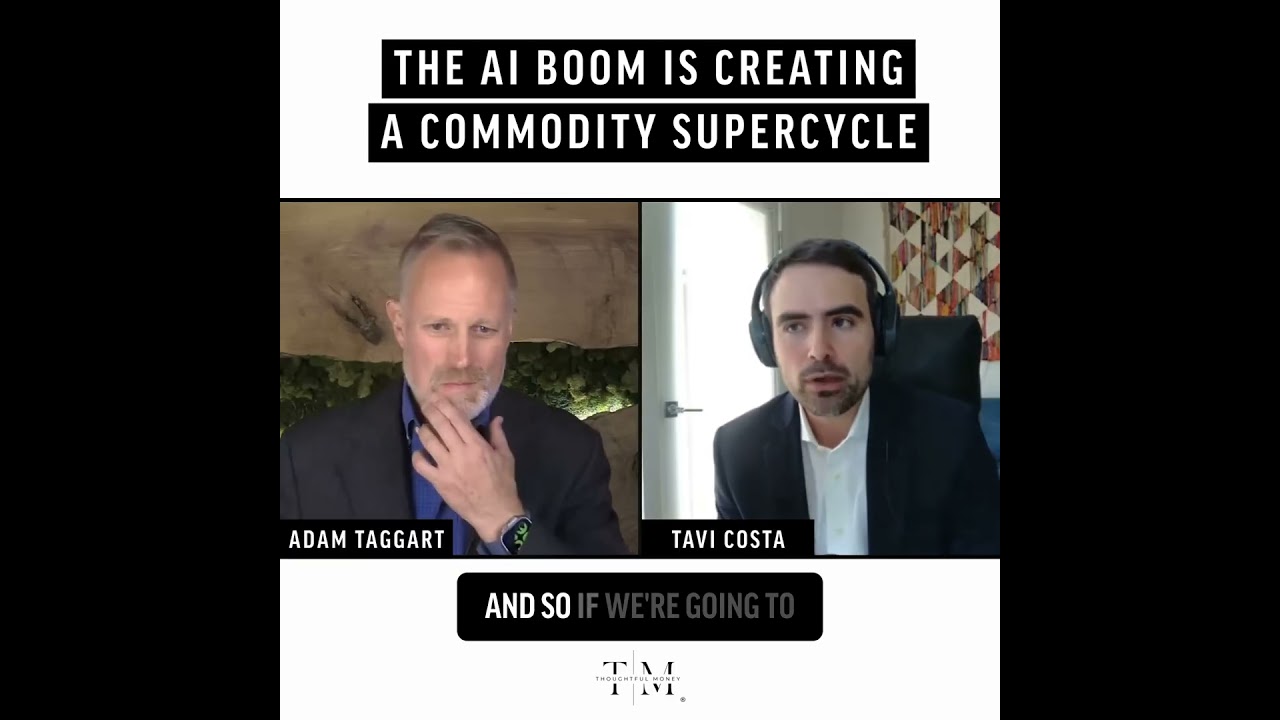
The AI Boom Is Creating a Commodity Supercycle | Tavi Costa
- Top takeaway Tavi Costa argues the AI build-out is leading to a commodity super boom, since data centers, electrical transmission lines, and power stations all require real-world materials and infrastructure.
- He contends governments will step in to sustain AI investment rather than letting companies pare it back, because countries view the technology arms race as critical to economic survival.
- He links the deglobalization and onshoring trend intensified after COVID to a coming surge in US electricity consumption, noting US power demand has been flat for decades while China's has grown as the world's manufacturing plant.
- He identifies materials, energy, and infrastructure-related businesses such as engineering firms, cement firms, and steel producers as the key investment pillars capital allocators should watch, estimating the equivalent of at least another US economy's worth of electricity demand added in the next few years.
- He worries investors are spending time, effort, and capital on smaller markets that are not as relevant as copper, which he expects to be a huge problem in the near future.
Tavi Costa argues the AI data-center build-out needs power plants, transmission lines and industrial materials, setting up a commodity supercycle. He expects governments to keep funding AI infrastructure because countries treat technological leadership as economic and national-security survival. Deglobalization and reshoring of manufacturing after COVID could add a second wave of electricity demand on top of the AI boom. He sees copper as the most important constraint: essential for data centers, grids and electrification, yet underappreciated by investors. He favors materials, energy, engineering, cement and steel businesses as likely beneficiaries while capital crowds into smaller AI markets.

AI Boom = Commodities Super-Boom? | Tavi Costa
Tavi Costa argues Wall Street is underpricing the massive commodity demand required for the AI infrastructure buildout, setting the stage for a hard assets super-boom. The physical infrastructure needed for artificial intelligence—particularly data centers—requires tremendous amounts of industrial metals like copper. Once financial markets realize the scale of raw materials needed for the tech sector, capital will rapidly rotate into commodities and mining equities.

Natural Gas Wins Near Term
Tavi Costa highlights natural gas as a major near-term investment opportunity driven by surging electricity demand from AI and data centers. Nuclear and renewables will play larger long-term roles but lack the scalability needed to address the immediate energy crunch. Industrial reshoring trends will further strain power grids, positioning natural gas as the most viable short-term energy solution.

The Gold Standard Returns?
Tavi Costa argues persistent inflation and rising hard asset prices could eventually force governments toward conversations about monetary discipline. Ideas once considered politically impossible, such as a return to some form of gold backing, may reemerge as viable policy solutions. The next decade is forecasted to become increasingly favorable for hard assets broadly, presenting a strong macroeconomic tailwind for investors.
Don’t Wait Longer: Copper Is EXTREMELY Cheap … But Not For Long.
Tavi Costa argues investors remain underweight hard assets despite debt and money supply pressures creating a highly favorable macro environment for commodities. Geopolitical shocks and rising energy demands are tightening supply chains, keeping resource prices elevated and creating structural inflation across the mining sector. Copper presents a highly asymmetric investment opportunity due to an impossible-to-ignore supply crunch, offering significant upside for explorers and producers.

“People Call Me Crazy”: Three Contrarian Macro Trades from Tavi Costa
- Top takeaway Argues the recent gold sell-off was not a true liquidation event — equities and treasuries were unchanged, so he treated the drop as an oversold buying opportunity and expects gold to be multiples of today's price within a decade.
- Says he deployed most of his cash into gold itself (via futures and ETFs such as GLD) plus high-quality miners after the sell-off, while taking substantial profits in energy, which he views as overbought near term though intact long term.
- Adds three contrarian option trades he expects to be mocked: long-term treasuries (via options), Chinese equities (calls, sized small because a Taiwan invasion would zero out shares), and European banks — all cheaply priced and bought with 1-2 year option horizons.
- Frames his gold thesis around U.S. twin deficits forcing dollar devaluation, central-bank buying to justify system leverage, stagnant mine supply with no major new projects, deglobalization driving reserve building, and under-owned 60/40 portfolios needing gold.
- Believes a reserve-currency change is unlikely within five years but expects gradual U.S. decline and unexpected currency moves, and is bullish on Brazil and Latin America if falling U.S. rates let Brazilian cost of capital decline, unlocking an economic-growth explosion.
Tavi Costa argues the gold sell-off was not a true liquidation, since equities and treasuries held steady while gold fell. He suggests gray-area actors like Iran may have sold gold accumulated through oil trades conducted outside the dollar system. Costa sees the pullback as an oversold buying opportunity and expects gold to be multiples higher over five to ten years. Central-bank buying, dollar devaluation from US twin deficits, and stagnant mine supply form the core of his long-term gold thesis. He took profits in energy, bought gold largely via futures and quality miners, and added contrarian options in treasuries, Chinese equities, and European banks.
Key Quotes
"If you ask me, 2026 has the potential to mark a major inflection point for commodities. Gold has already led the way, and what we're seeing now appears to be the early stages of a much broader move across resource markets."
— X (Twitter) post on commodity market outlook
"The next leg up for gold in my view is probably going to be driven by the dollar."
— Investing News Network interview, March 2025
"A policy shift toward gold accumulation is imminent."
— GoldBroker.com interview on central bank gold reserves
"Gold could be the trade of the century."
— Palisades Gold Radio interview on debt and monetary distortion
Key Works
In-depth interview covering gold's dollar-driven catalyst, silver's supply deficit thesis, and the copper opportunity
Palisades Gold Radio discussion on gold, silver, mining stocks, and the macroeconomic case for precious metals revaluation
Comprehensive analysis covering silver cup-and-handle technicals, miner profit margins, and the contrarian energy thesis
Updated analysis on gold's dollar-driven breakout and silver's technical setup for a major move
Specializations
Disclaimer: Tavi Costa has NOT endorsed this platform and is not affiliated with Pixys in any way.