Jay Martin
Host
"Resource sector commentary and interviews covering gold, silver, copper, and uranium investment themes"
Biography
Jay Martin is a well-known figure in the resource investment community, serving as the host and producer of The Jay Martin Show and a key voice at VRIC Media (Vancouver Resource Investment Conference). With deep roots in the industry through his work with Cambridge House International, Martin has spent years interviewing mining executives, analysts, and investors, becoming a recognized interviewer and commentator in the precious metals and mining space.
Martin is best known for his macro-level commentary on commodity markets, particularly gold, silver, copper, and uranium. His perspective that "the sure money is made in the gold sector, but the big money is made in the silver sector" has resonated with retail investors navigating precious metals cycles. He regularly discusses geopolitical themes—including energy security, currency debasement, and the decline of Western economic dominance—as frameworks for understanding commodity price action.
Through his show and media appearances, Martin has built a platform that bridges retail investor education with high-level resource sector discourse. He has interviewed prominent figures across the mining investment world and frequently appears on channels such as Rich Dad (Robert Kiyosaki), SilverSeek, and Investing News Network. His coverage of consolidation trends in uranium and the strategic importance of copper has made him a followed voice for investors tracking energy transition metals.
Martin's investment philosophy centers on the idea that empires depend on cheap energy and that the current macroeconomic environment—characterized by fiscal expansion, central bank gold buying, and structural supply deficits—favors hard assets. He advocates for positioning in physical precious metals and carefully selected resource stocks, with particular attention to junior miners during favorable commodity cycles.
Videos (100)

BREAKING: Strikepoint Acquires Massive Gold Deposit From Newmont
- Top takeaway The host frames the interview, saying he is a shareholder and that there has been a material shift in what StrikePoint Gold is, with an acquisition that changes exactly what the company is and what it is shooting for - in his words, not small, very big.
- He presses on the dormancy risk, noting the asset has sat inside Newmont for about 15 years and asking what the guest makes of that, and argues investors deserve an update because the last Northumberland information to come out was around 2010, which he calls 16 years ago.
- He states his expectation of a news calendar into the end of the year - a maiden resource expectation of Q4 of 2026 on Hercules and results before year end - and closes by saying he wants the guest back on the show near the end of 2026 to discuss what has happened in between.
StrikePoint agreed to pay Newmont $70 million US cash for Northumberland, adding 2.57 million indicated and 1.72 million inferred ounces. Closing is expected in early-to-mid September, with $25 million US more due after a feasibility study and after commercial production. A 15,000-metre October drill program, two-thirds reverse circulation, targets resource upgrade and expansion, with a PEA targeted for early 2028. The guest says the undrilled eastern limb and the Rockwell gap could support 8 to 10 million ounces; the last public estimate dates to 2010. A Canaccord-led $100 million US raise funds the purchase, leaving about $15 million, with a 10-for-1 consolidation ahead of a $2 unit.

John Florek: Every Single Drill Hole Has Hit Gold Since 2023
- Top takeaway He frames the case as district consolidation optionality, asking whether Emperor could sell into a jurisdiction where there is going to be a market, and pointing at Agnico Eagle's dormant mine, with its mill and tailings dam already built, as the reason the local set of assets is in play.
- He argues gold is in the next incremental leg up of a secular bull after eight or nine quiet months, and that Emperor benefits in tandem with the drilling it is doing.
- He argues that if Emperor does go back to the market for capital it would be from a position of strength, with the stock up about 300% over the year, rather than from weakness.
- His near-term milestone framework is the Lac Pelletier PFS expected by end-2027, then an updated resource and a PEA at Duquesne West, and he sets the next drill campaign goal at 25 to 50,000 meters.
Emperor Metals paid for this interview, so every project figure here is the company's own promotional case, not independent verification. The guest says machine-learning grade models added 20% more gold through Detour Lake's mill at the same rock tonnage. Lac Pelletier sits at 227,000 ounces; the guest targets 400,000 and pushed production to late 2028 after a Quebec engineer strike. Duquesne West's 1.46 million ounces are all inferred; the guest's deeper vision shifts from three-to-five million ounces to two-to-three times, then three-to-ten. Treasury holds about $5 million, drilling restarts mid-October, and roughly 40% of the last program's assays remain outstanding.

Brad Langille: This Will Be The Biggest Silver Bull Market Of My Career
- Top takeaway Martin tells his commodity university students to expect about 25 percent cost inflation between a pre-feasibility study and a feasibility study.
- He notes GoGold raised around $300 million in 2025, pairing new cash with Parral cash flow so the build proceeds without further dilution.
- He likens a preliminary economic assessment to a back-of-the-napkin sketch that gets more honest as studies advance to feasibility.
- He presses Langille to be held to on-time, on-budget delivery and books a Q1 check-in on mill construction.
GoGold's Parral tailings operation generates roughly $60 million a year in after-tax free cash flow, funding the Los Ricos South build without new equity. Los Ricos South's published $227 million capex now points to about $260 million after 18 months of Mexican mining inflation, still carrying a 12 percent contingency. Langille calls this likely the biggest silver bull market of his career; his answer is low-cost projects running about $12 silver-equivalent all-in sustaining costs. Los Ricos South targets a June 2028 first pour; the high-grade Eagle zone should then generate $500-600 million US after tax in 18 months. Success would lift GoGold from about 2 million to 9 million silver-equivalent ounces per year, with Los Ricos North pointing toward 15-17 million.
Adrien O’Brien: Why Zambia Is The the Next Huge Copper Opportunity
- Top takeaway Martin frames Zambia as the clearest current example of his view that trade and geopolitical conflict ultimately come down to supply and demand for raw materials, with the US and China competing to move the same copper to opposite coasts.
- He presses the path to a maiden resource and the next six months of news flow, and says he expects copper to take a larger share of the investment conversation over the coming eight months.
The US-funded Lobito rail corridor and a rival Chinese line east are turning Zambia's Domes region into a geopolitical copper contest. Midnight Sun's Phase 1 fence drilling outlined 11.5 kilometers of mineralized strike at Dombwa, drilling about 70,000 meters in 13 months. The guest argues a maiden resource needs about 250 million tons at 0.3-0.35% copper, so Phase 2 infills higher-grade zones and tests flanking targets. Selling the Kazhiba deposit (2.3 million tons at 1.41% copper) is underway as an internal funding source alongside $40 million raised in 18 months. With every major copper producer already exploring the Domes region, the guest argues a sized discovery creates ideal conditions for M&A.
The Billion-Tonne Copper Project Nobody Knows About - Yet.
- Top takeaway Argues copper is at a structural inflection driven by 20 years of underinvestment, TCRCs flipping from ~$90/ton to negative $150/ton in some areas, and surging AI and electrification demand — about 60% of the $760B in annual AI capex flows to raw materials — so the 2018 'Cupboard is Nearly Bare' thesis he co-authored at RFC Ambrian is now materializing before the full deficits hit.
- Frames Oroco's Santo Tomas as sharply mispriced: a 2024 PEA NPV of $1.48B at $4 copper (40% below the then-spot price) versus a market cap of ~$170M, attributing the discount to legacy anti-mining rhetoric around Mexico rather than the asset, and expects the gap to close as new open-pit permits and Plan Mexico inclusion are recognized.
- Argues Mexico's adjacency to the United States is a strategic advantage, not a risk — in a bifurcated West/East supply chain world, 'proximity to a hegemon' reduces jurisdictional uncertainty versus countries caught between trading blocs.
- Casts Oroco's new CEO appointment as a deliberate 'go-to-market' pivot, with the 20,000-metre drill program finishing by year-end 2026, an updated mineral resource estimate due February 2027, and a PFS targeted for Q2/Q3 2027 serving as leverage points for inbound M&A interest from majors looking to refill their pipelines.
Tight physical copper market: smelter treatment charges have flipped from $90/ton to negative $150/ton, signaling acute supply stress. Cyclical, short-term, and structural drivers are converging — declining capex, aging mines, AI-data-center build-out, and electrification all pulling on copper supply. Oroco's Santo Tomas in Sinaloa is a billion-tonne near-surface copper porphyry in the Laramide Belt, with existing infrastructure (highway, rail, power, deepwater port). The 2024 PEA outlines a 100,000-tpa copper operation over a 23-year mine life at $4 copper — roughly 40% below today's price — with NPV of $1.48B and capex of $1B. A 20,000-metre drill program (completion pre-Christmas) is upgrading inferred resources ahead of a new MRE (~end of February 2027) and a PFS in Q2/Q3 2027.
Drew Anwyll: This Gold Mine Could Generate $1.4 BILLION in Free Cash Flow
- Top takeaway Martin says he has been buying developers, including some Mayfair shares, because he expects a re-rating at production as gold rises on US debt, deficits, and money printing — and says he is willing to be patient through the construction 'no man's land' of the Lausanne curve.
Anwyll projects roughly $1.4B of free cash flow from Fenn-Gib's first six years, driven by near-surface high-grade ore at current gold prices. Ontario's new One Project, One Process framework could halve the typical 3-4 year permit timeline — Mayfair has applied. Anwyll targets roughly $300M of debt against an estimated $450M initial capex, with a 2028 construction decision on the line. First Nations partnership with Abitibi and Ishibek is a Section 35 permitting prerequisite, not a stakeholder checkbox. Beyond the planned first mine, Mayfair positions itself as a multi-mine operator, with a south block pipeline along the Porcupine-Dester fault.

Robert Eckford: Why Gold Will Keep Running for Another 5 Years
- Top takeaway Frames gold as a multi-year debasement cycle rather than a 2025-only spike, and positions Rua as well-set for a fall 2026 catalyst window as gold sentiment reawakens after a quiet summer
Robert Eckford argues gold has another 3-5 years of upside as US deficits persist across parties and central banks keep buying. Central banks are price-agnostic, multi-year gold buyers, and institutions that follow them push equities to catch up to the metal. Rua Gold ran a small PEA early so New Zealand would fast-track a six-month permit for Old Creek inside the Reefton district. A hub-and-spoke plan turns Old Creek into the first mine feeding a central mill, with Glamorgan as high-upside exploration leverage. Roughly $29.5M cash and no warrant overhang let Rua plan $130-150M of project financing and a 2027 Reefton build decision.

The AI Bubble is WAY Worse Than You Think - '2008 All Over Again': Jay Martin
- Top takeaway Jay Martin's central argument is that the AI bubble is a direct analog to the 2008 housing crisis — AI companies keep raising capital at higher valuations like 2/28 mortgages, and the financial structure built on top will collapse when valuations stop climbing.
- He says the hyperscalers carry more than $750 billion in annual data center CapEx, financed by bank loans against more than $2 trillion in future compute contracts from loss-making AI firms.
- He argues commodities — copper, silver, lithium, nickel, iron and steel — are the biggest beneficiary of AI data center build-outs, with roughly 60 cents of every data-center dollar going to physical materials after 25 years of supply underinvestment.
- He highlights unprecedented government intervention in mining — Department of Defense equity stakes in MP Materials (15%), US Antimony (5%) and Lithium Americas (10%) — and record central-bank gold accumulation as multi-year structural shifts.
- He warns that central-bank gold repatriation from New York vaults by France and the Netherlands signals waning confidence in US custody, framing gold as the counterparty-risk-free asset to own ahead of a coming crisis moment.
AI companies refinance debt at ever-higher valuations — the same pattern that broke in 2008 once housing price growth slowed, not crashed. AI data center capex pulls 60 cents of every dollar into physical commodities, easing but not reversing 25 years of mining underinvestment. Central banks bought 244 tons of gold in a single quarter and are repatriating reserves from US vaults at unprecedented pace. Gold miners' average 58% margin lets them absorb a 50% gold price drop — supportive of a long-duration thesis on producers. Copper faces the most acute supply gap from multi-decade underinvestment; large-tonnage deposits in stable jurisdictions are scarce.

Ian Harris: The Smart Money Is Rushing To Copper
- Top takeaway Martin frames Copper Giant's Trafigura offtake as the 'first mainstream validation' and Colombia as the 'next frontier' for copper exploration.
- He likens government stockpiling of critical metals to a 'toilet paper / COVID' moment — arguing countries are racing to secure supply chains before generalist investors catch on.
Colombia's August 7 election of right-wing, business-friendly president Espriella opens a four-year political window for mining in a region long underexplored. Copper Giant closed a $31 million financing the same day Trafigura signed a 10-year, 20% offtake for Mocoa copper and molybdenum at market prices. Trafigura's deal leaves 80% of Mocoa's future production open for further offtakes and is structured to support non-dilutive debt financing at construction. Core shareholders Frank Giustra, Denarius Metals' Serafino Iacono, and CEO Ian Harris locked up stakes for two years, totaling roughly 33-34% on an undiluted basis. Copper Giant expects its Mocoa preliminary economic assessment (PEA) inside 2026 and aims to push the project into construction during the new political cycle.

The Real Gold Price May Be Higher
China argues the physical gold price is suppressed because most gold trading is paper contracts on physical ounces, not coins or bars actually changing hands. Since most paper contract buyers never claim physical delivery, sellers can theoretically sell more contracts than the ounces they actually hold to back them. The actual gap between paper claims and physical gold can't be reliably measured — too many sellers operate across too many venues and instruments to track. China and other Eastern economies have been the primary buyers and holders of gold for the past five to ten years.

The Political System Protecting the Rich
Richard Wolff argues the wealthy buy influence in both major US parties to shield assets from political reform. Clip carries no commodity, mining, or company coverage, so investor relevance sits outside Pixys's resource scope.
Nuclear Deterrence Changes Everything
- Top takeaway The host frames the segment with reports that, as of the 25 July 2026 video, there is talk inside Iran of potentially building a nuclear weapon.
- He then asks why Iran would want that capability, which sets up the deterrence argument the guest goes on to make.
Macgregor attributes renewed talk of an Iranian nuclear weapon to relentless Israeli and American attacks on Iran. He cites 1991 Iraq: without a nuclear threat, the US could rely on high-end conventional dominance to attack. A nuclear arsenal, he argues, removes the guarantee of victory from superior conventional forces by exposing them to mass losses.

The Silver Bull Market Is Just Getting Started - Here’s Why
- Top takeaway He frames the interview as a scorecard: he had the CEO on the show about six months earlier, became a shareholder, and says the company delivered the milestones it set out then, so he now treats Kootenay as a development company rather than an explorer.
- He argues the market has not yet priced in the La Cigarra PEA, pointing to the summer slowdown, attention pulled toward events in the Middle East, and investors knowing Kootenay only as the Columba story.
- He singles out the PEA headline numbers as what makes the asset interesting, roughly $19 per ounce all-in sustaining cost, a 14-year mine life, reasonable capital and a sub-two-year payback, and says he likes having two projects advancing at once because they will effectively race each other.
- He presses on discipline and affordability rather than geology, asking about security in Mexico, whether about $34 million in the bank funds both programs for at least 18 months, and saying what he values is knowing each milestone, its cost and whether the company can afford it.
- His own market view is that metals should regain attention because governments in developed and non-developed nations are forming strategies to bring capital to their natural resource industries and central bank gold buying is not a short-term decision, which he calls a tectonic shift; he wants to return in December or January for results.
Kootenay Silver now develops two Mexican silver projects after a preliminary economic assessment (PEA) on La Cigarra showed $763 million after-tax NPV at $50 silver. AISC (All-In Sustaining Cost - what it really costs to produce an ounce) is forecast below $19, with payback under two years at La Cigarra. The guest argues silver is forming a new price band several times higher than the mid-$20s range it occupied for years. A 7,000-metre fall drill program targets the undrilled gap between two deposits, a low-cost path to 10 to 20 million more ounces by year end. Columba's high-grade inferred resource is being drilled toward 100 million ounces, funded by about $34 million in cash.
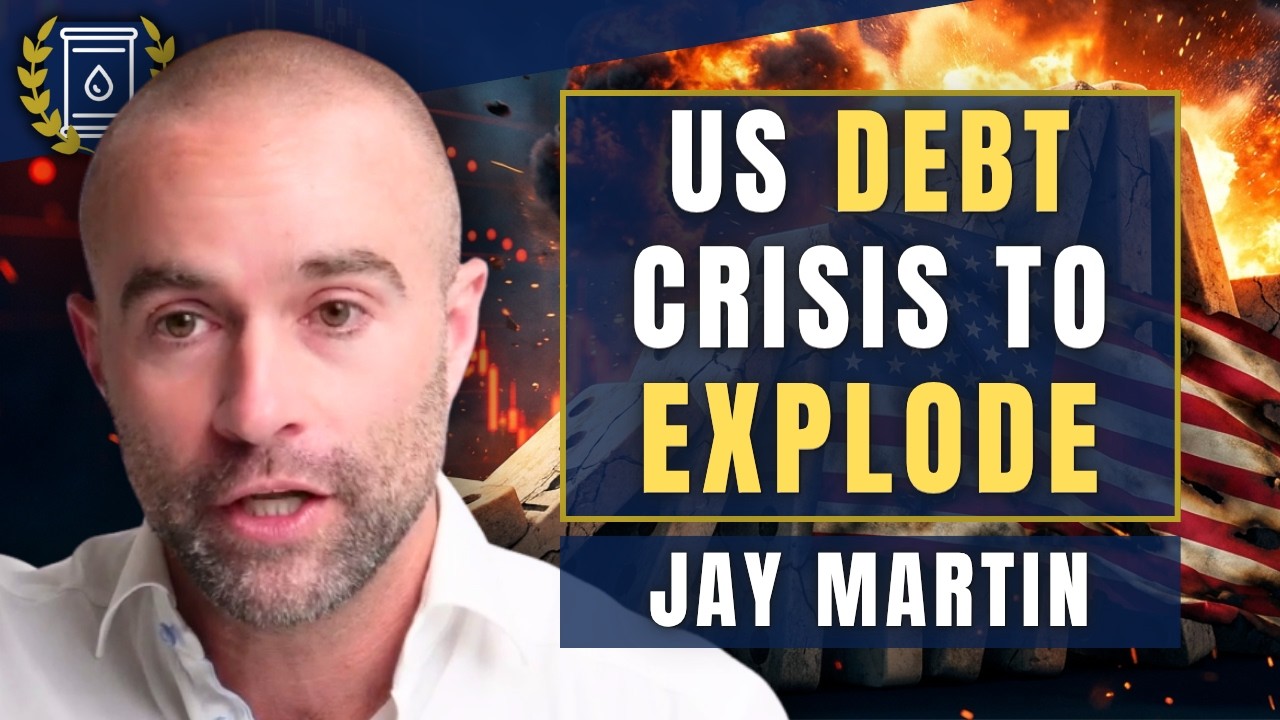
US Debt Dominoes Collapsing as Crisis Threatens To Go Global: Jay Martin
- Top takeaway Argues the US is in a debt spiral it cannot escape — about $2 trillion of annual overspending, $39 trillion of total debt, and $1 trillion a year in interest — and that events can only speed the end of the American world order cycle up or slow it down, not change its direction.
- Explains that the Strait of Hormuz closure doubled energy bills for oil-importing emerging economies, forcing them to sell US Treasuries, which pushes bond prices down and effective yields up, and in turn forces the US to offer higher rates at new auctions — feeding the spiral.
- Cites Turkey as the classic case that went first: it sold down about 90% of its roughly $15 billion Treasury position to around $1 billion, then turned to its gold, selling or borrowing against billions, and he expects a dozen-plus similar economies to head for the exit before their Treasury holdings fall further.
- Notes gold is now the number one asset held by central banks on a value basis, and argues the US endgame is printing money to buy its own debt — inflation with an 'alibi' — because a failed Treasury auction would mean a hard crash.
- Says he is most bullish on high-quality silver producers and later-stage silver developers as of July 8, 2026 — even with the metal down from its frothy December-January highs to around $60 an ounce, he says these companies are more profitable than they have been in generations.
Central banks now hold gold as their largest reserve asset because global appetite for funding new US debt keeps falling. Energy-shocked importers like Turkey sell Treasuries and then gold to keep the lights on, signaling a cascade of forced reserve selling. America's $2 trillion deficit and $1 trillion interest bill form a spiral: weak auction demand forces higher rates and more borrowing. The Strait of Hormuz closure doubled energy bills for oil-importing nations and exposed how fast sovereign dominoes can fall. Martin argues high-quality silver producers and developers are undervalued, with six straight supply deficits and rising defense demand supporting the metal.

Why This New Copper Spinout Has Huge Upside
- Top takeaway Says he is a very happy shareholder of Cambria and closes by expecting both Cambria and Freedom Copper to have news-rich quarters ahead, naming drilling results as the next milestone he wants to see.
- Argues that one company holding two flagship assets leaves investors discounting one of them — his stated premise for why spinning Mount Margaret out into a separate company makes sense.
- Presses that the 1980 historic resource estimate cannot be relied on and that investors, himself included, need to see current results before trusting the story.
- Suggests Mount Margaret went undeveloped partly because it came of age in an era when supporting mine development was not politically palatable, noting mining has been among the most vilified industries for roughly 15 years.
Cambria Gold Mines will spin its Mount Margaret deposit — a historical 570-million-ton resource at 0.72% copper equivalent — into a new US company, Freedom Copper. Abandoned after the Mount St. Helens eruption, the porphyry (a large copper system) remains open in every direction, and every 2010 hole ended in mineralization. Cambria shareholders keep 49.9% exposure plus a 15% dividend in the spinout, while Cambria focuses on restarting the Premier gold mine in British Columbia. The restart plan feeds one 2,500-tonne-per-day mill from four deposits, led by high-grade Red Mountain — 544,000 measured ounces near 9 grams per tonne. A planned $100 million raise funds about 100,000 meters of drilling toward a modern resource estimate, a PEA (early economic study), and US permitting.

Money Is Leaving Financial Markets
Strong global growth is draining liquidity out of financial markets into the real economy, tightening conditions without central bank action. Because all money must be somewhere, capital absorbed by the real economy is, by definition, absent from financial markets. Michael Howell argues the result is a paradox: strong growth becomes a drag on financial market performance.

Gold, Bonds and the Iran War Shock
Gold came under pressure after the Iran war shock as real long-term yields rose and bonds became more competitive stores of value. Merk notes markets priced the Iran war as a shock, not a structural change, leaving long-term inflation expectations unchanged. Gold competes with bonds as a store of purchasing power; when real yields rise, bonds become more competitive and gold weakens. The speaker notes the gold move happened to correlate with how equity markets reacted to the same shock.

America Is Running Out Of Buyers For Its Debt | Jay Martin
- Top takeaway Martin argues all roads lead to an inflated money supply: he expects the US to print money and buy the Treasuries other countries are selling rather than raise rates, calling that outcome 'a certainty in my books'.
- He argues the Strait of Hormuz closure is the most consequential event in geopolitics and macro finance, cutting about a fifth of global oil but roughly 39% of the export oil market, so importers like Japan, Korea and Taiwan are hit much harder.
- He sees the most probable off-ramp as an American retreat from the strait, an 'American Suez moment' paralleling Britain's 1956 withdrawal that ended sterling's reserve-currency role, coming at the cost of US credibility.
- He argues the new Gulf swap lines (UAE now, Kuwait likely next) are the US bailing out its own Treasury market with printed dollars, and expects the growing, riskier swap-line club to become a mainstream money-creation pathway.
- On positioning, he says his own money is in producers of non-discretionary raw materials such as copper, timber and nickel, and cites gold's staying power: an ounce still buys a luxury suit as it did in the 1920s.
Jay Martin argues the Strait of Hormuz closure forces oil-importing nations to sell US Treasuries, draining the foreign financing America's deficit depends on. The guest expects the new Fed chair to choose printing money over raising rates, calling money-supply inflation a certainty from here. Martin frames Gulf swap lines as disguised money printing — dollars lent to oil exporters so they avoid dumping US Treasuries. He likens a US retreat from Hormuz to Britain's 1956 Suez moment, when sterling lost its reserve-currency role to the dollar. On protection, he favors producers of non-discretionary raw materials — copper, timber, nickel — and gold as the tested store of purchasing power.

$3,400 Gold Before the Real Rally Begins
- Top takeaway Says he will be buying more gold if it drops to $3,600, treating that downside target as his add level.
- Acknowledges that Vermeulen's pre-conference warning of a gold selloff has played out, saying "Chris was spot on."
- Frames the long-term question: with bulls pointing to $10,000 gold on debt and deficits, he asks what upside remains once gold hits the $3,600 target or reverses from here.
- Notes gold is trading below its 200-day moving average with weak sentiment and asks whether it is oversold on the RSI.
Vermeulen argues gold's ongoing selloff is a healthy multi-wave correction designed to shake out late buyers before the long-term bull market resumes. He projects a pullback into $3,300-$3,800, where Fibonacci retracement levels (support zones measured from the prior rally) mark the buy area. Fibonacci extension projections put gold at $8,000-$8,600 per ounce over the next couple of years, roughly a double from $3,600. With the long-term trend up but short-term momentum down, Vermeulen says investors should wait for his targets rather than trade bounces. He reports exiting gold above $5,000 and silver at $111, planning to re-enter and accumulate when precious metals hit his support levels.
The World Is Running Out of Iron Ore — This Company Has The Answer
- Top takeaway The host discloses he is a new Oceanic shareholder and frames the interview around whether transportation, not geology, is the limiting factor for iron ore developers.
- He presses for near-term catalysts, including the updated economic study, the federal Major Projects Office, government funding programs, and where a strategic partner might come from.
Steel demand is shifting toward high-purity iron ore as green-steel pressure grows and major producers mine out high-grade deposits. Transportation is at least half the all-in cost of iron ore, so tidewater access without rail can decide project economics. Direct reduction iron needs about 67% iron content and under 3% silica (impurities that can make steel brittle), a bar few deposits meet. Iron ore prices anchor to a benchmark 62% grade, then add premiums for higher purity and deduct shipping to the customer. The featured Quebec project pairs tidewater access with a 1.4 billion tonne resource and a pre-feasibility study (an updated economic study) due late 2026.
Key Quotes
"The sure money is made in the gold sector, but the big money is made in the silver sector — that's proven true over the last couple of precious metals cycles. I believe it will be true in this one as well."
— Interview with Investing News Network
"Empires depend on cheap energy. When you lose access to cheap energy, the empire begins to crumble."
— Commodities outlook discussion
Key Works
YouTube channel featuring interviews and commentary on resource investing, precious metals, and macroeconomic trends
Market commentary and sector analysis delivered through the Vancouver Resource Investment Conference platform
Specializations
Disclaimer: Jay Martin has NOT endorsed this platform and is not affiliated with Pixys in any way.